Altered Uncinate Fasciculus Microstructure in Childhood Anxiety Disorders in Boys But Not Girls
- PMID: 30654645
- PMCID: PMC6661168
- DOI: 10.1176/appi.ajp.2018.18040425
Altered Uncinate Fasciculus Microstructure in Childhood Anxiety Disorders in Boys But Not Girls
Abstract
Objective: Anxiety disorders are common, can result in lifelong suffering, and frequently begin before adolescence. Evidence from adults suggests that altered prefrontal-limbic connectivity is a pathophysiological feature of anxiety disorders. More specifically, in adults with anxiety disorders, decreased fractional anisotropy (FA), a measure of white matter integrity, has been observed in the uncinate fasciculus, the major tract that connects limbic and prefrontal regions. Because of the early onset of anxiety disorders and the increased incidence in anxiety disorders in females during their reproductive years, it is important to understand whether the reduction in uncinate fasciculus FA exists in children with anxiety disorders and the extent to which this alteration is sex related. To address these issues, the authors assessed FA in the uncinate fasciculus in unmedicated boys and girls with anxiety disorders.
Methods: FA measures were derived from diffusion tensor images that were acquired from 98 unmedicated children (ages 8-12); 52 met criteria for generalized anxiety disorder, separation anxiety disorder, social anxiety disorder, or anxiety disorder not otherwise specified, and 46 were matched control subjects.
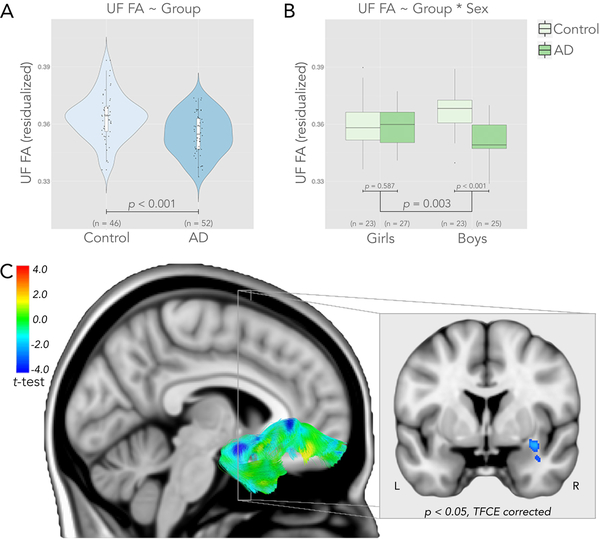
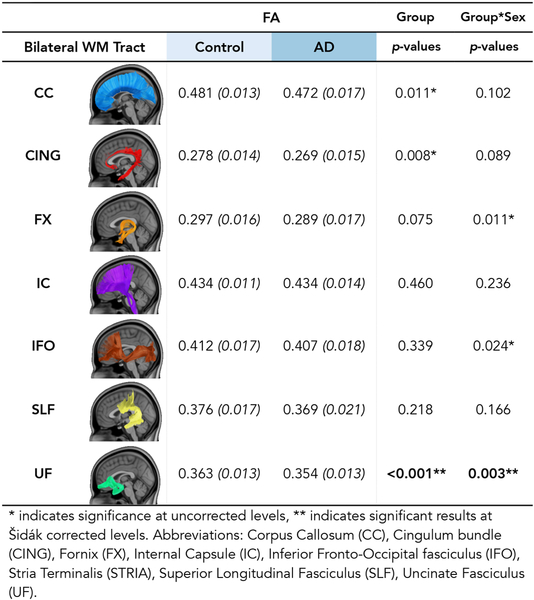
Results: Tract-based results demonstrated that children with anxiety disorders have significant reductions in uncinate fasciculus FA. A significant sex-by-group interaction and post hoc testing revealed that this effect was evident only in boys. No other main effects or sex-by-group interactions were found for other white matter tracts.
Conclusions: These findings provide evidence of uncinate fasciculus white matter alterations in boys with anxiety disorders. The data demonstrate that anxiety disorder-related alterations in prefrontal-limbic structural connectivity are present early in life, are not related to psychotropic medication exposure, and are sex specific. Building on these findings, future research has the potential to provide insights into the genesis and sexual dimorphism of the pathophysiology that leads to anxiety disorders, as well as to identify sex-specific early-life treatment targets.
Keywords: Anxiety Disorder-Generalized; Biological Markers.
Conflict of interest statement
Conflicts of interest:
Do P.M. Tromp reports no conflicts of interest.
Lisa E. Williams reports no conflicts of interest.
Andrew S. Fox reports no conflicts of interest.
Jonathan A. Oler reports no conflicts of interest.
Patrick H. Roseboom reports no conflicts of interest.
Gregory M. Rogers reports no conflicts of interest.
Brenda E. Benson reports no conflicts of interest.
Andrew L. Alexander reports no conflicts of interest.
Daniel S. Pine reports no conflicts of interest.
Ned H. Kalin’s Disclosure of Competing Interest and Financial Support:
Honoraria: CME Outfitters; Elsevier Inc.; Pritzker Consortium
Scientific Advisory Board: Pritzker Neuroscience Consortium, Neuronetics, Ketamine Clinics of America Editor: Psychoneuroendocrinology, Elsevier
Patents: Promoter sequences for corticotropin-releasing factor CRF2alpha and method of identifying agents that alter the activity of the promoter sequences: U.S. Patent issued on 07–04-06; #7071323, U.S. Patent issued on 05–12-09; #7,531,356. Promoter sequences for urocortin II and the use thereof: U.S. Patent issued on 08–08-06; #7087385. Promoter sequences for corticotropin-releasing factor binding protein and use thereof: U.S. Patent issued on 10–17-06; #7122650.
Figures
References
-
- Kessler RC, Ruscio AM, Shear K, Wittchen H-U. Epidemiology of anxiety disorders. Curr Top Behav Neurosci. 2010;2:21–35. - PubMed
-
- MacKinaw-Koons B, Vasey MW. Considering sex differences in anxiety and its disorders across the life span: A construct-validation approach. Appl Prev Psychol. 2000;9:191–209. doi: 10.1016/S0962-1849(05)80004-6. - DOI
Publication types
MeSH terms
Grants and funding
LinkOut - more resources
Full Text Sources
Other Literature Sources
Miscellaneous