


Efficacy of tuina in patients with chronic neck pain: study protocol for a randomized controlled trial
- PMID: 30654844
- PMCID: PMC6337769
- DOI: 10.1186/s13063-018-3096-3
Efficacy of tuina in patients with chronic neck pain: study protocol for a randomized controlled trial
Abstract
Background: Chronic neck pain (CNP) is a common and disabling musculoskeletal disorder in developing and developed countries. Previous studies have shown that tuina and traditional Chinese massage are effective treatments for patients with CNP. However, there is little evidence to support the use of one intervention over the other. The aim of this study is to compare the effects of tuina and traditional Chinese massage in the treatment of pain and disability in patients with CNP.
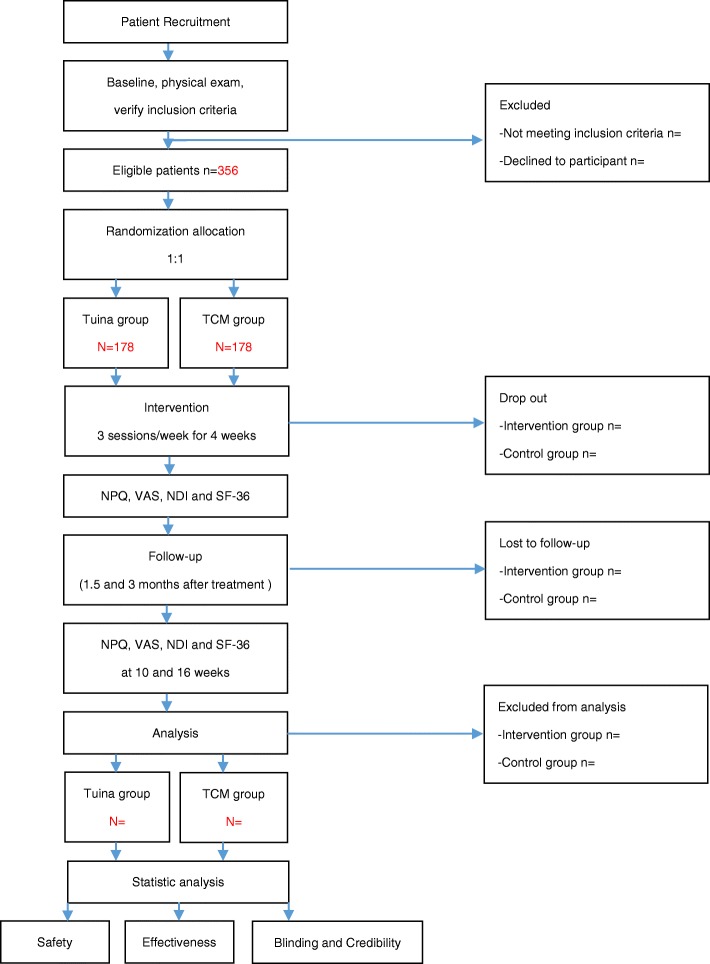
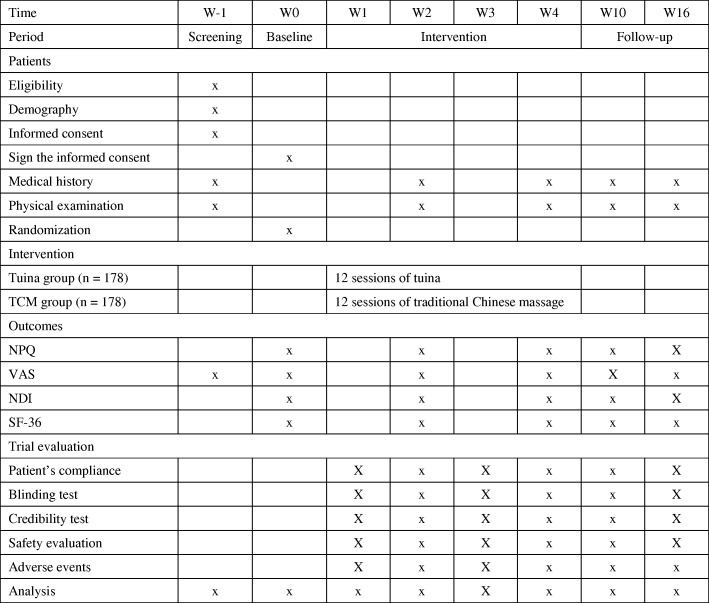
Methods/design: This is a multicenter, assessor- and analyst-blinded, randomized controlled trial with two parallel arms: a tuina group and a traditional Chinese massage group. A total of 356 eligible CNP patients will be randomly assigned to the groups in a 1:1 ratio. The intervention in the tuina group includes both structural and relaxation massage, while the traditional Chinese massage group will receive relaxation massage only. The interventions for both groups will last for 15 min and will be carried out three times a week for a period of 4 weeks. The primary outcome will be changes in the Northwick Park Neck Pain Questionnaire. Secondary outcomes will be measured by a visual analogue scale (VAS), the Neck Disability Index (NDI), and the 36-item Short-Form Health Survey (SF-36). The data will be analyzed at the baseline, at the end of the intervention, and during the 3 months of follow-up by repeated measures analysis of variance. The significance level is 5%. The safety of tuina and traditional Chinese massage will be evaluated after each treatment session. The results of this trial will help clarify the value of tuina and traditional Chinese massage as treatments for CNP and will highlight any differences in the efficacy of the treatments.
Discussion: The purpose of this trial is to determine whether tuina is more effective than traditional Chinese massage in adults with CNP. This trial will, therefore, contribute to providing a solid foundation for clinical treatment of CNP, as well as future research in massage therapy.
Trial registration: Chinese Clinical Trial Registry, ChiCTR-INR-17013763 . Registered 8 December 2017.
Keywords: Chronic neck pain; Efficacy; Randomized controlled trial; Tuina; traditional Chinese massage.
Conflict of interest statement
Ethics approval and consent to participate
Ethics approval was requested and granted by the ethics committee of Yueyang Hospital of Integrated Traditional Chinese and Western Medicine, which is affiliated with Shanghai University of Traditional Chinese Medicine (reference 2017–028). Informed consent will be obtained from all study participants before starting any data collection by the clinical trial communicator. All participants will provide their consent in writing. Nobody except the investigators have access to the final data.
Consent for publication
All authors gave their consent for publication.
Competing interests
The authors declare that they have no competing interests.
Publisher’s Note
Springer Nature remains neutral with regard to jurisdictional claims in published maps and institutional affiliations.
Figures
References
Publication types
MeSH terms
Grants and funding
- 2015468003-1/Special Scientific Research of Traditional Chinese Medicine Industry
- 30304114316/'Peak plateau discipline' High Level Innovation Teams of Traditional Chinese Medicine
- 81503673/National Natural Science Foundation of China
- 16CR1023A/Major Disease Clinical Skills Upgrading Project of Shanghai Shen-kang Hospital Development Center
- 16401970200/Scientific Research Project of Shanghai Science and Technology Committee
LinkOut - more resources
Full Text Sources
Medical
