Review
. 2019 Apr;25(4):407-422.
doi: 10.1261/rna.070136.118. Epub 2019 Jan 17.

UPFront and center in RNA decay: UPF1 in nonsense-mediated mRNA decay and beyond

Affiliations
Review

UPFront and center in RNA decay: UPF1 in nonsense-mediated mRNA decay and beyond

Yoon Ki Kim et al. RNA. 2019 Apr.

Abstract

Nonsense-mediated mRNA decay (NMD), which is arguably the best-characterized translation-dependent regulatory pathway in mammals, selectively degrades mRNAs as a means of post-transcriptional gene control. Control can be for the purpose of ensuring the quality of gene expression. Alternatively, control can facilitate the adaptation of cells to changes in their environment. The key to NMD, no matter what its purpose, is the ATP-dependent RNA helicase upstream frameshift 1 (UPF1), without which NMD fails to occur. However, UPF1 does much more than regulate NMD. As examples, UPF1 is engaged in functionally diverse mRNA decay pathways mediated by a variety of RNA-binding proteins that include staufen, stem-loop-binding protein, glucocorticoid receptor, and regnase 1. Moreover, UPF1 promotes tudor-staphylococcal/micrococcal-like nuclease-mediated microRNA decay. In this review, we first focus on how the NMD machinery recognizes an NMD target and triggers mRNA degradation. Next, we compare and contrast the mechanisms by which UPF1 functions in the decay of other mRNAs and also in microRNA decay. UPF1, as a protein polymath, engenders cells with the ability to shape their transcriptome in response to diverse biological and physiological needs.

Keywords: Staufen-mediated mRNA decay; UPF1; nonsense-mediated mRNA decay.


Figures

FIGURE 1.
FIGURE 1.
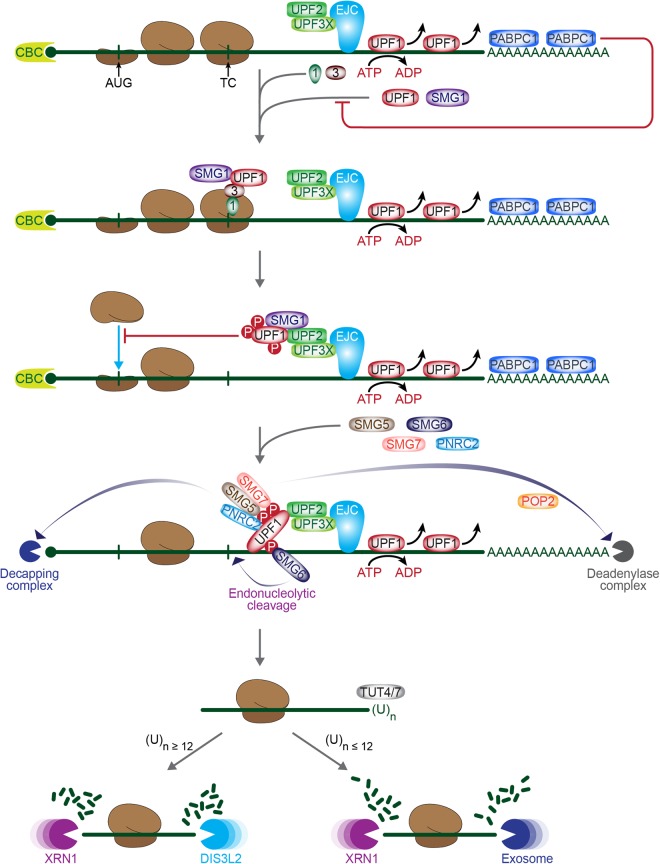
Stepwise processes for nonsense-mediated mRNA decay (NMD). Whether a termination codon (TC) does or does not trigger NMD is determined by two opposing events, respectively, termination-delaying (i.e., NMD-stimulating) events, which are promoted by factor(s) such as a 3′UTR EJC or a structured 3′UTR, each of which has a propensity for binding the UPF1 ATP-dependent RNA helicase, or termination-promoting (i.e., NMD-antagonizing) factor(s) such as PABPC1. Shown here are the steps that constitute 3′UTR EJC-dependent NMD. Briefly, when a 3′UTR EJC remains after translation termination at a TC, UPF1, its kinase SMG1 (and additional SMG factors that will not be discussed here) form the SURF complex together with the two termination factors eRF1 and eRF3. Subsequently, UPF1 and SMG1 either bridge or move to the EJC, at which point EJC-bound UPF2 binding to the CH domain of UPF1 induces a large conformational change in UPF1, concomitantly promoting the phosphorylation of UPF1 by the SMG1 kinase and, possibly, also promoting its helicase activity. Phosphorylated UPF1 represses translation by precluding further translation initiation events and also recruits factors that either directly (SMG6) or indirectly (SMG5−SMG7 and/or PNRC2) result in decay. Endoribonucleolytic cleavage occurs near the TC by SMG6, whereas DCP2−DCP1A decapping followed by 5′-to-3′ exoribonucleolytic activities are recruited by PNRC2, and CCR4−POP2 deadenylating as well as 3′-to-5′ exosome activities are recruited by SMG5−SMG7. Ribosome-bound NMD decay intermediates can be uridylated at their 3′-ends by TUT4 and TUT7 to promote further 3′-to-5′ exoribonucleolytic by DIS3L2 and/or the exosome. Terminal uridylation can also induce decapping followed by XRN1-mediated 5′-to-3′ degradation.
FIGURE 2.
FIGURE 2.
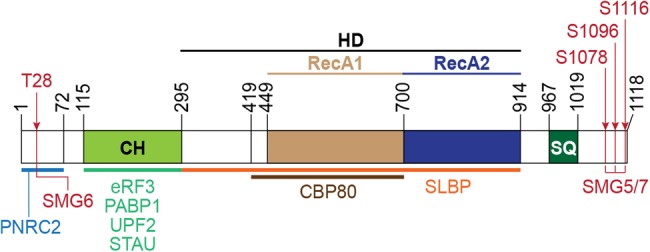
Schematic of UPF1 domains. The binding regions for UPF1-interacting proteins are indicated. Numbers and red arrows indicate amino acid positions and experimentally validated phosphorylation sites, respectively. CH, cysteine- and histidine-rich domain; HD, helicase domain; and SQ, serine- and glutamine-rich domain.
FIGURE 3.
FIGURE 3.
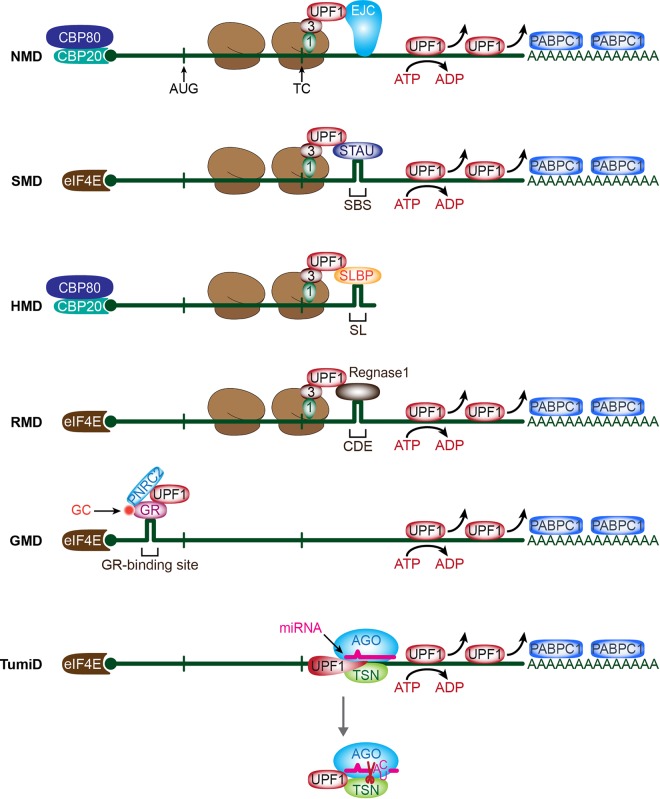
Various UPF1-dependent RNA decay pathways. Shown are six categories of RNA decay pathways that differ by how UPF1 engages with the substrate. UPF1 is engaged in NMD via either a 3′UTR EJC or another 3′UTR feature that attracts UPF1 and delays translation termination. UPF1 is engaged in SMD via 3′UTR-bound STAU1 or STAU2, and in HMD via a 3′UTR SLBP. GMD engages UPF1 via a GC-bound GR and RMD via regnase 1. Finally, TumiD engages UPF1 as a transiently or weakly associated constituent of the RNA-induced silencing complex, which consists of an AGO protein. Each of these pathways require the helicase activity of UPF1 and, of the mRNA decay pathways, all but GMD require the substrate be translated. The primary cap-binding protein(s) for each pathway are shown. SBS, STAU-binding site; SL, histone stem–loop; CDE, constitute decay element.

References

    1. Anders KR, Grimson A, Anderson P. 2003. SMG-5, required for C. elegans nonsense-mediated mRNA decay, associates with SMG-2 and protein phosphatase 2A. EMBO J 22: 641–650. 10.1093/emboj/cdg056 - DOI - PMC - PubMed
    1. Apcher S, Daskalogianni C, Lejeune F, Manoury B, Imhoos G, Heslop L, Fahraeus R. 2011. Major source of antigenic peptides for the MHC class I pathway is produced during the pioneer round of mRNA translation. Proc Natl Acad Sci 108: 11572–11577. 10.1073/pnas.1104104108 - DOI - PMC - PubMed
    1. Bhuvanagiri M, Schlitter AM, Hentze MW, Kulozik AE. 2010. NMD: RNA biology meets human genetic medicine. Biochem J 430: 365–377. 10.1042/BJ20100699 - DOI - PubMed
    1. Boehm V, Gehring NH. 2016. Exon junction complexes: supervising the gene expression assembly line. Trends Genet 32: 724–735. 10.1016/j.tig.2016.09.003 - DOI - PubMed
    1. Bokhari A, Jonchere V, Lagrange A, Bertrand R, Svrcek M, Marisa L, Buhard O, Greene M, Demidova A, Jia J, et al. 2018. Targeting nonsense-mediated mRNA decay in colorectal cancers with microsatellite instability. Oncogenesis 7: 70 10.1038/s41389-018-0079-x - DOI - PMC - PubMed

Publication types

MeSH terms