


Genetic Contribution to the Divergence in Type 1 Diabetes Risk Between Children From the General Population and Children From Affected Families
- PMID: 30655385
- PMCID: PMC6425872
- DOI: 10.2337/db18-0882
Genetic Contribution to the Divergence in Type 1 Diabetes Risk Between Children From the General Population and Children From Affected Families
Abstract
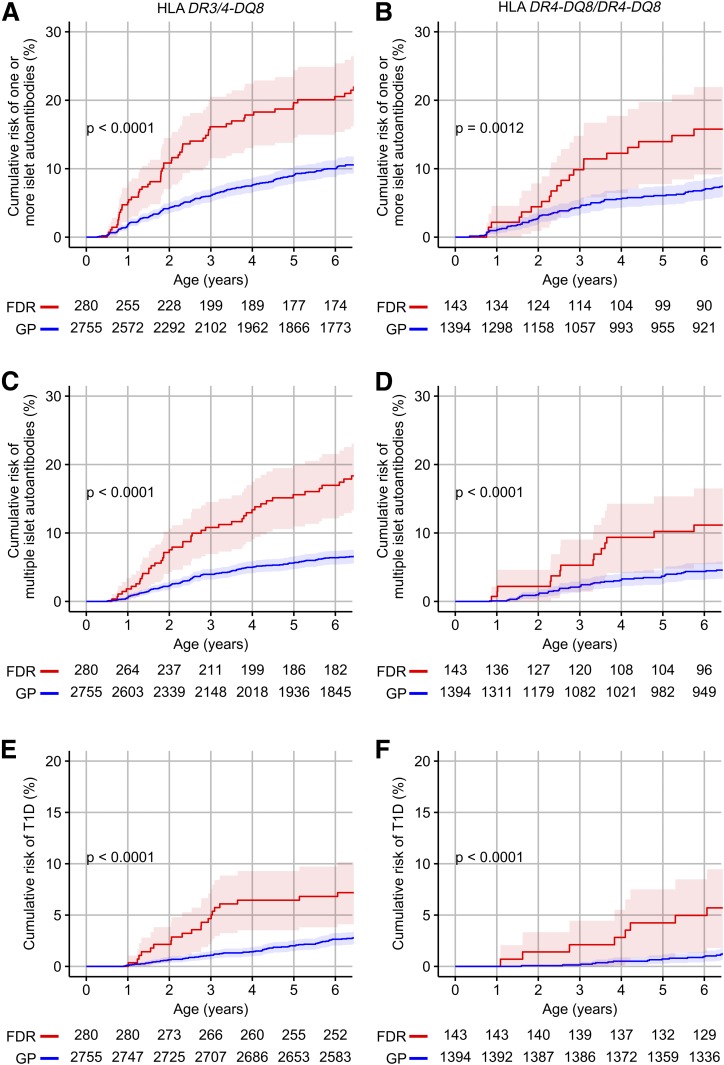
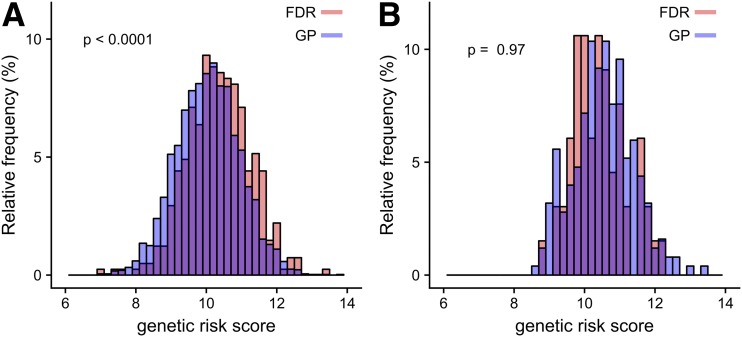
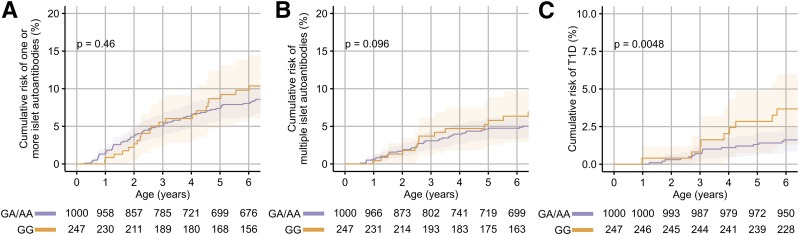
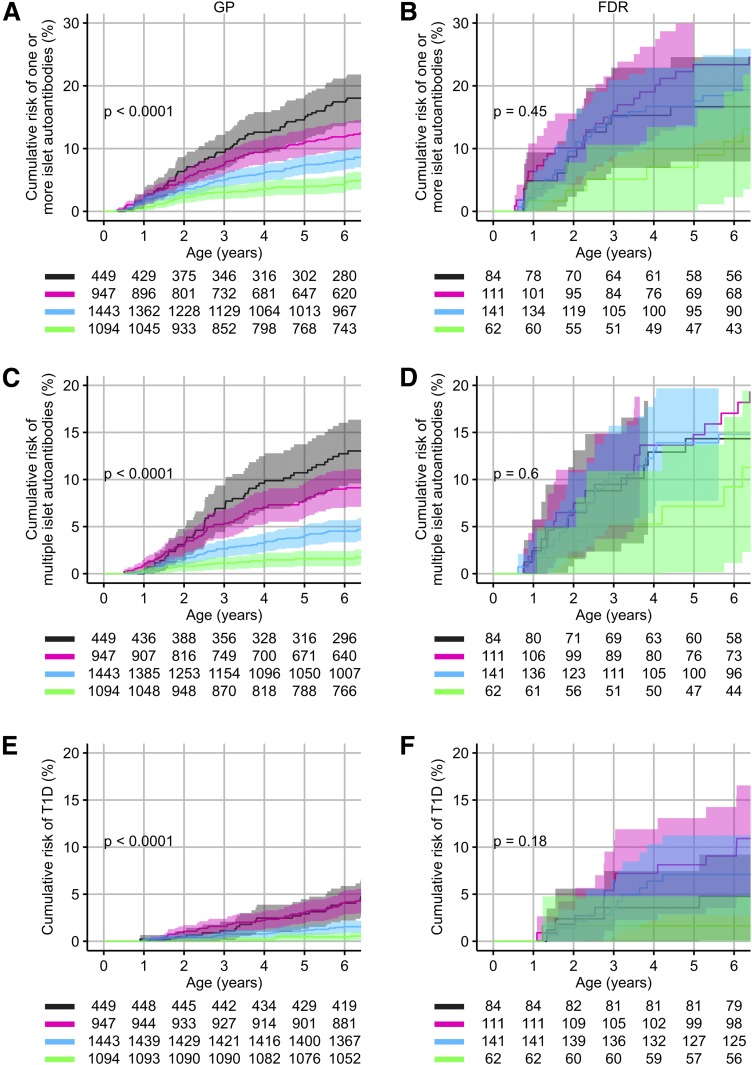
The risk for autoimmunity and subsequently type 1 diabetes is 10-fold higher in children with a first-degree family history of type 1 diabetes (FDR children) than in children in the general population (GP children). We analyzed children with high-risk HLA genotypes (n = 4,573) in the longitudinal TEDDY birth cohort to determine how much of the divergent risk is attributable to genetic enrichment in affected families. Enrichment for susceptible genotypes of multiple type 1 diabetes-associated genes and a novel risk gene, BTNL2, was identified in FDR children compared with GP children. After correction for genetic enrichment, the risks in the FDR and GP children converged but were not identical for multiple islet autoantibodies (hazard ratio [HR] 2.26 [95% CI 1.6-3.02]) and for diabetes (HR 2.92 [95% CI 2.05-4.16]). Convergence varied depending upon the degree of genetic susceptibility. Risks were similar in the highest genetic susceptibility group for multiple islet autoantibodies (14.3% vs .12.7%) and diabetes (4.8% vs. 4.1%) and were up to 5.8-fold divergent for children in the lowest genetic susceptibility group, decreasing incrementally in GP children but not in FDR children. These findings suggest that additional factors enriched within affected families preferentially increase the risk of autoimmunity and type 1 diabetes in lower genetic susceptibility strata.
Trial registration: ClinicalTrials.gov NCT00279318.
© 2019 by the American Diabetes Association.
Figures
References
-
- Schenker M, Hummel M, Ferber K, et al. Early expression and high prevalence of islet autoantibodies for DR3/4 heterozygous and DR4/4 homozygous offspring of parents with type I diabetes: the German BABYDIAB study. Diabetologia 1999;42:671–677 - PubMed
Publication types
MeSH terms
Substances
Associated data
Grants and funding
- U01 DK063821/DK/NIDDK NIH HHS/United States
- UC4 DK063863/DK/NIDDK NIH HHS/United States
- DP3 DK111906/DK/NIDDK NIH HHS/United States
- HHSN267200700014C/DK/NIDDK NIH HHS/United States
- U01 DK063861/DK/NIDDK NIH HHS/United States
- U01 DK063790/DK/NIDDK NIH HHS/United States
- UL1 TR001082/TR/NCATS NIH HHS/United States
- P30 DK017047/DK/NIDDK NIH HHS/United States
- UL1 TR000064/TR/NCATS NIH HHS/United States
- U01 DK063836/DK/NIDDK NIH HHS/United States
- U01 DK063829/DK/NIDDK NIH HHS/United States
- U01 DK063865/DK/NIDDK NIH HHS/United States
- UC4 DK095300/DK/NIDDK NIH HHS/United States
- UC4 DK063861/DK/NIDDK NIH HHS/United States
- UC4 DK063829/DK/NIDDK NIH HHS/United States
- UC4 DK063821/DK/NIDDK NIH HHS/United States
- UC4 DK117483/DK/NIDDK NIH HHS/United States
- UC4 DK063836/DK/NIDDK NIH HHS/United States
- UC4 DK112243/DK/NIDDK NIH HHS/United States
- UC4 DK063865/DK/NIDDK NIH HHS/United States
- U01 DK063863/DK/NIDDK NIH HHS/United States
- UC4 DK106955/DK/NIDDK NIH HHS/United States
- UC4 DK100238/DK/NIDDK NIH HHS/United States
LinkOut - more resources
Full Text Sources
Other Literature Sources
Medical
Research Materials
