. 2019 Jan 17;10(1):294.
doi: 10.1038/s41467-018-08167-w.

CRISPR analysis suggests that small circular single-stranded DNA smacoviruses infect Archaea instead of humans

Affiliations

CRISPR analysis suggests that small circular single-stranded DNA smacoviruses infect Archaea instead of humans

César Díez-Villaseñor et al. Nat Commun. .

Abstract

Smacoviridae is a family of small (~2.5 Kb) CRESS-DNA (Circular Rep Encoding Single-Stranded (ss) DNA) viruses. These viruses have been found in faeces, were thought to infect eukaryotes and are suspected to cause gastrointestinal disease in humans. CRISPR-Cas systems are adaptive immune systems in prokaryotes, wherein snippets of genomes from invaders are stored as spacers that are interspersed between a repeated CRISPR sequence. Here we report several spacer sequences in the faecal archaeon Candidatus Methanomassiliicoccus intestinalis matching smacoviruses, implicating the archaeon as a firm candidate for a host. This finding may be relevant to understanding the potential origin of smacovirus-associated human diseases. Our results support that CRESS-DNA viruses can infect non-eukaryotes, which would mean that smacoviruses are the viruses with the smallest genomes to infect prokaryotes known to date. A probable target strand bias suggests that, in addition to double-stranded DNA, the CRISPR-Cas system can target ssDNA.


Conflict of interest statement

The authors declare no competing interests.

Figures
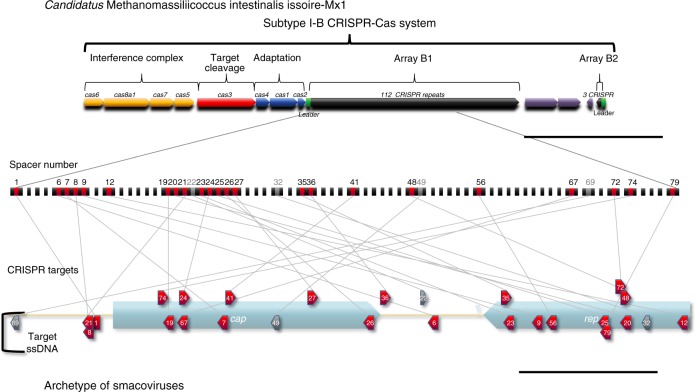
Fig. 1
Fig. 1
Clustered Interspaced Short Palindromic Repeats (CRISPR)-Cas Subtype I-B in Candidatus M. intestinalis and its targets in smacoviruses. The CRISPR-Cas subtype I-B in Ca. M. intestinalis is represented. Related cas genes are grouped and coloured according to functional categories: adaptation (cas1–2 and cas4), target cleavage (cas3) and formation of interference complex (cas6, cas8a1, cas7 and cas5). Cas8a1 would belong to subtype I-A. Two repetitive arrays are found in opposite orientations, here named B1 (112 repeats) and B2 (3 repeats), with putative leader sequences, from where transcription would start. Array B1 is amplified and similarities of spacers to sequences in smacoviruses indicated. A smacovirus 'archetype' is depicted where targets are represented with their relative positions to genes (see Methods). Similar sequences that are in the same orientation of spacers point right and vice versa. Smacoviruses are circular single-stranded DNA (ssDNA) virus with just two genes (rep and cap). Targets in the ssDNA are represented below the viral genome, and targets in the complementary strand above. Targets in red were found with local–global alignments, while targets in grey only with local alignments. All arrows point in the sense of predicted transcription (for targets transcription of CRISPR RNA (crRNA)). Scale bars are 5 kb (above) and 0.5 kb (bottom). Non-CRISPR genes are coloured violet
Fig. 2
Fig. 2
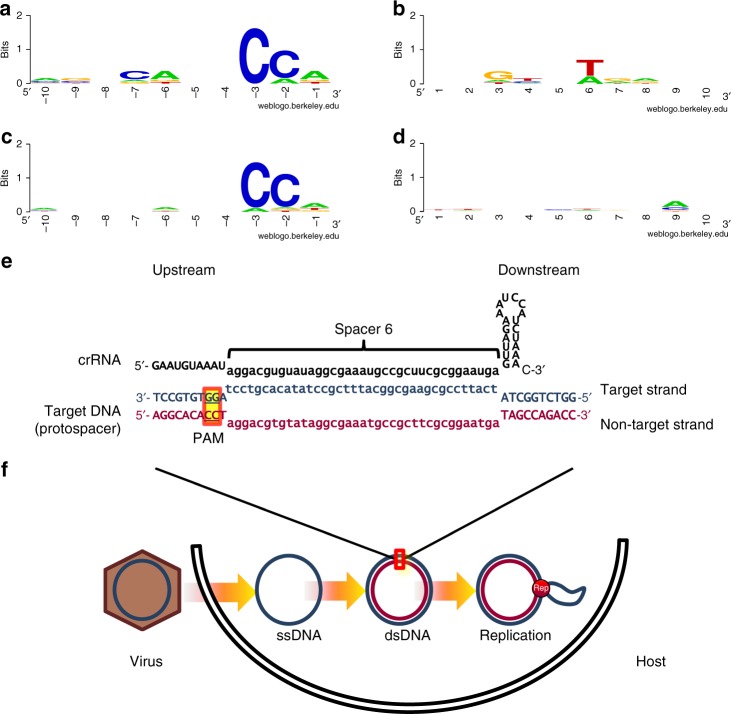
Sequence conservation in flanking regions of smacoviral Candidatus M. intestinalis Clustered Interspaced Short Palindromic Repeats (CRISPR) targets. Sequence logos represent conservation of 10 bases, in non-target strand, upstream (5' end of corresponding spacer in CRISPR RNA (crRNA)) (a, c) and downstream (b, d) from sequences targeted by the spacer in Ca. M. intestinalis. Up (a, b), conservation around the six matches identical to spacers. Down (c, d), conservation in best matches to each 23 spacers. e Representation of an R-loop, where crRNA from spacer 6 hybridizes to target double-stranded DNA (dsDNA) protospacer in smacoviurs. f Part of life cycle of a Circular Rep Encoding Single-Stranded DNA (CRESS-DNA) virus showcasing presence of dsDNA, targeted presumably by the Type I CRISPR-Cas system, after synthesis of complementary strand, and in replication. In e, f the viral strand is represented in blue, complimentary in garnet and RNA in black
Fig. 3
Fig. 3
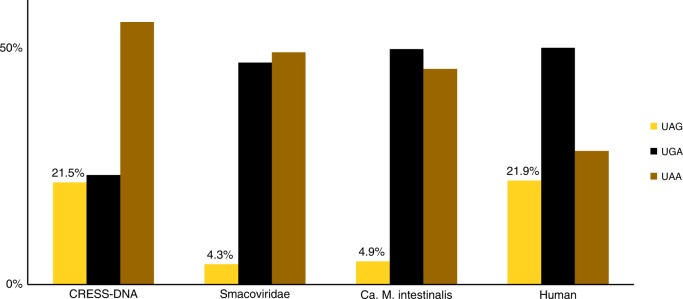
Stop codons usage of Smacoviridae compared to Circular Rep Encoding Single-Stranded DNA (CRESS-DNA) viruses and possible hosts. In organisms, such as Candidatus M. intestinalis, that use amber (UAG) codon to codify pyrrolysine, its use for translation termination is reduced. Bars represent the percentage of coding sequences ending in one of the standard termination codons that end with amber, opal (UGA) or ochre (UAA) codons for a set of CRESS-DNA virus, a set of smacoviruses, Ca. M. intestinalis genome and human genome (see details in Methods section). Only percentages of amber codon are shown

References

    1. Ng TFF, et al. A diverse group of small circular ssDNA viral genomes in human and non-human primate stools. Virus Evol. 2015;1:vev017. doi: 10.1093/ve/vev017. - DOI - PMC - PubMed
    1. Kazlauskas, D., Varsani, A. & Krupovic, M. Pervasive chimerism in the replication-associated proteins of uncultured single-stranded DNA viruses. Viruses10, 187 (2018). - PMC - PubMed
    1. Simmonds P, et al. Consensus statement: irus taxonomy in the age of metagenomics. Nat. Rev. Microbiol. 2017;15:161–168. doi: 10.1038/nrmicro.2016.177. - DOI - PubMed
    1. Zerbini FM, et al. ICTV Virus Taxonomy Profile: Geminiviridae. J. Gen. Virol. 2017;98:131–133. doi: 10.1099/jgv.0.000738. - DOI - PMC - PubMed
    1. Vetten, H. J. et al. in Virus Taxonomy: Ninth Report of the International Committee on Taxonomy of Viruses (eds King, A. M. Q., Lefkowitz, M. J., Adams, E. C., Carstens, E.) 395–404 (Elsevier/Academic Press, San Diego, CA, 2012).

Publication types

MeSH terms

Substances