


Lessons learned from introducing huddle boards to involve nursing staff in targeted observation and reporting of medication effect in a nursing home
- PMID: 30655672
- PMCID: PMC6322511
- DOI: 10.2147/JMDH.S182872
Lessons learned from introducing huddle boards to involve nursing staff in targeted observation and reporting of medication effect in a nursing home
Abstract
Background: Medication administration and management in nursing homes can occur during all phases of the medication process. The aim of this study was to investigate if an introduction of a systematic use of huddle board led to an increased amount of documentation in the patient record of observations of effects and side effects following a change in medication.
Methods: A three-layer intervention approach combining huddle boards, educating the entire staff in medication observation and documentation, and frequent feedback to the staff about the outcome was applied. A standard was set for the expected reporting. Correlation between expected and actual reporting as an average was calculated and the staff received weekly updates on their observation-reporting results.
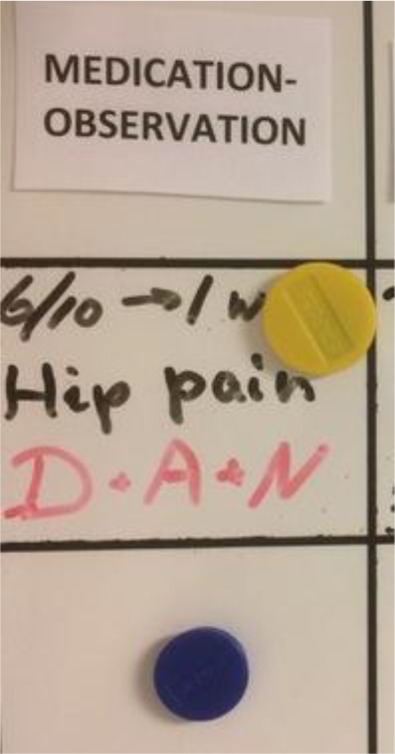
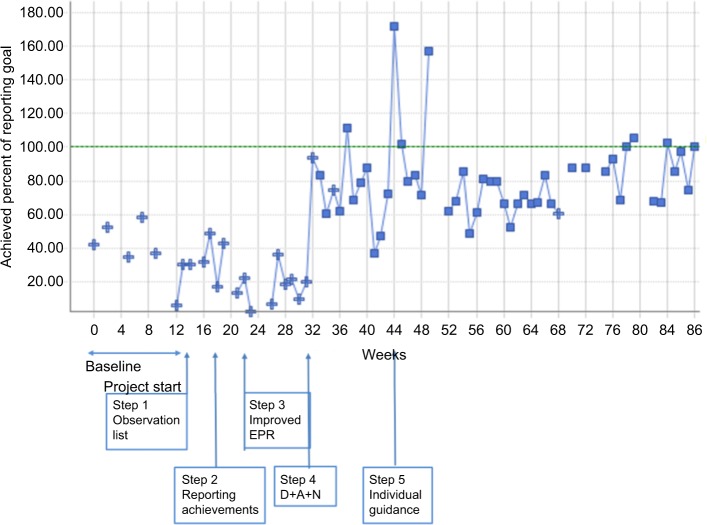
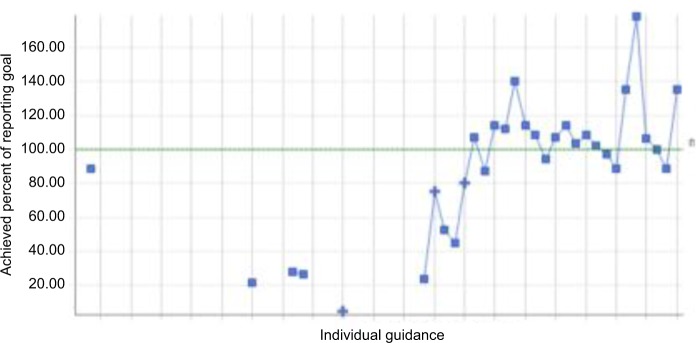
Results: The huddle board became a hub in providing an overview of the expectations of observations. To visualize the impact of the intervention, use of a run chart gave comprehensive information about the extent to which the expected goal of documentation was reached. Four different organizational steps and one individual action in the last step were taken to improve the observation-reporting. The identifying of the nonreporting nurses and individual staff guidance to these nurses resulted in a significant improvement in observation-reporting. The expected goal of 100% average reporting was achieved 6 months after all wards were included in the improvement project.
Conclusion: The combination of huddle boards, educating the entire staff in observation and documentation, and frequent feedback to the staff about the outcome proved to be a useful approach in medication safety work in nursing homes.
Keywords: huddle board; long-term care; medication-effect documentation; nursing staff; patient safety; prescribing; system-approach.
Conflict of interest statement
Disclosure The authors report no conflicts of interest in this work.
Figures
References
-
- Dilles T, Elseviers MM, Van Rompaey B, Van Bortel LM, Stichele RR. Barriers for nurses to safe medication management in nursing homes. J Nurs Scholarsh. 2011;43(2):171–180. - PubMed
-
- Thomson MS, Gruneir A, Lee M, et al. Nursing time devoted to medication administration in long-term care: clinical, safety, and resource implications. J Am Geriatr Soc. 2009;57(2):266–272. - PubMed
-
- Institute of Medicine Committee on Quality of Health Care in America . Errors in health care: a leading cause of death and injury. In: Kohn LT, Corrigan JM, Donaldson MS, editors. To Err Is Human: Building a Safer Health System. Washington (DC): National Academies Press (US) Copyright 2000 by the National Academy of Sciences; 2000. All rights reserved. - PubMed
-
- Ulrich B, Kear T. Patient safety and patient safety culture: foundations of excellent health care delivery. Nephrol Nurs J. 2014;41(5):447–456. - PubMed
LinkOut - more resources
Full Text Sources
