Tai Chi Chuan can improve balance and reduce fear of falling in community dwelling older adults: a randomized control trial
- PMID: 30656165
- PMCID: PMC6323335
- DOI: 10.12965/jer.1836488.244
Tai Chi Chuan can improve balance and reduce fear of falling in community dwelling older adults: a randomized control trial
Abstract
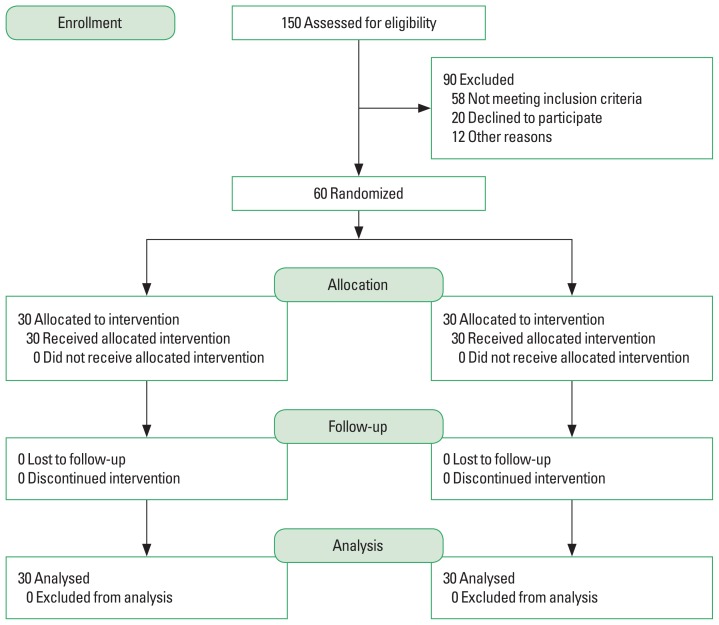
Fear of falling and balance impairment are prevalent in older adults and cause major morbidities for this population. The aim of this study was to evaluate the effect of Tai Chi Chuan on balance and fear of falling in community-dwelling older adults. This study was a single-blind randomized control trial. Sixty older adults were randomly allocated into two groups using a 4-cell random block design. The participants of intervention group were trained in Tai Chi Chuan for eight weeks, twice a week, and 55 min in each session. Balance and fear of falling were assessed by Timed Up and Go (TUG) test, Tinetti test and Falls Efficacy Scale International in baseline and after 8 weeks. After eight weeks of intervention, the mean scores of the TUG and Tinetti scales in the intervention group were improved significantly compared to the baseline and the control group (P<0.001). Moreover, the intervention group showed a significant reduction in fear of falling scores (P<0.001), while those in the control group remained unchanged. Tai Chi Chuan effectively improves the balance and fear of falling and could be considered as a practical and useful method for fall prevention in community-dwelling older adults.
Keywords: Alternative therapy; Exercise; Fall prevention; Older adults; Tai Chi Chuan.
Conflict of interest statement
CONFLICT OF INTEREST No potential conflict of interest relevant to this article was reported.
References
-
- Akbari Kamrani AA, Zamani Sani SH, Fathi Rezaie Z, Aghdasi MT. Concurrent validity of functional gait assessment, timed up and go, and gait speed tests in the Persian community-dwelling elderly. Iran Rehabil J. 2010;8:15–20.
-
- Allen NE, Sherrington C, Paul SS, Canning CG. Balance and falls in Parkinson’s disease: a meta-analysis of the effect of exercise and motor training. Mov Disord. 2011;26:1605–1615. - PubMed
-
- Bellg AJ, Borrelli B, Resnick B, Hecht J, Minicucci DS, Ory M, Ogedegbe G, Orwig D, Ernst D, Czajkowski S, Treatment Fidelity Workgroup of the NIH Behavior Change Consortium Enhancing treatment fidelity in health behavior change studies: best practices and recommendations from the NIH Behavior Change Consortium. Health Psychol. 2004;23:443–451. - PubMed
-
- Cruz-Díaz D, Martínez-Amat A, De la Torre-Cruz MJ, Casuso RA, de Guevara NM, Hita-Contreras F. Effects of a six-week Pilates intervention on balance and fear of falling in women aged over 65 with chronic low-back pain: a randomized controlled trial. Maturitas. 2015;82:371–376. - PubMed
-
- Ćwiękała-Lewis KJ, Gallek M, Taylor-Piliae RE. The effects of Tai Chi on physical function and well-being among persons with Parkinson’s Disease: a systematic review. J Bodyw Mov Ther. 2017;21:414–421. - PubMed
LinkOut - more resources
Full Text Sources