


The Moving to Health (M2H) approach to natural experiment research: A paradigm shift for studies on built environment and health
- PMID: 30656207
- PMCID: PMC6329830
- DOI: 10.1016/j.ssmph.2018.100345
The Moving to Health (M2H) approach to natural experiment research: A paradigm shift for studies on built environment and health
Erratum in
-
Erratum regarding missing Declaration of Competing Interest statements in previously published articles.SSM Popul Health. 2020 Dec 10;12:100716. doi: 10.1016/j.ssmph.2020.100716. eCollection 2020 Dec. SSM Popul Health. 2020. PMID: 33381638 Free PMC article.
Abstract
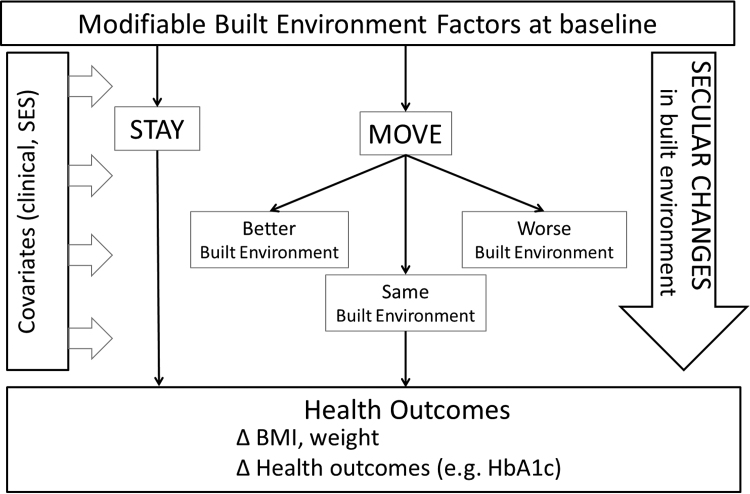
Improving the built environment (BE) is viewed as one strategy to improve community diets and health. The present goal is to review the literature on the effects of BE on health, highlight its limitations, and explore the growing use of natural experiments in BE research, such as the advent of new supermarkets, revitalized parks, or new transportation systems. Based on recent studies on movers, a paradigm shift in built-environment health research may be imminent. Following the classic Moving to Opportunity study in the US, the present Moving to Health (M2H) strategy takes advantage of the fact that changing residential location can entail overnight changes in multiple BE variables. The necessary conditions for applying the M2H strategy to Geographic Information Systems (GIS) databases and to large longitudinal cohorts are outlined below. Also outlined are significant limitations of this approach, including the use of electronic medical records in lieu of survey data. The key research question is whether documented changes in BE exposure can be linked to changes in health outcomes in a causal manner. The use of geo-localized clinical information from regional health care systems should permit new insights into the social and environmental determinants of health.
Keywords: Built environment (BE); Diabetes; Electronic medical records; Geographic information systems (GIS); Natural experiments; Obesity; Residential mobility.
Figures
References
-
- Alexander D.S., Huber L.R.B., Piper C.R., Tanner A.E. The association between recreational parks, facilities and childhood obesity: A cross-sectional study of the 2007 National Survey of Children's Health. Journal of Epidemiology and Community Health. 2013 (jech-2012-201301) - PubMed
Grants and funding
LinkOut - more resources
Full Text Sources
