Review
. 2018 Nov 16;3(1):26-37.
doi: 10.1002/rth2.12160. eCollection 2019 Jan.

Thrombotic thrombocytopenic purpura: Toward targeted therapy and precision medicine

Affiliations
Review

Thrombotic thrombocytopenic purpura: Toward targeted therapy and precision medicine

Paul Coppo et al. Res Pract Thromb Haemost. .

Abstract

Thrombotic thrombocytopenic purpura (TTP) is a thrombotic microangiopathy characterized by severe congenital or immune-mediated deficiency in ADAMTS13, the enzyme that cleaves von Willebrand factor multimers. This rare condition leads invariably and rapidly to a fatal outcome in the absence of treatment, and therefore raises multiple diagnostic and therapeutic challenges. The novel concepts and mechanisms identified in the laboratory for this disease have been rapidly and successfully translated into the clinic for the benefit of patients, making TTP an archetypal disease that has benefited from targeted therapies. After decades of empirical treatment with plasma exchange, identification of ADAMTS13 as the key enzyme involved in TTP pathophysiology provided an explanation for the remarkable efficacy of plasma administration, in which the missing enzyme is replenished, and paved the way for development of a recombinant form of the enzyme. Similarly, the demonstration of a major role of anti-ADAMTS13 antibodies through models of passive transfer of autoimmunity spurred development of immunomodulatory strategies based on B-cell depletion. More recently, an inhibitor of the platelet-von Willebrand factor interaction demonstrated efficacy in large clinical trials through prevention of formation of further microthrombi and protection of organs from ischemia. These translational breakthroughs in TTP are described in our review.

Keywords: ADAMTS13; caplacizumab; precision medicine; rituximab; targeted therapies; thrombotic thrombocytopenic purpura.


Figures
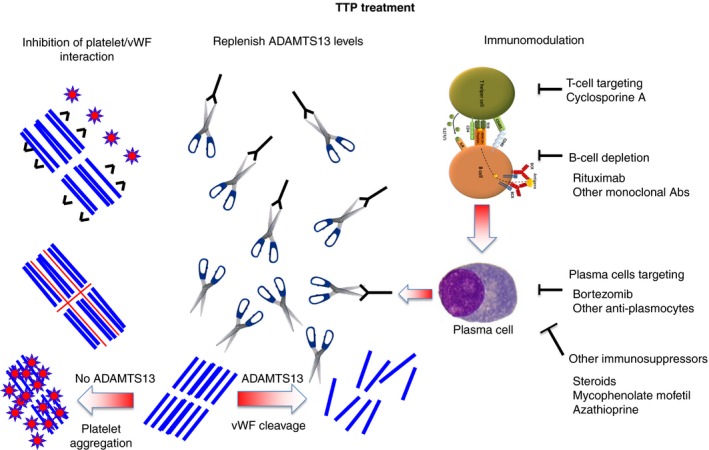
Figure 1
Figure 1
The three strategies of immune thrombotic thrombocytopenic purpura treatment. Abs, antibodies; vWF, von Willebrand factor. formula image, ADAMTS13; formula image, platelets; formula image, von Willebrand factor; formula image, anti‐ADAMTS13 antibodies; formula image, anti‐vWF nanobody (caplacizumab); formula image, N‐acetylcysteine
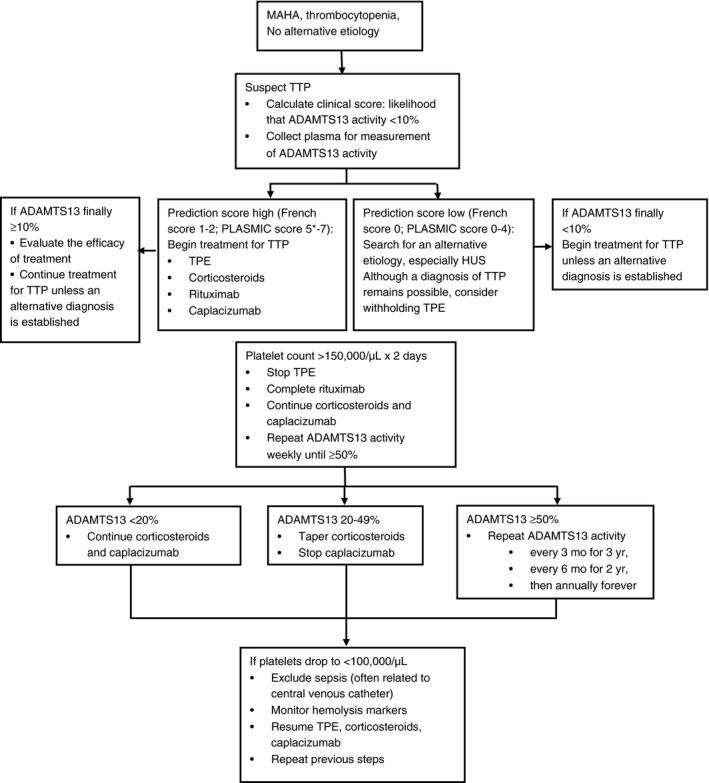
Algorithm A1
Algorithm A1
Initial evaluation and management of patients with acquired, autoimmune TTP. Because of the urgency to begin treatment for TTP, a clinical score (Table 1, 12, 13), which can be calculated from the initial clinical and laboratory data, is used to establish a probable diagnosis. When the clinical score suggests a high probability for ADAMTS13 activity <10% (French score 1‐2; PLASMIC score 6‐7), it is important to begin the full treatment for TTP immediately. *If the likelihood for ADAMTS13 activity <10% is intermediate (for example, PLASMIC score = 5; Table 1), we recommend empiric treatment for TTP because of the potential harms of withholding or delaying treatment, particularly TPE. This salvage treatment should be subsequently completed with immunosuppressive strategies and caplacizumab only when/if severe ADAMTS13 deficiency is confirmed. If ADAMTS13 activity is subsequently reported to be ≥10%, the diagnosis of TTP may still be correct and treatment should be continued unless an alternative diagnosis is established. It is important to recognize that some patients with ADAMTS13 ≥ 10% activity may have well documented TTP.7, 17 When the clinical score suggests a low probability for ADAMTS13 activity <10%, it may be appropriate to withhold treatment for TTP; however the diagnosis of TTP cannot be excluded. In these patients it is critical to search for an alternative etiology for the MAHA and thrombocytopenia, especially atypical (or complement‐mediated) hemolytic uremic syndrome (HUS) as well as a post‐infection HUS when renal involvement is predominant. If ADAMTS13 activity is subsequently reported to be <10%, treatment for TTP is indicated unless a clear alternative etiology for MAHA and thrombocytopenia has been established. Some patients in whom an alternative etiology for MAHA and thrombocytopenia is clearly established (eg, systemic infection or malignancy) may have ADAMTS13 activity <10%.7 The diagnosis of TTP requires clinical judgment as well as measurement of ADAMTS13 activity. Corticosteroids may be prednisone, 1 mg/kg/day, or for patients who are acutely ill, high doses of corticosteroids may be given initially (eg, intravenous methylprednisolone, 1000 mg/day for 3 days) before beginning oral prednisone. We use the conventional regimen for rituximab: 375 mg/m2/week, four doses once or twice weekly. Current studies are evaluating alternative regimens for rituximab, to determine if a lower dose or fewer infusions are equally efficacious. Caplacizumab is listed as initial treatment although it is not yet approved as treatment for TTP in the United States or Europe. Patients may continue to have deficient ADAMTS13 activity when their platelet count recovers to normal. Therefore weekly measurements of ADAMTS13 activity are important to guide the duration of corticosteroid and caplacizumab treatment. Persistent ADAMTS13 activity <20% requires continued treatment until ADAMTS13 improvement, because exacerbations of TTP may occur when plasma exchange is stopped. Weekly measurements should be continued until ADAMTS13 activity recovers to normal (≥50%). When ADAMTS13 activity returns to normal (≥50%) with effective immunosuppression, serial measurements continue at increasingly greater intervals. Because of the risk for relapse many years after the initial episode, indefinite follow‐up with annual measurement of ADAMTS13 activity is important.
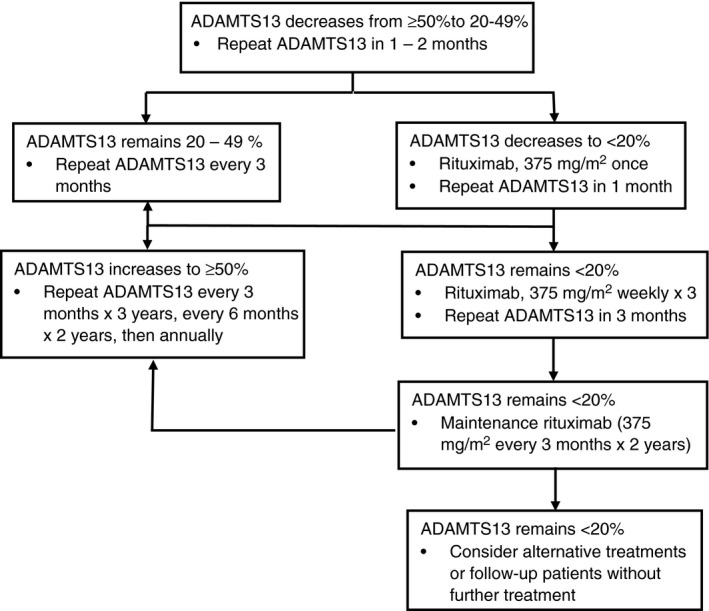
Algorithm A2
Algorithm A2
Management of patients with acquired, autoimmune TTP during remission. If ADAMTS13 activity decreases to 20%‐49%, more frequent measurements of ADAMTS13 activity are required. If ADAMTS13 activity decreases to <20%, rituximab is recommended to allow recovery of ADAMTS13 activity to normal (≥50%). In approximately 80% of patients in whom ADAMTS13 activity decreases to <20% during remission, activity will return to normal with rituximab, often with only a single administration. If only partial recovery occurs (ADAMTS13 activity 20%‐50%), then no further rituximab is required, but more frequent measurements of ADAMTS13 activity are recommended. If maintenance rituximab for 2 y does not cause recovery of ADAMTS13 activity to <20%, alternative treatments (eg cyclosporine, splenectomy) may be considered or the patient may be followed without further treatment.

References

    1. Rock GA, Shumak KH, Buskard NA, et al. Comparison of plasma exchange with plasma infusion in the treatment of thrombotic thrombocytopenic purpura. Canadian Apheresis Study Group. N Engl J Med. 1991;325:393–7. - PubMed
    1. Furlan M, Robles R, Galbusera M, et al. von Willebrand factor‐cleaving protease in thrombotic thrombocytopenic purpura and the hemolytic‐uremic syndrome. N Engl J Med. 1998;339:1578–84. - PubMed
    1. Tsai HM, Lian EC. Antibodies to von Willebrand factor‐cleaving protease in acute thrombotic thrombocytopenic purpura. N Engl J Med. 1998;339:1585–94. - PMC - PubMed
    1. Kremer Hovinga JA, Coppo P, Lammle B, Moake JL, Miyata T, Vanhoorelbeke K. Thrombotic thrombocytopenic purpura. Nat Rev Dis Primers. 2017;3:17020. - PubMed
    1. Joly BS, Coppo P, Veyradier A. Thrombotic thrombocytopenic purpura. Blood. 2017;129:2836–46. - PubMed