


Work ability and work functioning: measuring change in individuals recently returned to work
- PMID: 30656402
- PMCID: PMC6420615
- DOI: 10.1007/s00420-019-01400-z
Work ability and work functioning: measuring change in individuals recently returned to work
Abstract
Purpose: To assess: (1) whether work ability and work-functioning instruments can detect relevant changes in their respective parameters following a return to work (RTW) and (2) what proportion of those returning to work show changes in their work ability and work functioning.
Methods: A total of 1073 workers who returned to work after at least 2 weeks of sick leave were invited to fill out three questionnaires in the first 8 weeks after RTW. These consisted of an appraisal of general, physical, and mental/emotional work ability (scores 0-10) and a work-functioning questionnaire (scores 0-100). Minimal Important Change (MIC) was defined to determine the proportion of people, whose scores had changed at weeks 5 and 8 following RTW. The Smallest Detectable Change (SDC) was determined to put the MIC in perspective of measurement error.
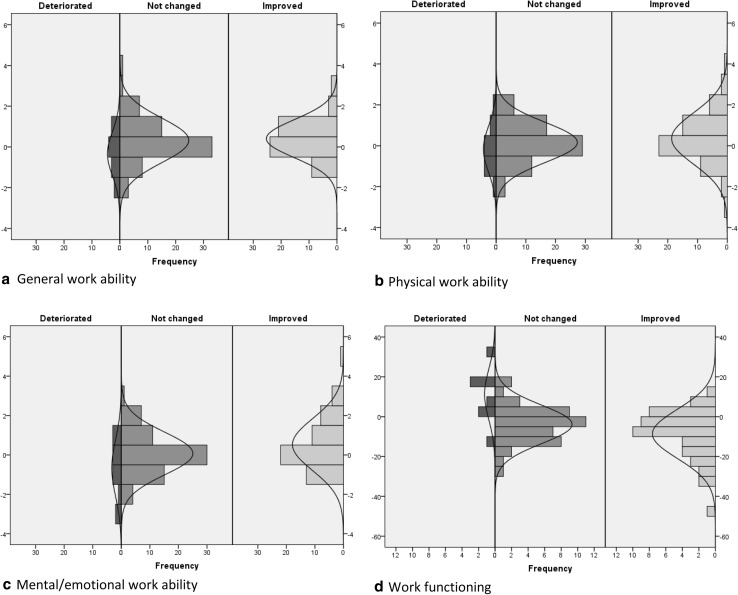
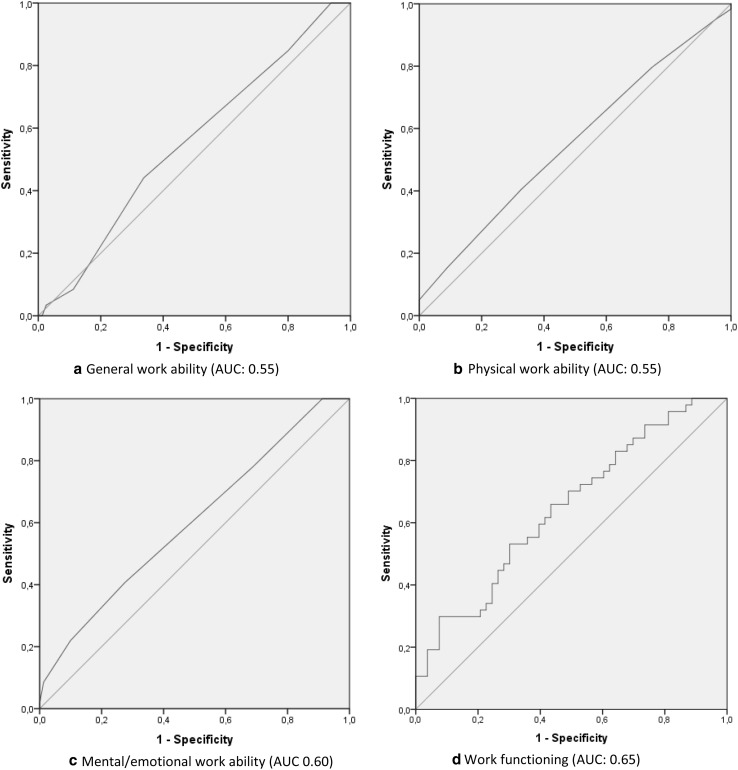
Results: Of all participants, 235 were eligible for the analysis. All MIC values were below the SDC and thus not suitable for use. The SDC for work ability was 2.2 and 19.9 for work functioning. In the first 5 weeks after RTW, 10-15% showed a relevant, measurable improvement in work ability, and work functioning based on the SDC margins.
Conclusions: Both instruments were unable to identify change after RTW adequately. We can conclude that 10-15% of individuals showed improvement in work ability and work functioning in the first 5 weeks after RTW when SDC is used.
Keywords: Minimally clinical important difference; Occupational physician; Return to work; Smallest detectable change; Work Ability Score.
Conflict of interest statement
Conflict of interest
The authors declare that they have no conflict of interest.
Ethical approval
All procedures performed in studies involving human participants were in accordance with the ethical standards of the institutional and national research committee and with the 1964 Helsinki declaration and its later amendments or comparable ethical standards.
Figures
References
-
- Abma FI, van der Klink JJ, Bultmann U. The work role functioning questionnaire 2.0 (Dutch version): examination of its reliability, validity and responsiveness in the general working population. J Occup Rehabil. 2013;23(1):135–147. - PubMed
-
- Arends I, van der Klink JJ, van Rhenen W, de Boer MR, Bultmann U. Predictors of recurrent sickness absence among workers having returned to work after sickness absence due to common mental disorders. Scand J Work Environ Health. 2014;40(2):195–202. - PubMed
-
- Boezeman EJ, Nieuwenhuijsen K, de Bekker-Grob EW, van den Akker-van Marle ME, Sluiter JK. The relative importance of the domains of work functioning: evaluations of health-impaired employees, healthy employees, and employers. J Occup Environ Med. 2015;57(4):361–366. - PubMed
-
- Boezeman EJ, Sluiter JK, Nieuwenhuijsen K. Measuring work functioning: validity of a weighted composite work functioning approach. J Occup Rehabil. 2015;25(3):537–542. - PubMed
-
- Burton WN, Conti DJ, Chen CY, Schultz AB, Edington DW. The role of health risk factors and disease on worker productivity. J Occup Environ Med. 1999;41(10):863–877. - PubMed
MeSH terms
LinkOut - more resources
Full Text Sources
