


A simple non-toxic ethylene carbonate fluorescence in situ hybridization (EC-FISH) for simultaneous detection of repetitive DNA sequences and fluorescent bands in plants
- PMID: 30656455
- PMCID: PMC6482133
- DOI: 10.1007/s00709-019-01345-7
A simple non-toxic ethylene carbonate fluorescence in situ hybridization (EC-FISH) for simultaneous detection of repetitive DNA sequences and fluorescent bands in plants
Abstract
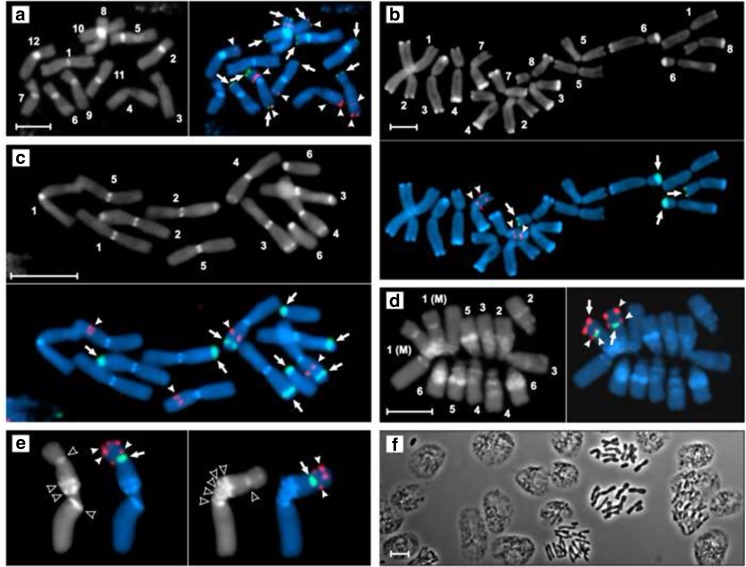
The major drawbacks of standard plant fluorescence in situ hybridization (FISH) designed for double-stranded DNA probes include requirement for experimentally determined heat denaturation of chromosomes at high temperatures and at least overnight hybridization. Consequently, processing with chromosomal preparations may easily result in heat-induced deterioration of chromosomal structural details, is time-consuming, and involves the use of toxic formamide and formaldehyde. Here, I have described a simple and appealing non-toxic procedure with ethylene carbonate (EC)-a formamide-substituting solvent and double-stranded repetitive DNA probes. Applying EC as a component of the hybridization solution at 46 °C not only allowed successful overnight hybridization but also gave a possibility to reduce the hybridization time to 3 h, hence converting the technique into a 1-day procedure. Importantly, the EC-FISH tended to preserve well chromosome structural details, e.g., DAPI-positive bands, thus facilitating simultaneous FISH mapping and chromosome banding on the same slide. The procedure requires no formaldehyde and RNA-se treatment of chromosomes, and no heat denaturation of chromosomal DNA. The key condition is to obtain high-quality cytoplasm-free preparations. The method was reproducible in all the plants studied (Allium, Nigella, Tradescantia, Vicia), giving a species-specific signal pattern together with clear DAPI bands on chromosomes. The procedure described here is expected to give a positive stimulus for improving gene-mapping approaches in plants.
Keywords: Chromosome DAPI banding; Ethylene carbonate; Fluorescence in situ hybridization; Heterochromatin; Plants; rDNA.
Conflict of interest statement
The author declares that there is no conflict of interest.
Figures
References
-
- Badaeva ED, Ruban AS, Aliyeva-Schnorr L, Municio C, Hesse S, Houben A. In situ hybridization to plant chromosomes. In: Liehr T, editor. Fluorescence in situ hybridization (FISH). Application guide. Berlin, Heidelberg: Springer; 2017. pp. 477–494.
-
- Chester M, Gallagher JP, Symonds VV, Cruz da Silva AV, Mavrodiev EV, Leitch AR, Soltis PS, Soltis DE. Extensive chromosomal variation in a recently formed natural allopolyploid species, Tragopogon miscellus (Asteraceae) Proc Natl Acad Sci U S A. 2012;109:1176–1181. doi: 10.1073/pnas.1112041109. - DOI - PMC - PubMed
MeSH terms
Substances
Grants and funding
LinkOut - more resources
Full Text Sources
Other Literature Sources
