


The Be-Well Study: a prospective cohort study of lifestyle and genetic factors to reduce the risk of recurrence and progression of non-muscle-invasive bladder cancer
- PMID: 30656539
- PMCID: PMC6422041
- DOI: 10.1007/s10552-019-1130-8
The Be-Well Study: a prospective cohort study of lifestyle and genetic factors to reduce the risk of recurrence and progression of non-muscle-invasive bladder cancer
Abstract
Purpose: Bladder cancer is one of the top five cancers diagnosed in the U.S. with a high recurrence rate, and also one of the most expensive cancers to treat over the life-course. However, there are few observational, prospective studies of bladder cancer survivors.
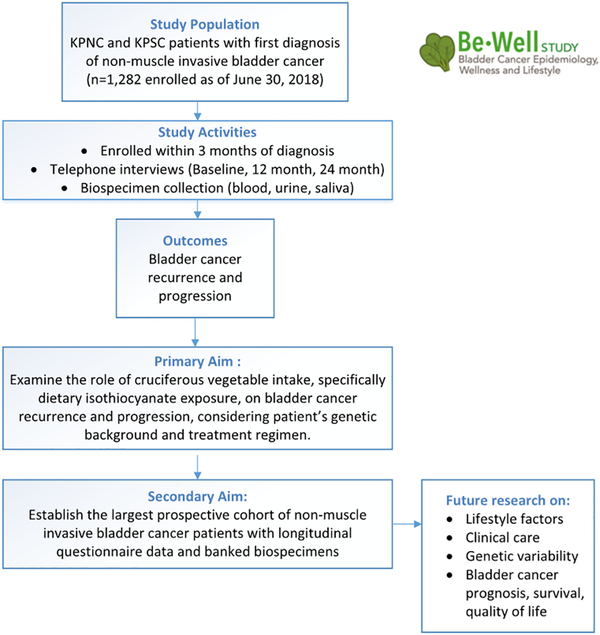
Methods: The Bladder Cancer Epidemiology, Wellness, and Lifestyle Study (Be-Well Study) is a National Cancer Institute-funded, multi-center prospective cohort study of non-muscle-invasive bladder cancer (NMIBC) patients (Stage Ta, T1, Tis) enrolled from the Kaiser Permanente Northern California (KPNC) and Southern California (KPSC) health care systems, with genotyping and biomarker assays performed at Roswell Park Comprehensive Cancer Center. The goal is to investigate diet and lifestyle factors in recurrence and progression of NMIBC, with genetic profiles considered, and to build a resource for future NMIBC studies.
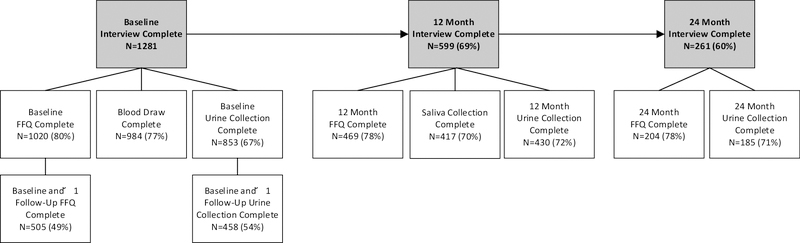
Results: Recruitment began in February 2015. As of 30 June 2018, 1,281 patients completed the baseline interview (774 KPNC, 511 KPSC) with a recruitment rate of 54%, of whom 77% were male and 23% female, and 80% White, 6% Black, 8% Hispanic, 5% Asian, and 2% other race/ethnicity. Most patients were diagnosed with Ta (69%) or T1 (27%) tumors. Urine and blood specimens were collected from 67% and 73% of consented patients at baseline, respectively. To date, 599 and 261 patients have completed the 12- and 24-month follow-up questionnaires, respectively, with additional urine and saliva collection.
Conclusions: The Be-Well Study will be able to answer novel questions related to diet, other lifestyle, and genetic factors and their relationship to recurrence and progression among early-stage bladder cancer patients.
Keywords: Lifestyle and genetic factors; Non-muscle-invasive bladder cancer; Prospective cohort study; Recurrence; Urothelial carcinoma.
Conflict of interest statement
Figures
References
-
- American Cancer Society, Cancer Facts & Figures 2016. 2016, American Cancer Society: Atlanta.
-
- Botteman MF, Pashos CL, Redaelli A, Laskin B, and Hauser R, The health economics of bladder cancer: a comprehensive review of the published literature. Pharmacoeconomics, 2003. 21(18): p. 1315–30. - PubMed
-
- Avritscher EB, Cooksley CD, Grossman HB, Sabichi AL, Hamblin L, Dinney CP, and Elting LS, Clinical model of lifetime cost of treating bladder cancer and associated complications. Urology, 2006. 68(3): p. 549–53. - PubMed
Publication types
MeSH terms
Grants and funding
LinkOut - more resources
Full Text Sources
Medical
Research Materials
