


Dysmorphic contribution of neurotransmitter and neuroendocrine system polymorphisms to subtherapeutic mood states
- PMID: 30656852
- PMCID: PMC6379594
- DOI: 10.1002/brb3.1140
Dysmorphic contribution of neurotransmitter and neuroendocrine system polymorphisms to subtherapeutic mood states
Abstract
Objective: From an evolutionary perspective, emotions emerged as rapid adaptive reactions that increase survival rates. Current psychobiology includes the consideration that genetic changes affecting neuroendocrine and neurotransmission pathways may also be affecting mood states. Following this hypothesis, abnormal levels of any of the aminergic neurotransmitters would be of considerable importance in the development of a pathophysiological state.
Materials and methods: A total of 668 students from the School of Medicine of the University of Malaga (Average = 22.41 ± 3; 41% men) provided self-report measures of mood states using POMS and GHQ-28 questionnaires and buccal cells for genotyping 19 polymorphisms from 14 selected neurotransmitter pathways genes (HTR1A; HTR2A; HTR2C; HTR3B; TPH1; SLC18A1; SLC18A2; COMT; MAOA; MAOB) and neuroendocrine system (AVPR1B; OPRM1; BDNF; OXTR).
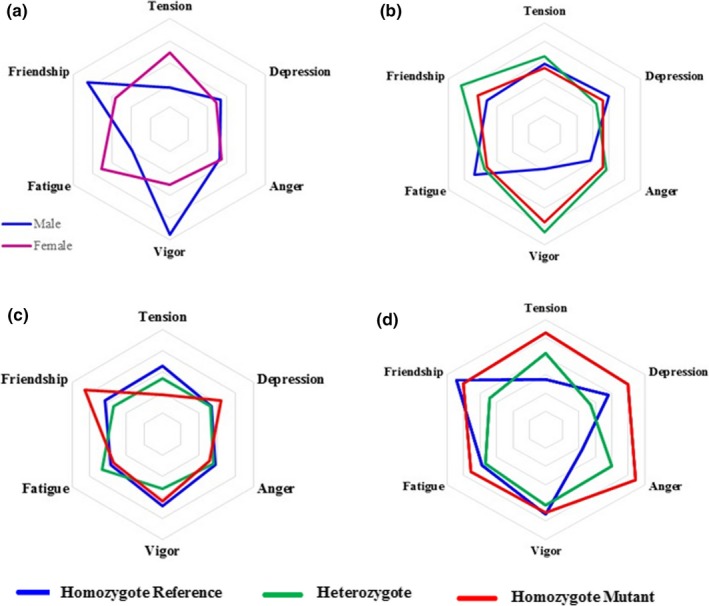
Results: MAOA rs3788862 genotype correlates with decreasing levels of Tension among females (beta = -0.168, p-value = 0.003) but it is neutral among males in this subscale. On the contrary, it correlates with lower GHQ-28 depression scores among males (beta = -0.196, p-value = 0.008). Equivalently, SLC18A1 and HTR2A variants correlated with anger and vigor scores, only among males. From the neuroendocrine system, OPRM1 rs1799971 correlated increasing levels of female's Anxiety, depression and Social Dysfunction scores.
Conclusion: Our findings suggest that these polymorphisms contribute to define general population mood levels, although exhibiting a clear sexual dimorphism.
Keywords: BDNF; COMT; Goldberg; HTR2A; MAO; OPRM1; POMS; SLC18A1; mood state.
© 2018 The Authors. Brain and Behavior published by Wiley Periodicals, Inc.
Figures
References
-
- Andrade‐Fernandez, E. M. , Arce‐Fernandez, C. , & Seaone‐Pesqueira, G. (2002). Adaptación al español del cuestionario «Perfil de los Estados de Ánimo» en una muestra de deportistas. Psicothema, 14, 708–713.
-
- Anton, R. F. , Oroszi, G. , O’Malley, S. , Couper, D. , Swift, R. , Pettinati, H. , & Goldman, D. (2008). An Evaluation of μ‐Opioid Receptor (OPRM1) as a predictor of naltrexone response in the treatment of alcohol dependence. Archives of General Psychiatry, 65, 135 10.1001/archpsyc.65.2.135 - DOI - PMC - PubMed
-
- Baldwin, D. , & Birtwistle, J. (2002). An atlas of depression. The encyclopedia of visual medicine: Parthenon Publishing Group.
-
- Cho, H. J. , Meira‐Lima, I. , Cordeiro, Q. , Michelon, L. , Sham, P. , Vallada, H. , & Collier, D. A. (2005). Population‐based and family‐based studies on the serotonin transporter gene polymorphisms and bipolar disorder: A systematic review and meta‐analysis. Molecular Psychiatry, 10, 771–781. 10.1038/sj.mp.4001663 - DOI - PubMed
-
- Cichon, S. , Winge, I. , Mattheisen, M. , Georgi, A. , Karpushova, A. , Freudenberg, J. , … Nöthen, M. M. (2008). Brain‐specific tryptophan hydroxylase 2 (TPH2): A functional Pro206Ser substitution and variation in the 5'‐region are associated with bipolar affective disorder. Human Molecular Genetics, 17, 87–97. 10.1093/hmg/ddm286 - DOI - PubMed
Publication types
MeSH terms
Substances
LinkOut - more resources
Full Text Sources
Molecular Biology Databases
Miscellaneous
