Association of Infants Exposed to Prenatal Zika Virus Infection With Their Clinical, Neurologic, and Developmental Status Evaluated via the General Movement Assessment Tool
- PMID: 30657537
- PMCID: PMC6431234
- DOI: 10.1001/jamanetworkopen.2018.7235
Association of Infants Exposed to Prenatal Zika Virus Infection With Their Clinical, Neurologic, and Developmental Status Evaluated via the General Movement Assessment Tool
Abstract
Importance: There is an urgent need to assess neurodevelopment in Zika virus (ZIKV)-exposed infants.
Objectives: To perform general movement assessment (GMA) at 9 to 20 weeks' postterm age and to evaluate whether the findings are associated with neurodevelopmental outcomes at age 12 months in infants prenatally exposed to acute maternal illness with rash in Brazil during the ZIKV outbreak and in age-matched controls.
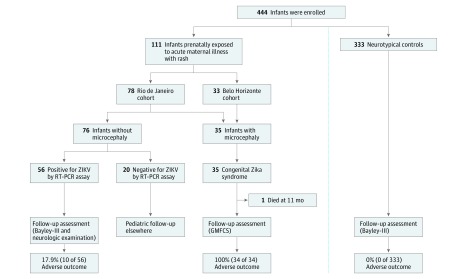
Design, setting, and participants: In this cohort study, infants prenatally exposed to acute maternal illness with rash were recruited at medical institutions in Rio de Janeiro and Belo Horizonte, Brazil, from February 1, 2016, to April 30, 2017, while infants without any exposure to maternal illness originated from the Graz University Audiovisual Research Database for the Interdisciplinary Analysis of Neurodevelopment. Participants were 444 infants, including 76 infants without congenital microcephaly, 35 infants with microcephaly, and 333 neurotypical children matched for sex, gestational age at birth, and age at GMA.
Main outcomes and measures: General movement assessment performed at 9 to 20 weeks' postterm age, with negative predictive value, positive predictive value, sensitivity, and specificity generated, as well as clinical, neurologic, and developmental status (Bayley Scales of Infant and Toddler Development, Third Edition [Bayley-III] scores) at age 12 months. Motor Optimality Scores were generated based on the overall quality of the motor repertoire. Adverse outcomes were defined as a Bayley-III score less than 2 SD in at least 1 domain, a score less than 1 SD in at least 2 domains, and/or atypical neurologic findings.
Results: A total of 444 infants were enrolled, including 111 children prenatally exposed to a maternal illness with rash and 333 children without any prenatal exposure to maternal illness (57.7% male and mean [SD] age, 14 [2] weeks for both groups); 82.1% (46 of 56) of ZIKV-exposed infants without congenital microcephaly were healthy at age 12 months. Forty-four of 46 infants were correctly identified by GMA at 3 months, with a negative predictive value of 94% (95% CI, 85%-97%). Seven of 10 ZIKV-exposed children without microcephaly with adverse neurodevelopmental outcomes were identified by GMA. The GMA positive predictive value was 78% (95% CI, 46%-94%), sensitivity was 70% (95% CI, 35%-93%), specificity was 96% (95% CI, 85%-99%), and accuracy was 91% (95% CI, 80%-97%). Children with microcephaly had bilateral spastic cerebral palsy; none had normal movements. The Motor Optimality Score differentiated outcomes: the median Motor Optimality Score was 23 (interquartile range [IQR], 21-26) in children with normal development, 12 (IQR, 8-19) in children with adverse outcomes, and 5 (IQR, 5-6) in children with microcephaly, a significant difference (P = .001).
Conclusions and relevance: This study suggests that although a large proportion of ZIKV-exposed infants without microcephaly develop normally, many do not. The GMA should be incorporated into routine infant assessments to enable early entry into targeted treatment programs.
Conflict of interest statement
Figures
References
-
- Rice ME, Galang RR, Roth NM, et al. Vital Signs: Zika-associated birth defects and neurodevelopmental abnormalities possibly associated with congenital Zika virus infection: U.S. territories and freely associated states, 2018. MMWR Morb Mortal Wkly Rep. 2018;67(31):-. doi: 10.15585/mmwr.mm6731e1 - DOI - PMC - PubMed
Publication types
MeSH terms
Grants and funding
LinkOut - more resources
Full Text Sources
Other Literature Sources
Medical
Miscellaneous