


Cancer Immunotherapy: Silencing Intracellular Negative Immune Regulators of Dendritic Cells
- PMID: 30658461
- PMCID: PMC6357062
- DOI: 10.3390/cancers11010108
Cancer Immunotherapy: Silencing Intracellular Negative Immune Regulators of Dendritic Cells
Abstract
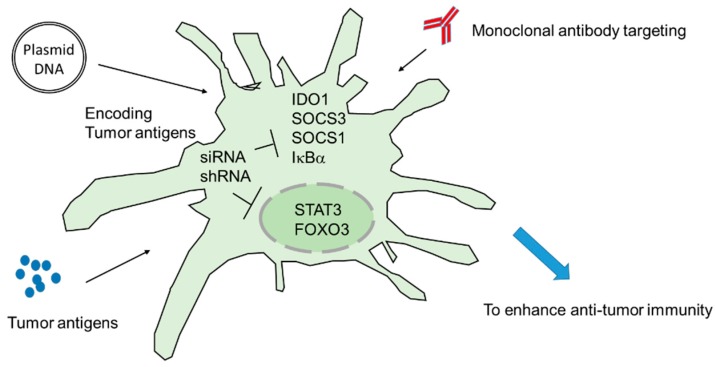
Dendritic cells (DCs) are capable of activating adaptive immune responses, or inducing immune suppression or tolerance. In the tumor microenvironment, the function of DCs is polarized into immune suppression that attenuates the effect of T cells, promoting differentiation of regulatory T cells and supporting tumor progression. Therefore, blocking negative immune regulators in DCs is considered a strategy of cancer immunotherapy. Antibodies can target molecules on the cell surface, but not intracellular molecules of DCs. The delivery of short-hairpin RNAs (shRNA) and small-interfering RNAs (siRNA) should be a strategy to silence specific intracellular targets in DCs. This review provides an overview of the known negative immune regulators of DCs. Moreover, a combination of shRNA/siRNA and DC vaccines, DNA vaccines in animal models, and clinical trials are also discussed.
Keywords: cancer; dendritic cells (DCs); intracellular negative immune regulator; short-hairpin RNA (shRNA); small-interfering RNA (siRNA).
Conflict of interest statement
The authors declare no conflict of interest.
Figures

References
-
- Diamond M.S., Kinder M., Matsushita H., Mashayekhi M., Dunn G.P., Archambault J.M., Lee H., Arthur C.D., White J.M., Kalinke U., et al. Type I interferon is selectively required by dendritic cells for immune rejection of tumors. J. Exp. Med. 2011;208:1989–2003. doi: 10.1084/jem.20101158. - DOI - PMC - PubMed
Publication types
Grants and funding
LinkOut - more resources
Full Text Sources
Other Literature Sources
