. 2019 Jan 18;19(1):23.
doi: 10.1186/s12886-018-1017-6.

All-trans retinoic acid stimulates the secretion of TGF-β2 via the phospholipase C but not the adenylyl cyclase signaling pathway in retinal pigment epithelium cells

Affiliations

All-trans retinoic acid stimulates the secretion of TGF-β2 via the phospholipase C but not the adenylyl cyclase signaling pathway in retinal pigment epithelium cells

Daren Zhang et al. BMC Ophthalmol. .

Abstract

Background: By investigating that (i) all-trans retinoic acid (ATRA) affects human retinal pigment epithelium (RPE) in expressing and secreting transforming growth factor (TGF)-β2 and (ii) U73122 (phospholipase C inhibitor) and SQ22536 (adenylyl cyclase inhibitor) regulate the ATRA-induced secretion of TGF-β2 in human RPE, we sought to interpret the signaling pathway of ATRA in promoting the development of myopia.

Methods: The RPE cell line (D407) was treated with (i) ATRA (10 μM), (ii) U73122 (5-40 μM) and ATRA (10 μM), or (iii) SQ22536 (5-40 μM) and ATRA (10 μM). The control group was no-treated. After stimulated at 2, 4, 8, 16, 24, and 48 h, The expression and secretion of TGF-β2 was detected.

Results: TGF-β2 in the cytoplasm was time-dependent increased by ATRA (p < 0.001). A time-dependent increase in the TGF-β2 protein of the supernatant was induced by ATRA (p < 0.001). U73122 (in the range of 5 to 40 μM) could suppress the secretion of TGF-β2 induced by ATRA (p < 0.001), and 40 μM U73122 could completely inhibit the up-regulated effect of 10 μM ATRA. However, SQ22536 (in the range of 5 to 40 μM) had no impact on the secretion of TGF-β2 induced by ATRA (p > 0.05).

Conclusions: In RPE cells, ATRA stimulates the secretion of TGF-β2 via the phospholipase C signaling pathway but not the adenylyl cyclase signaling pathway. U73122 may inhibit the promotion of ATRA in the development of myopia.

Keywords: All-trans retinoic acid; Retinal pigment epithelium cells; SQ22536; Transforming growth factor-β2; U73122.


Conflict of interest statement

Ethics approval and consent to participate

Not applicable.

Consent for publication

Not applicable.

Competing interests

The authors declare that they have no competing interests.

Publisher’s Note

Springer Nature remains neutral with regard to jurisdictional claims in published maps and institutional affiliations.

Figures
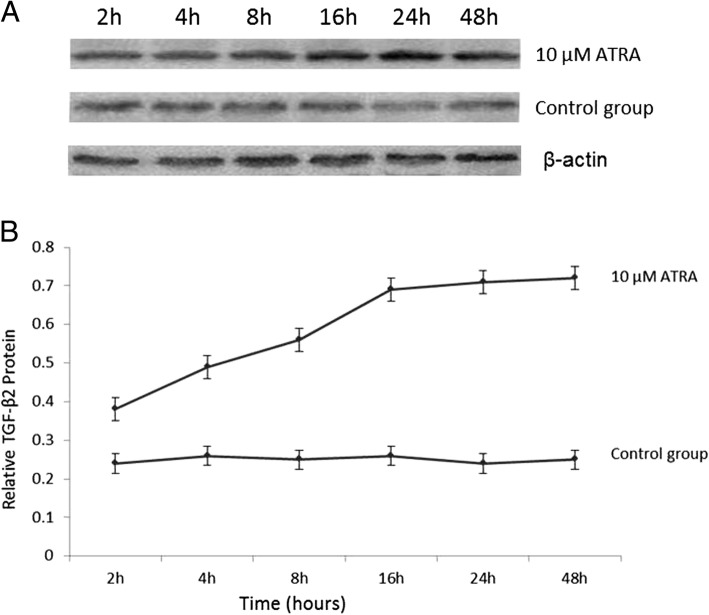
Fig. 1
Fig. 1
ATRA stimulated the expression of TGF-β2 mRNA in D407 cells. D407 cells were treated with 10 μM ATRA for 2, 4, 8, 16, 24, and 48 h, and the expression of TGF-β2 protein was detected by western blot analysis. a The electrophoretogram of TGF-β2 protein in the 10 μM ATRA-treated and control groups for 2, 4, 8, 16, 24, and 48 h. It was found that 10 μM ATRA stimulated the expression of TGF-β2 protein in a time-dependent manner. b After treatment with ATRA for 2 h, the level of TGF-β2 protein in D407 cells was increased significantly compared with that of the control group (p < 0.001) and peaked at 16 h. However, there were no statistically significant differences in the level of TGF-β2 protein at 16 h, 24 h and 48 h (p > 0.05; n = 6 per treatment)
Fig. 2
Fig. 2
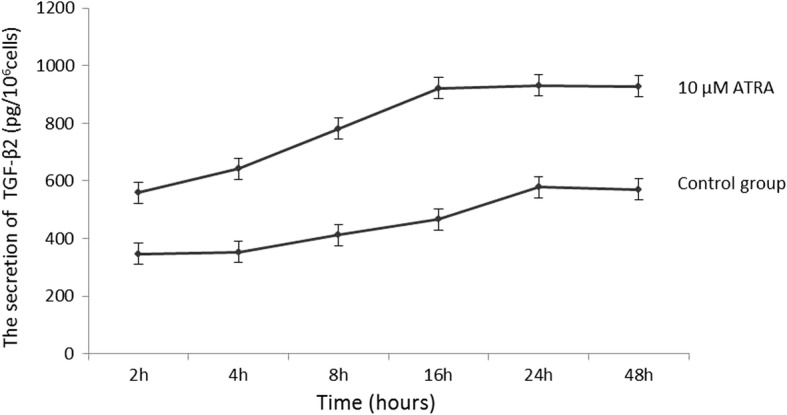
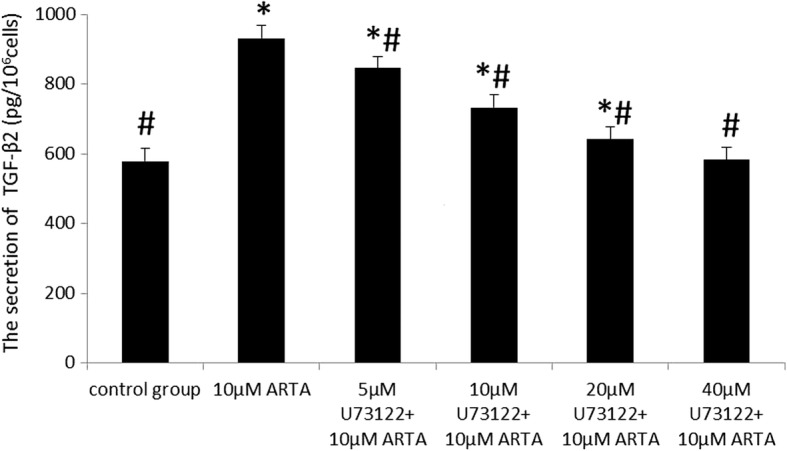
Treatment with 10 μM ATRA stimulated the secretion of TGF-β2 protein in the supernatants of D407 cells. TGF-β2 protein in the conditioned media was measured by ELISA and normalized to cell counts (1 × 106). The concentration of secreted TGF-β2 in the control group increased at 8 h and peaked at 24 h, and there was no statistically significant difference between 24 h and 48 h. After treatment with 10 μM ATRA for 2 h, the concentration of secreted TGF-β2 of the ATRA-treat group increased (p < 0.001) and peaked at 16 h. However, there was no statistically significant difference the concentrations of secreted TGF-β2 in the 10 μM ATRA-treated group at 16 h, 24 h and 48 h (p > 0.05; n = 3 per treatment). The effects of U73122 on the ATRA-induced secretion of TGF-β2 in D407 Cells . Cells were pretreated with U73122 (5 μM, 10 μM, 20 μM and 40 μM) for 30 min, followed by exposure to ATRA (10 μM) for 24 h. After treatment with 5–40 40 μM U73122 + 10 μM ATRA, the concentrations of secreted TGF-β2 in the supernatants were significantly lower than those of the ATRA-treated group (p < 0.01). The concentration of secreted TGF-β2 decreased with the increase of U73122. When the concentration of U73122 reached 40 μM, the concentration of secreted TGF-β2 was not significantly different from that of the control group (p > 0.05) (Fig. 3). The results indicated that the secretion of TGF-β2 induced by ATRA is inhibited by U73122 (5–40 μM) in D407 cells. This suppressive effect of U73122 was enhanced with increasing concentrations, and the effect of 10 μM ATRA was completely inhibited by 40 μM U73122
Fig. 3
Fig. 3
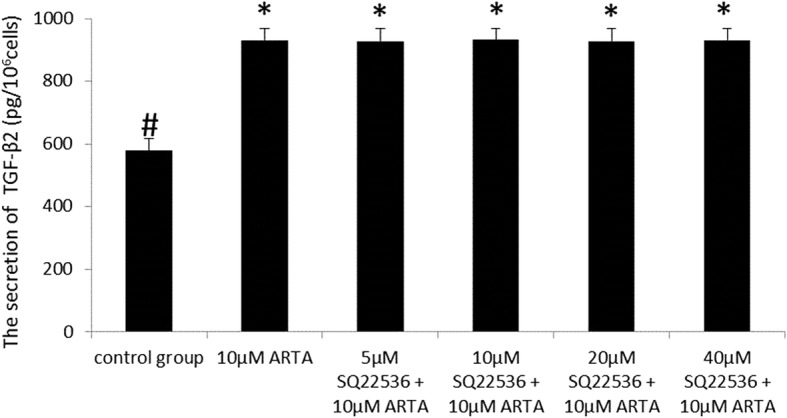
U73122 suppressed the quantity of TGF-β2 protein induced by ATRA in the supernatants of D407 cells. TGF-β2 protein levels in conditioned media were measured by ELISA and normalized to cell counts (1 × 106). The secretion of TGF-β2 induced by ATRA was inhibited by U73122 (5–40 μM) in D407 cells. The suppressive effect of U73122 was enhanced with increasing concentrations of U73122, and the effect of 10 μM ATRA was completely inhibited by 40 μM U73122. Data are represented as the mean ± SEM. Statistical comparisons were performed by one-way ANOVA. *Significance versus control group (p < 0.001; n = 3 per treatment). #Significance versus ATRA-treated group (10 μM) (p < 0.001; n = 3 per treatment). The effects of SQ22536 on the ATRA-induced secretion of TGF-β2 in D407 Cells. Cells were pretreated with SQ22536 (5 μM, 10 μM, 20 μM and 40 μM) for 30 min, followed by exposure to ATRA (10 μM) for 16 h. There was no significant difference between the secretion of TGF-β2 in the 5–40 μM SQ22536 + ATRA-treated group and ATRA-treated group (p > 0.05) (Fig. 4). These results indicate that SQ22536 (5–40 μM) had no suppressive effects on the secretion of TGF-β2 induced by ATRA in D407 cells
Fig. 4
Fig. 4
SQ22536 did not suppress the quantity of TGF-β2 protein induced by ATRA in the supernatants of D407 cells. TGF-β2 protein levels in conditioned media were measured by ELISA and normalized to cell counts (1 × 106). There was no significant difference in the secretion of TGF-β2 of the ATRA-treated group and SQ22536 (5–40 μM) + ATRA-treated group (p > 0.05). Data are represented as the mean ± SEM. Statistical comparisons were performed with one-way ANOVA. *Significance versus control group (p < 0.001; n = 3 per treatment). #Significance versus ATRA-treat group (10 μM) (p < 0.001; n = 3 per treatment)

References

    1. Durston AJ, Timmermans JP, Hage WJ, Hendriks HF, de Vries NJ, Heideveld M, Nieuwkoop PD. Retinoic acid causes an anteroposterior transformation in the developing central nervous system. Nature. 1989;340:140–144. doi: 10.1038/340140a0. - DOI - PubMed
    1. Osanai M, Petkovich M. Expression of the retinoic acid-metabolizing enzyme CYP26A1 limits programmed cell death. Mol Pharmacol. 2005;67:1808–1817. doi: 10.1124/mol.104.005769. - DOI - PubMed
    1. Bitzer M, Feldkaemper M, Schaeffel F. Visually induced changes in components of the retinoic acid system in fundal layers of the chick. Exp Eye Res. 2000;70:97–106. doi: 10.1006/exer.1999.0762. - DOI - PubMed
    1. Huang J, Qu XM, Chu RY. Expressions of cellular retinoic acid binding proteins I and retinoic acid receptor-beta in the Guinea pig eyes with experimental myopia. Int J Ophthalmol. 2011;4:131–136. - PMC - PubMed
    1. McFadden SA, Howlett MH, Mertz JR. Retinoic acid signals the direction of ocular elongation in the Guinea pig eye. Vis Res. 2004;44:643–653. doi: 10.1016/j.visres.2003.11.002. - DOI - PubMed

MeSH terms

LinkOut - more resources