


Effects of Oral Morphine on Dyspnea in Patients with Cancer: Response Rate, Predictive Factors, and Clinically Meaningful Change (CJLSG1101)
- PMID: 30659079
- PMCID: PMC6656455
- DOI: 10.1634/theoncologist.2018-0468
Effects of Oral Morphine on Dyspnea in Patients with Cancer: Response Rate, Predictive Factors, and Clinically Meaningful Change (CJLSG1101)
Abstract
Background: Although the efficacy of parenteral morphine for alleviating dyspnea has been previously demonstrated in several studies, little is known regarding the efficacy of oral morphine for dyspnea among patients with cancer, including its response rate and predictive factors of effectiveness. Therefore, the aim of this study was to clarify the effectiveness of oral morphine on dyspnea in patients with cancer and elucidate the predictive factors of its effectiveness.
Subjects, materials, and methods: In this multicenter prospective observational study, we investigated the change in dyspnea intensity in patients with cancer before and after the administration of oral morphine by using a visual analog scale (VAS). We also administered a self-assessment questionnaire to determine whether the patients believed oral morphine was effective.
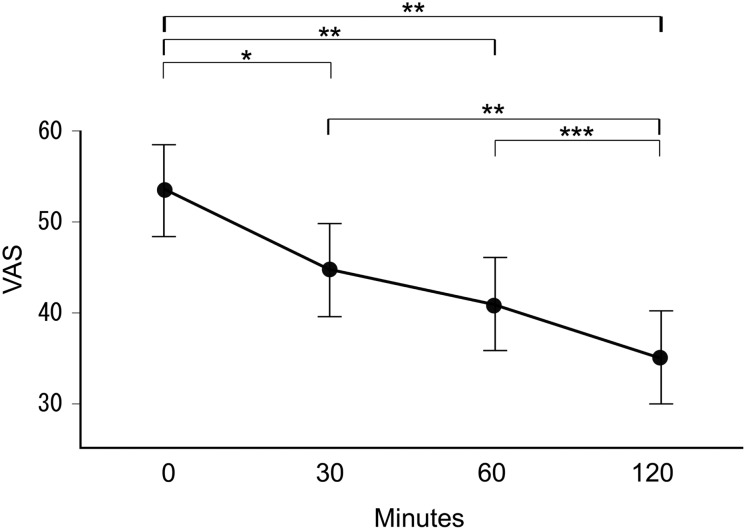
Results: Eighty patients were enrolled in the study, and 71 of these patients were eligible. The least square mean of the VAS scores for dyspnea intensity was 53.5 at baseline, which decreased significantly to 44.7, 40.8, and 35.0 at 30, 60, and 120 minutes after morphine administration, respectively. Fifty-four patients (76.1%) reported that oral morphine was effective on the self-assessment questionnaire. Among the background factors, a high score for "sense of discomfort" on the Cancer Dyspnea Scale (CDS) and a smoking history of fewer pack-years were associated with greater effectiveness.
Conclusion: Oral morphine was effective and feasible for treating cancer-related dyspnea. A higher score for "sense of discomfort" on the CDS and a smaller cumulative amount of smoking may be predictive factors of the effectiveness of oral morphine.
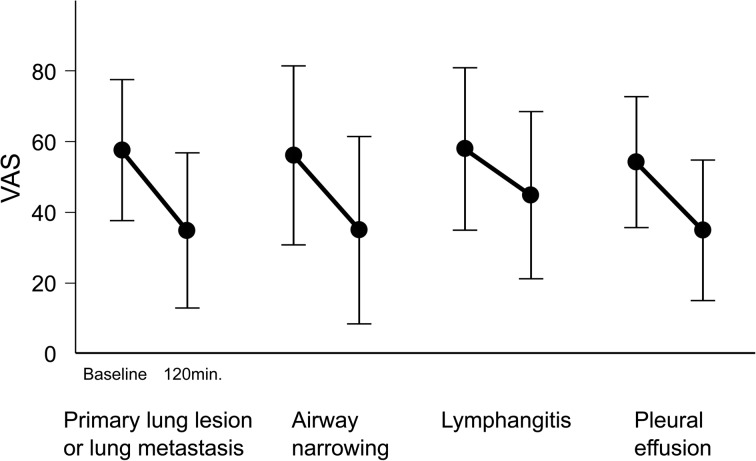
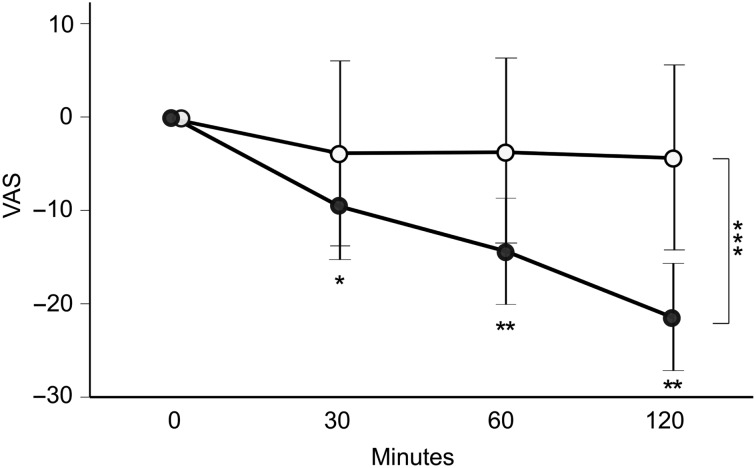
Implications for practice: This study demonstrated that oral morphine was effective in alleviating cancer-related dyspnea due to multiple factors including primary lung lesions, airway narrowing, and pleural effusion. Approximately 76% of patients reported that oral morphine was effective. A higher score for "sense of discomfort" on the Cancer Dyspnea Scale and a lower cumulative amount of smoking may be predictive factors for the effectiveness of oral morphine. Interestingly, respiratory rates in patients who reported the morphine to be effective decreased significantly after oral morphine administration, unlike the respiratory rates in "morphine-ineffective" patients.
Keywords: Cancer; Clinically meaningful change; Dyspnea; Morphine; Predictive factor.
© AlphaMed Press 2019.
Conflict of interest statement
Disclosures of potential conflicts of interest may be found at the end of this article.
Figures
References
-
- Reuben DB, Mor V. Dyspnea in terminally ill cancer patients. Chest 1986;89:234–236. - PubMed
-
- Lorenz KA, Lynn J, Dy S et al. Quality measures for symptoms and advance care planning in cancer: A systematic review. J Clin Oncol 2006;24:4933–4938. - PubMed
-
- Gupta D, Lis CG, Grutsch JF. The relationship between dyspnea and patient satisfaction with quality of life in advanced cancer. Support Care Cancer 2007;15:533–538. - PubMed
-
- Tanaka K, Akechi T, Okuyama T et al. Prevalence and screening of dyspnea interfering with daily life activities in ambulatory patients with advanced lung cancer. J Pain Symptom Manage 2002;23:484–489. - PubMed
-
- Ben‐Aharon I, Gafter‐Gvili A, Paul M et al. Interventions for alleviating cancer‐related dyspnea: A systematic review. J Clin Oncol 2008;26:2396–2404. - PubMed
Publication types
MeSH terms
Substances
LinkOut - more resources
Full Text Sources
Medical
