


The presence of cerebral white matter lesions and lower skin microvascular perfusion predicts lower cognitive performance in type 1 diabetes patients with retinopathy but not in healthy controls-A longitudinal study
- PMID: 30659710
- PMCID: PMC6593465
- DOI: 10.1111/micc.12530
The presence of cerebral white matter lesions and lower skin microvascular perfusion predicts lower cognitive performance in type 1 diabetes patients with retinopathy but not in healthy controls-A longitudinal study
Abstract
Objective: Cognitive impairments in type 1 diabetes may result from hyperglycemia-associated cerebral microangiopathy. We aimed to identify cerebral microangiopathy and skin microvascular dysfunction-as a surrogate marker for generalized microvascular function-as predictors of cognitive performance over time.
Methods: In this prospective cohort study, 25 type 1 diabetes patients with proliferative retinopathy and 25 matched healthy controls underwent neurocognitive testing at baseline and after follow-up (3.8 ± 0.8 years). At baseline, 1.5-T cerebral magnetic resonance imaging was used to detect WML and cerebral microbleeds. Skin capillary perfusion was assessed by means of capillary microscopy.
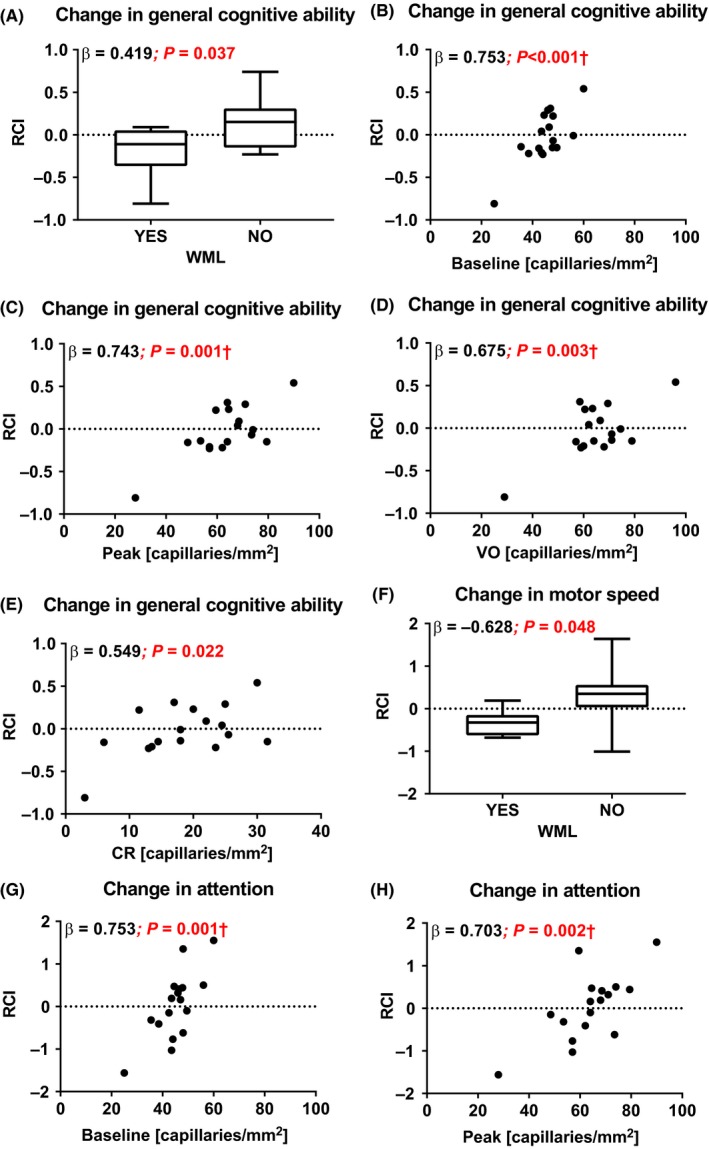
Results: In type 1 diabetes patients, but not in healthy controls, the presence of WML (ß = -0.419; P = 0.037) as well as lower skin capillary perfusion (baseline: ß = 0.753; P < 0.001; peak hyperemia: ß = 0.743; P = 0.001; venous occlusion: ß = 0.675; P = 0.003; capillary recruitment: ß = 0.549; P = 0.022) at baseline was associated with lower cognitive performance over time, independent of age, sex, HbA1c, and severe hypoglycemia. The relationship between WML and lower cognitive performance was significantly reduced after adjusting for capillary perfusion.
Conclusions: These data fit the hypothesis that cerebral microangiopathy is a manifestation of generalized microvascular dysfunction, leading to lower cognitive performance.
Keywords: cerebral microbleeds; cognitive performance; skin perfusion; type 1 diabetes; white matter lesions.
© 2019 The Authors. Microcirculation Published by John Wiley & Sons Ltd.
Conflict of interest statement
There is no conflict of interests to declare.
Figures
References
-
- Diabetes C, Complications Trial Research G , Nathan DM, et al. The effect of intensive treatment of diabetes on the development and progression of long‐term complications in insulin‐dependent diabetes mellitus. N Engl J Med. 1993;329(14):977‐986. - PubMed
-
- Biessels GJ, Strachan MW, Visseren FL, Kappelle LJ, Whitmer RA. Dementia and cognitive decline in type 2 diabetes and prediabetic stages: towards targeted interventions. Lancet Diabetes Endocrinol. 2014;2(3):246‐255. - PubMed
-
- Brands AM, Biessels GJ, de Haan EH, Kappelle LJ, Kessels RP. The effects of type 1 diabetes on cognitive performance: a meta‐analysis. Diabetes Care. 2005;28(3):726‐735. - PubMed
-
- McCrimmon RJ, Ryan CM, Frier BM. Diabetes and cognitive dysfunction. Lancet. 2012;379(9833):2291‐2299. - PubMed
-
- Brismar T, Maurex L, Cooray G, et al. Predictors of cognitive impairment in type 1 diabetes. Psychoneuroendocrino. 2007;32(8‐10):1041‐1051. - PubMed
Publication types
MeSH terms
Grants and funding
LinkOut - more resources
Full Text Sources
Medical
