


The effect of a lifestyle intervention in obese pregnant women on gestational metabolic profiles: findings from the UK Pregnancies Better Eating and Activity Trial (UPBEAT) randomised controlled trial
- PMID: 30661507
- PMCID: PMC6340185
- DOI: 10.1186/s12916-018-1248-7
The effect of a lifestyle intervention in obese pregnant women on gestational metabolic profiles: findings from the UK Pregnancies Better Eating and Activity Trial (UPBEAT) randomised controlled trial
Abstract
Background: Pregnancy is associated with widespread change in metabolism, which may be more marked in obese women. Whether lifestyle interventions in obese pregnant women improve pregnancy metabolic profiles remains unknown. Our objectives were to determine the magnitude of change in metabolic measures during obese pregnancy, to indirectly compare these to similar profiles in a general pregnant population, and to determine the impact of a lifestyle intervention on change in metabolic measures in obese pregnant women.
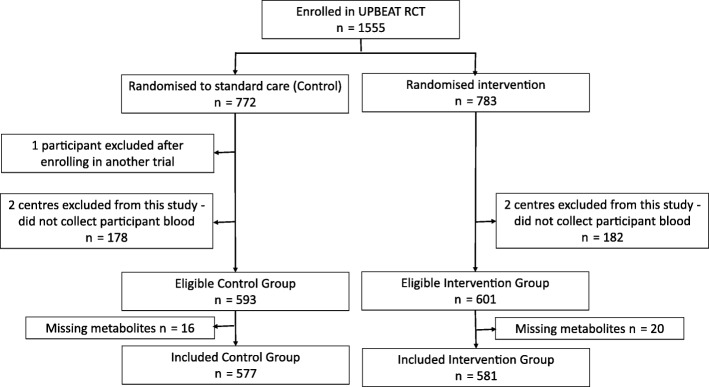
Methods: Data from a randomised controlled trial of 1158 obese (BMI ≥ 30 kg/m2) pregnant women recruited from six UK inner-city obstetric departments were used. Women were randomised to either the UPBEAT intervention, a tailored complex lifestyle intervention focused on improving diet and physical activity, or standard antenatal care (control group). UPBEAT has been shown to improve diet and physical activity during pregnancy and up to 6-months postnatally in obese women and to reduce offspring adiposity at 6-months; it did not affect risk of gestational diabetes (the primary outcome). Change in the concentrations of 158 metabolic measures (129 lipids, 9 glycerides and phospholipids, and 20 low-molecular weight metabolites), quantified three times during pregnancy, were compared using multilevel models. The role of chance was assessed with a false discovery rate of 5% adjusted p values.
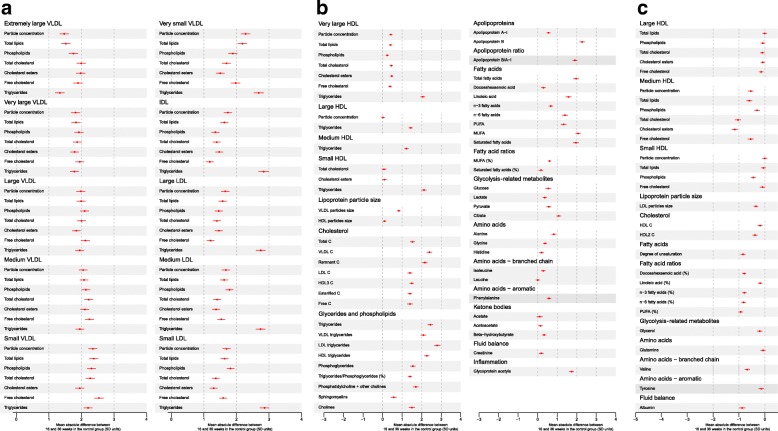
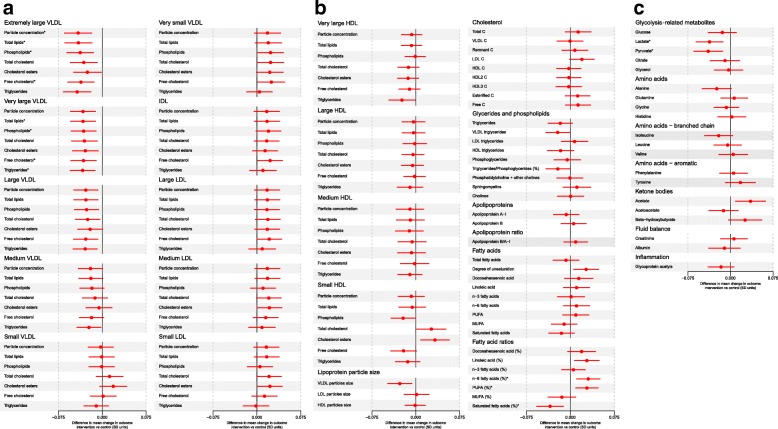
Results: All very low-density lipoprotein (VLDL) particles increased by 1.5-3 standard deviation units (SD) whereas intermediate density lipoprotein and specific (large, medium and small) LDL particles increased by 1-2 SD, between 16 and 36 weeks' gestation. Triglycerides increased by 2-3 SD, with more modest changes in other metabolites. Indirect comparisons suggest that the magnitudes of change across pregnancy in these obese women were 2- to 3-fold larger than in unselected women (n = 4260 in cross-sectional and 583 in longitudinal analyses) from an independent, previously published, study. The intervention reduced the rate of increase in extremely large, very large, large and medium VLDL particles, particularly those containing triglycerides.
Conclusion: There are marked changes in lipids and lipoproteins and more modest changes in other metabolites across pregnancy in obese women, with some evidence that this is more marked than in unselected pregnant women. The UPBEAT lifestyle intervention may contribute to a healthier metabolic profile in obese pregnant women, but our results require replication.
Trial registration: UPBEAT was registered with Current Controlled Trials, ISRCTN89971375 , on July 23, 2008 (prior to recruitment).
Keywords: Pregnancy; RCT; lifestyle intervention; metabolomics; obesity.
Conflict of interest statement
Ethics approval and consent to participate
This research complies with the Declaration of Helsinki. Approvals were obtained from the UK research ethics committee (UK integrated research application system, reference 09/H0802/5) and assent to participate was obtained from local Research and Development (R and D) departments for each participating centre. All women provided written informed consent prior to entering the study.
This trial is registered with Current Controlled Trials, ISRCTN89971375 (
Competing interests
SMN has received research support from Roche Diagnostics and Ferring Pharmaceuticals for research unrelated to the work presented here. DAL has received research support from Roche Diagnostics and Medtronic for research unrelated to the work presented here. All other authors declare they have no conflicts of interest.
Publisher’s Note
Springer Nature remains neutral with regard to jurisdictional claims in published maps and institutional affiliations.
Figures
References
Publication types
MeSH terms
Substances
Associated data
Grants and funding
- MC_UU_00011/3/MRC_/Medical Research Council/United Kingdom
- CZB/A/680/CSO_/Chief Scientist Office/United Kingdom
- 669545/ERC_/European Research Council/International
- MC_UU_00011/6/MRC_/Medical Research Council/United Kingdom
- R01 DK103246/DK/NIDDK NIH HHS/United States
- MC_UU_12013/5/MRC_/Medical Research Council/United Kingdom
- RP-PG-0407-10452/DH_/Department of Health/United Kingdom
- R01 DK10324/NH/NIH HHS/United States
- MC_UU_1201/5/MRC_/Medical Research Council/United Kingdom
- MC_UU_1201/9/MRC_/Medical Research Council/United Kingdom
- MR/L002477/1/MRC_/Medical Research Council/United Kingdom
LinkOut - more resources
Full Text Sources
Medical
