. 2019 Jan 4:12:524.
doi: 10.3389/fnhum.2018.00524. eCollection 2018.

A P300-Based Brain-Computer Interface for Improving Attention

Affiliations

A P300-Based Brain-Computer Interface for Improving Attention

Mahnaz Arvaneh et al. Front Hum Neurosci. .

Abstract

A Brain-computer Interface (BCI) can be used as a neurofeedback training tool to improve cognitive performance. BCIs aim to improve the effectiveness and efficiency of the conventional neurofeedback methods by focusing on the self-regulation of individualized neuromarkers rather than generic ones in a graphically appealing training environment. In this work, for the first time, we have modified a widely used P300-based speller BCI and used it as an engaging neurofeedack training game to enhance P300. According to the user's performance the game becomes more difficult in an adaptive manner, requiring the generation of a larger and stronger P300 (i.e., in terms of total energy) in response to target stimuli. Since the P300 is generated naturally without conscious effort in response to a target trial, unlike many rhythm-based neurofeedback tools, the ability to control the proposed P300-based neurofeedback training is obtained after a short calibration without undergoing tedious trial and error sessions. The performance of the proposed neurofeedback training was evaluated over a short time scale (approximately 30 min training) using 28 young adult participants who were randomly assigned to either the experimental group or the control group. In summary, our results show that the proposed P300-based BCI neurofeedback training yielded a significant enhancement in the ERP components of the target trials (i.e., 150-550 ms after the onset of stimuli which includes P300) as well as attenuation in the corresponding ERP components of the non-target trials. In addition, more centro-parietal alpha suppression was observed in the experimental group during the neurofeedback training as well as a post-training spatial attention task. Interestingly, a significant improvement in the response time of a spatial attention task performed immediately after the neurofeedback training was observed in the experimental group. This paper, as a proof-of-concept study, suggests that the proposed neurofeedback training tool is a promising tool for improving attention particularly for those who are at risk of attention deficiency.

Keywords: P300; attention; brain-computer interface; electroencephalography; neurofeedback.


Figures
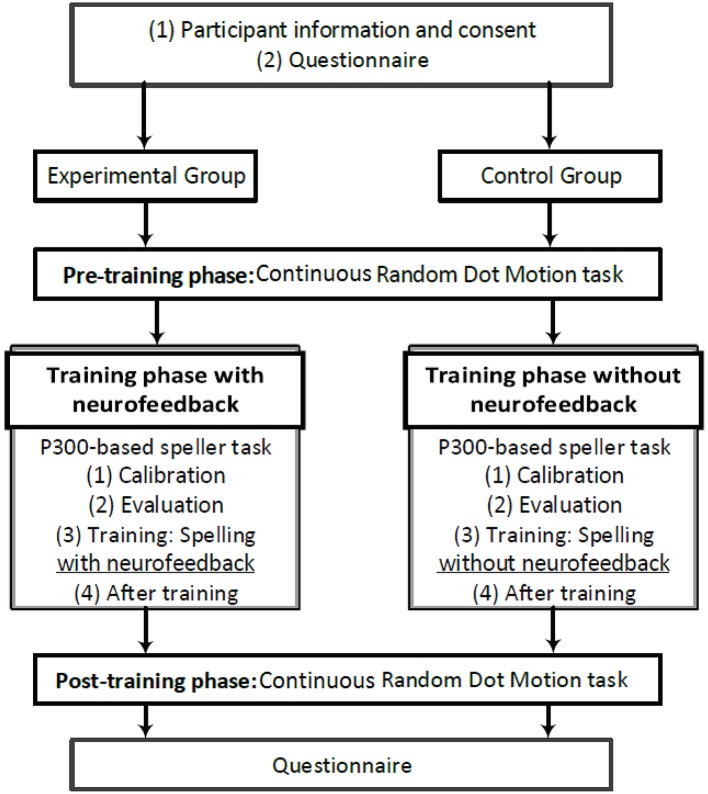
Figure 1
Figure 1
A schematic illustration of the procedure in the present study.
Figure 2
Figure 2
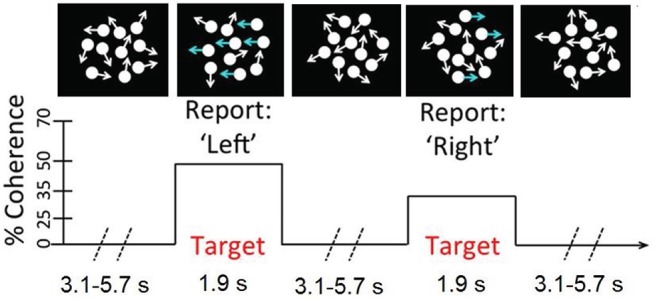
A schematic of the continuous RDM task. Participants monitored a number of centrally presented dots for step transitions from random to coherent motions.
Figure 3
Figure 3
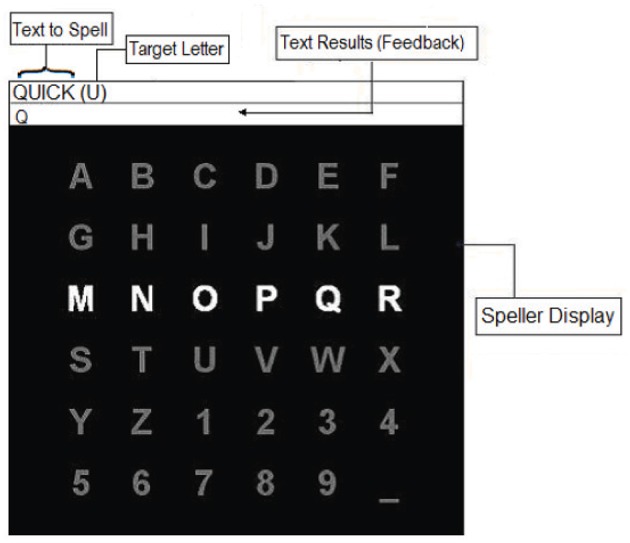
The interface of the P300-based speller task.
Figure 4
Figure 4
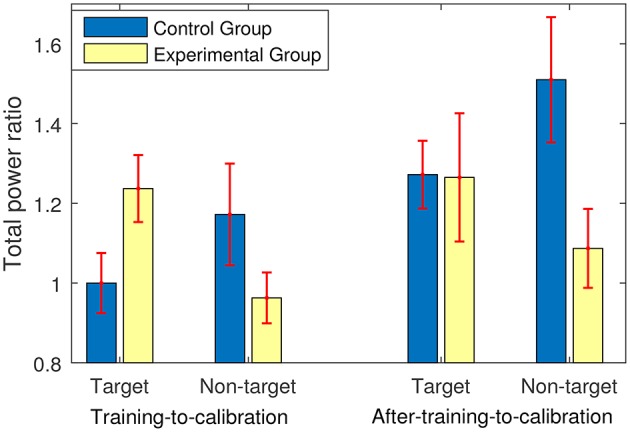
The power ratio of either training or after-training stage to calibration and evaluation stages. The power ratios were calculated for the target and the non-target trials separately.
Figure 5
Figure 5
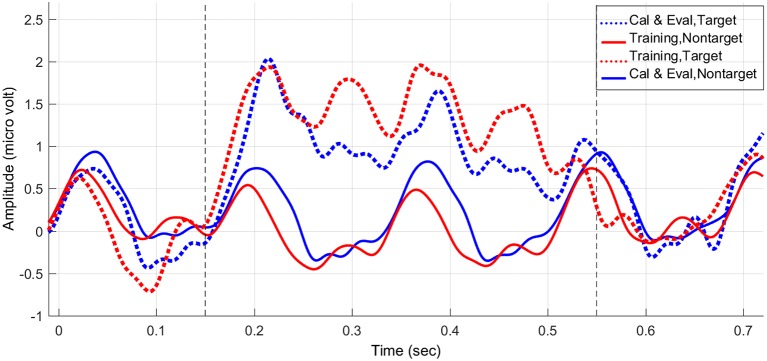
The average stimulus-locked ERPs of one subject in the experimental (feedback) group generated during the P300-based speller task, plotted at Pz.
Figure 6
Figure 6
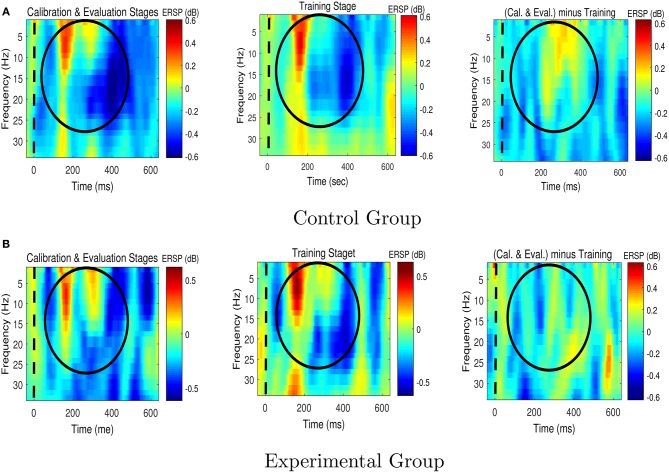
The Event-Related Spectral Perturbation (ERSP) images for the target trials for (A) the control group, and (B) the experimental group. The ERSP images were plotted at Pz. The dashed lines denote the cue time. Cal. and Eval. denote calibration and evaluation, respectively.
Figure 7
Figure 7
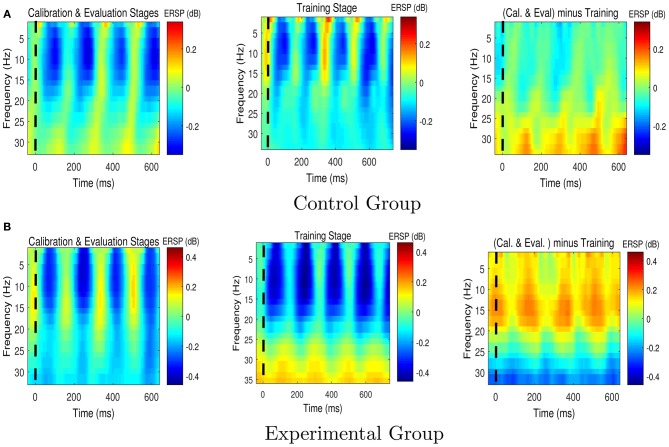
The Event-Related Spectral Perturbation (ERSP) images for the non-target trials for (A) the control group, and (B) the experimental group. The ERSP images were plotted at Pz. The dashed lines denote the cue time. Cal. and Eval. denote calibration and evaluation, respectively.
Figure 8
Figure 8
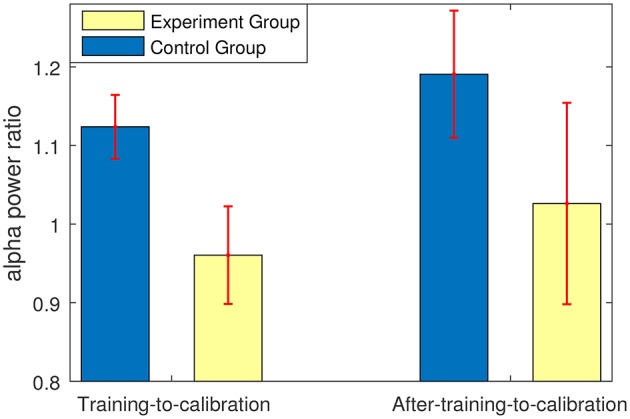
Ratios of alpha power in either training or after-training stages to that of the calibration and evaluation stages. The alpha powers were calculated only for non-target trials.

References

    1. Ang K. K., Chua K. S. G., Phua K. S., Wang C., Chin Z. Y., Kuah C. W. K., et al. (2015). A randomized controlled trial of eeg-based motor imagery brain-computer interface robotic rehabilitation for stroke. Clin. EEG Neurosci. 46, 310–320. 10.1177/1550059414522229 - DOI - PubMed
    1. Ang K. K., Guan C., Chua K. S. G., Ang T. B., Kuah C. W. K., Wang C., et al. (2011). A large clinical study on the ability of stroke patients to use EEG-Based motor imagery brain-computer interface. Clin. EEG Neurosci. 42, 253–258. 10.1177/155005941104200411 - DOI - PubMed
    1. Angelakis E., Stathopoulou S., Frymiare J. L., Green D. L., Lubar J. F., Kounios J. (2007). Eeg neurofeedback: a brief overview and an example of peak alpha frequency training for cognitive enhancement in the elderly. Clin. Neuropsychol. 21, 110–129. 10.1080/13854040600744839 - DOI - PubMed
    1. Arvaneh M., Ward T. E., Robertson I. H. (2015). Effects of feedback latency on p300-based brain-computer interface in 2015 37th Annual International Conference of the IEEE Engineering in Medicine and Biology Society (EMBC) (Milan: ), 2315–2318. 10.1109/EMBC.2015.7318856 - DOI - PubMed
    1. Ashford J. W., Coburn K. L., Rose T. L., Bayley P. J. (2011). P300 Energy Loss in Aging and Alzheimer's Disease. J. Alzheimer's Dis. 26, 229–238. 10.3233/JAD-2011-0061 - DOI - PubMed