. 2018 Dec 15;10(12):4210-4222.
eCollection 2018.

Menthol inhibits oxidative stress and inflammation in acetic acid-induced colitis in rat colonic mucosa

Affiliations

Menthol inhibits oxidative stress and inflammation in acetic acid-induced colitis in rat colonic mucosa

Salim Ma Bastaki et al. Am J Transl Res. .

Abstract

Inflammatory bowel diseases (IBD) such as ulcerative colitis and Crohn's disease are characterized by chronic inflammation of the gastrointestinal system. There is no permanent cure from IBD except constant medication or surgery to keep the disease in remission. In the present study, the effect of menthol, a major ingredient of peppermint has been investigated in acetic acid-induced colitis model in Wistar rats. Menthol (50 mg/kg/day) was orally administered for either 3 days before or 30 min after IBD induction for 7 days. The changes in body weight, macroscopic and microscopic analysis of the colon of rats of different experimental groups were observed on day 0, 2, 4 and 7. Acetic acid caused a significant reduction in mean body weight and induced macroscopic and microscopic ulceration along with a significant decline of glutathione (GSH) levels, an antioxidant substrate concomitant to increased malondialdehyde (MDA) level, a marker of lipid peroxidation and raised myeloperoxidase (MPO) activity, itself a marker for neutrophil activation. Acetic acid also induced the release of pro-inflammatory cytokines. Furthermore, acetic acid also raised the levels of calprotectin, a protein released by neutrophils under inflammatory conditions of the gastrointestinal tract. Treatment with menthol significantly improved IBD-induced reduction in mean body weight and mean macroscopic and microscopic ulcer scores and reduced activities of MPO and levels of MDA with concomitant increase in GSH level. Additionally, menthol treatment significantly reduced the levels of pro-inflammatory cytokines such as interleukin-1, interleukin-23 and tumor necrosis factor-α with no significant change in interleukin-6 levels. The data indicate that menthol improved body weight gain, mean macroscopic and microscopic ulcer scores, attenuated lipid peroxidation, oxidative stress and inflammation in the IBD rat mucosa.

Keywords: Menthol; acetic acid; colitis; inflammation; oxidative stress; rats.


Conflict of interest statement

None.

Figures
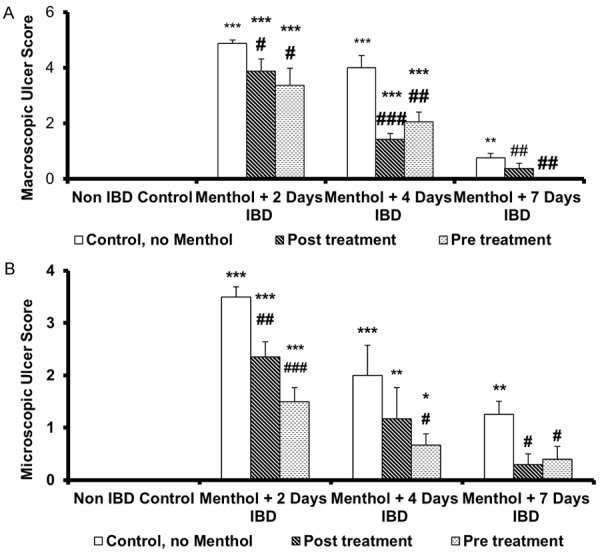
Figure 1
Figure 1
Effect of menthol on ulcer score in rat model of IBD. A. Colon macroscopic ulcer score; B. Colon microscopic ulcer score. Values are expressed as mean ± SEM; *P < 0.05, **P < 0.01, ***P < 0.001 vs. non IBD control group; #P < 0.05, ##P < 0.01, ###P < 0.001 vs. relative IBD control group.
Figure 2
Figure 2
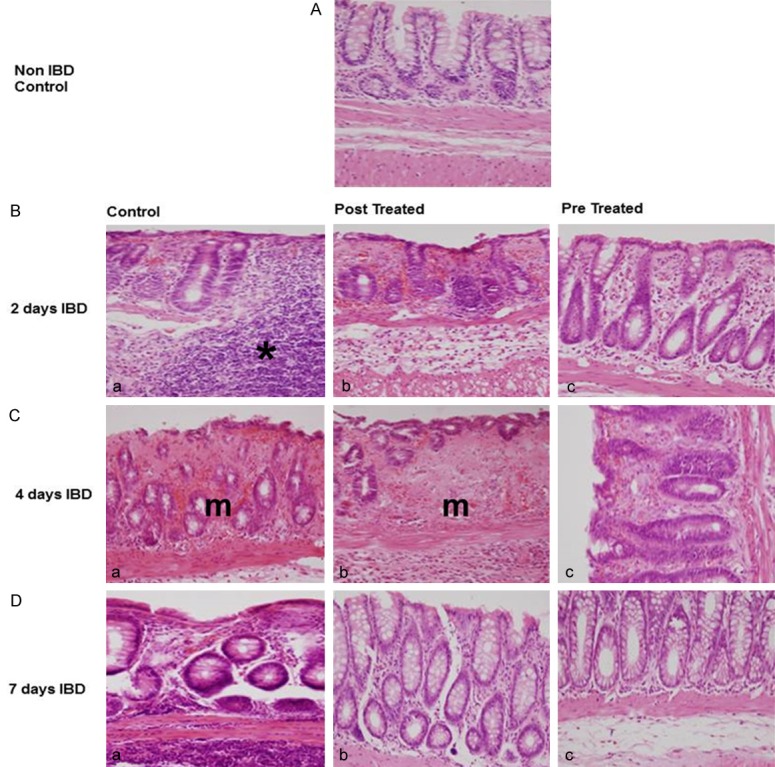
Photomicrographs representing the effects of menthol on the histopathological changes on descending colon in rat model of IBD. A: Non IBD control; B: 2 days IBD; C: 4-day IBD; D: 7-day IBD, (a) Control, no menthol, (b) Post IBD menthol treated (c) Pre IBD menthol treated. Note a large degree of lymphatic infiltration in B(a). In addition, the mucosal layer of C(a) and C(b) are highly compromised. *Lymphatic infiltration. m = mucosa.
Figure 3
Figure 3
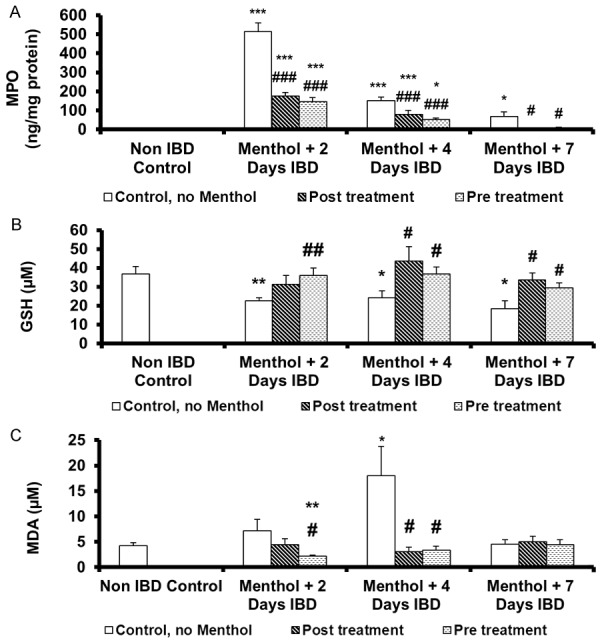
Effect of menthol on the markers of oxidative stress in colonic tissues of rat model of IBD. A. Activities of myeloperoxidase (MPO); B. Glutathione (GSH) level; C. Malondialdehyde (MDA) level. Values are expressed as mean ± SEM; *P < 0.05, **P < 0.01, ***P < 0.001 vs. non IBD control group; #P < 0.05, ##P < 0.01, ###P < 0.001 vs. relative IBD control group.
Figure 4
Figure 4
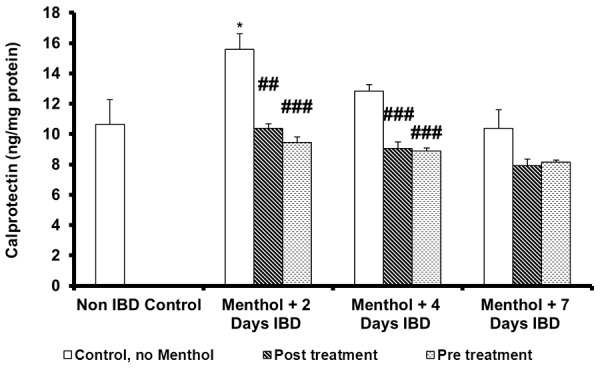
Effect of menthol on calprotectin level in colonic tissues of rat model of IBD. Values are expressed as mean ± SEM; *P < 0.05, **P < 0.01, ***P < 0.001 vs. non IBD control group; #P < 0.05, ##P < 0.01, ###P < 0.001 vs. relative IBD control group.
Figure 5
Figure 5
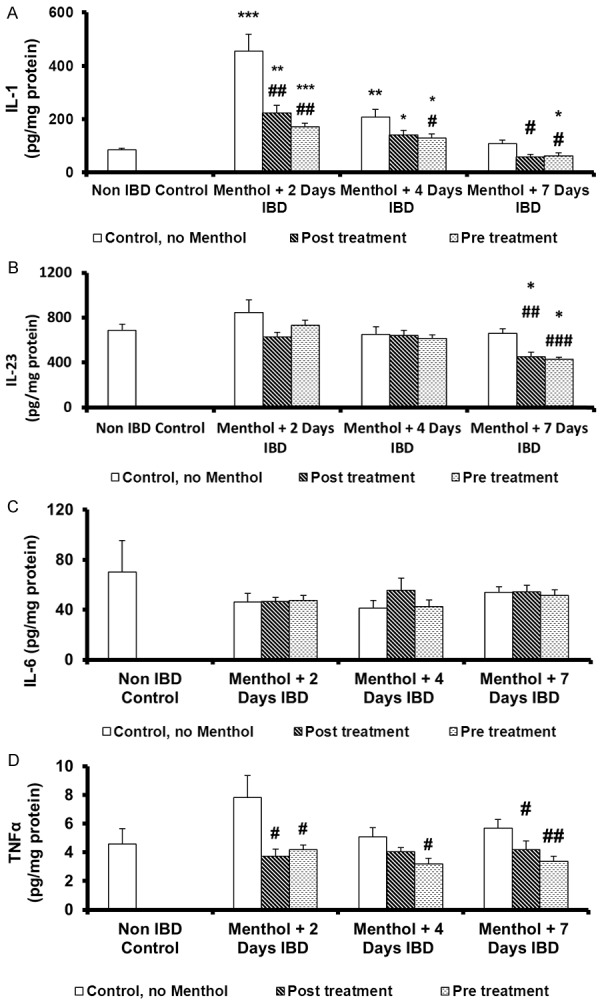
Effect of menthol on level of pro-inflammatory cytokines in colonic tissues of rat model of IBD. A. Interleukin-1 (IL-1); B. Interleukin-23 (IL-23); C. Interleukin-6 (IL-6); D. Tumor necrosis factor -α (TNFα). Values are expressed as mean ± SEM; *P < 0.05, **P < 0.01, ***P < 0.001 vs. non IBD control group; #P < 0.05, ##P < 0.01, ###P < 0.001 vs. relative IBD control group.

References

    1. Jurjus AR, Khoury NN, Reimund JM. Animal models of inflammatory bowel disease. J Pharmacol Toxicol Methods. 2004;50:81–92. - PubMed
    1. Wallace KL, Zheng LB, Kanazawa Y, Shih DQ. Immunopathology of inflammatory bowel disease. World J Gastroenterol. 2014;20:6–21. - PMC - PubMed
    1. Sales-Campos H, Basso PJ, Alves VB, Fonseca MT, Bonfá G, Nardini V, Cardoso CR. Classical and recent advances in the treatment of inflammatory bowel diseases. Braz J Med Biol Res. 2015;48:96–107. - PMC - PubMed
    1. McLean LP, Cross RK. Adverse events in IBD: to stop or continue immune suppressant and biologic treatment. Expert Rev Gastroenterol Hepatol. 2014;8:223–40. - PMC - PubMed
    1. Esters P, Dignass A. Complementary therapies in inflammatory bowel diseases. Curr Drug Targets. 2014;15:1079–1088. - PubMed

LinkOut - more resources