Dermal papillae flattening of thigh skin in Conus Cauda Syndrome
- PMID: 30662702
- PMCID: PMC6317141
- DOI: 10.4081/ejtm.2018.7914
Dermal papillae flattening of thigh skin in Conus Cauda Syndrome
Abstract
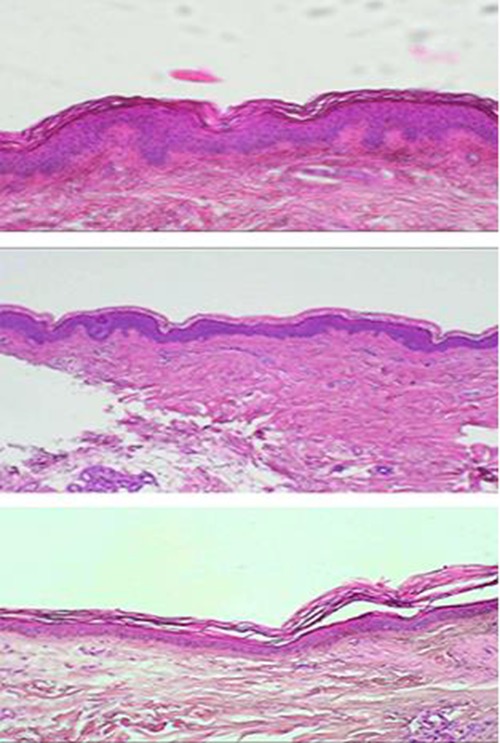
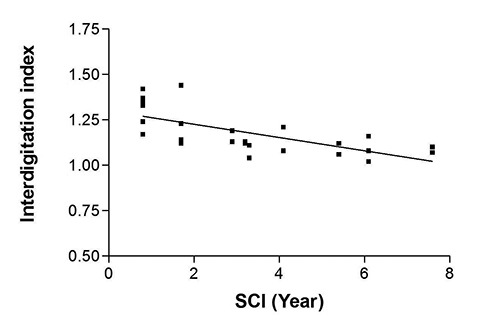
Our previous studies have shown that severely atrophic Quadriceps muscles of spinal cord injury (SCI) persons suffering with complete conus and cauda equina syndrome, and thus with permanent denervation-induced atrophy and degeneration of muscle, were almost completely rescued to normal size after two years of home based Functional Electrical Stimulation (hbFES). Since large surface electrodes were used to stimulate the denervated thigh muscles, we wanted to know if the skin was affected by this peculiar long-term treatment. Indeed, we demonstrated by two approaches that the epidermis decreases in thickness in the long term denervated persons, while it increased to almost pre-SCI values in hbFES compliant SCI persons. Here we report data of morphometry of skin biopsies from both legs of 18 SCI persons, harvested at enrolment in the Project RISE, to test if the Interdigitation Index, a simple measurement of the epidermal-dermal junction, may provide a further precise quantitative evidence of the flattening of the skin in those SCI persons. The Interdigitation Index of the 36 skin biopsies shows a higly significant linear correlation with the years of SCI (p < 0.001). Furthermore, when the 18 SCI persons are divided in two groups (1 to 3.9 versus 4.1 to 8.0 years from SCI, respectively) and the data are compared, the later Group presents a statistically significant -22% decrease (p, 0.029) of the Interdigitation Index. On the other hand counting the papille do not provide the same strong evidence. In conclusion, the Interdigitation Index is an additional sound quantitative structural biomarker of skin atrophy and flattening occurring in SCI. The result correlates with the much severe extent of atrophy of the permanently denervated thigh muscles, as determined at both macro and microscopic levels.We are confident that the Interdigitation Index will provide sound evidence that the effects of hbFES, we previously reported on skeletal muscle and epidermis thickness, will be extended to the dermal layer of the skin, suggesting a coordinated negative effects of SCI on skeletal muscle and skin, and an improvement of both tissues after hbFES. Incoming analyses will be extended to basal lamina, collagene types, elastic fibers and skin annexes in the subcutaneous layer.
Keywords: Interdigitation Index; Skin morphometry; denervated-degenerating muscle; h-bFES induced recovery; skin biopsy; spinal cord injury.
Conflict of interest statement
Conflict of Interest The authors report no conflicts of interests.
Figures
References
-
- Kern H, Hofer C, Löfler S, et al. Atrophy, ultra-structural disorders, severe atrophy and degeneration of denervated human muscle in SCI and Aging. Implications for their recovery by Functional Electrical Stimulation, updated 2017. Neurol Res 2017;39:660-6. doi: 10.1080/01616412.2017.1314906. Epub 2017 Apr 13. - PubMed
-
- Kern H, Carraro U, Adami N, et al. Home-based functional electrical stimulation rescues permanently denervated muscles in paraplegic patients with complete lower motor neuron lesion. Neurorehabil Neural Repair. 2010;24:709-721. DOI:10.1177/1545968310366129. Epub 2010 May 11. - PubMed
-
- Kern H, Carraro U, Adami N, et al. One year of home-based functional electrical stimulation (FES) in complete lower motor neuron paraplegia: recovery of tetanic contractility drives the structural improvements of denervated muscle. Neurol Res 2010;32:5-12. DOI:1 0.1189/184313209X385644 - PubMed
-
- Fiorucci R, Piscioneri A. FES for large denervated muscles: comments of patients and practical demonstrations. Eur J Transl Myol 2013;23:162–4.
LinkOut - more resources
Full Text Sources