Less than you think: Prevalence and predictors of fake news dissemination on Facebook
- PMID: 30662946
- PMCID: PMC6326755
- DOI: 10.1126/sciadv.aau4586
Less than you think: Prevalence and predictors of fake news dissemination on Facebook
Abstract
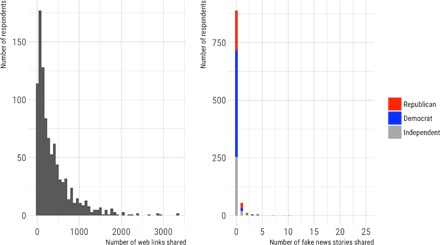
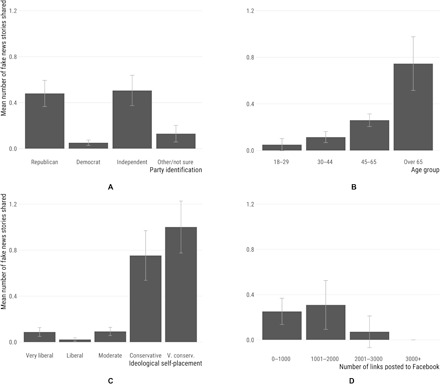
So-called "fake news" has renewed concerns about the prevalence and effects of misinformation in political campaigns. Given the potential for widespread dissemination of this material, we examine the individual-level characteristics associated with sharing false articles during the 2016 U.S. presidential campaign. To do so, we uniquely link an original survey with respondents' sharing activity as recorded in Facebook profile data. First and foremost, we find that sharing this content was a relatively rare activity. Conservatives were more likely to share articles from fake news domains, which in 2016 were largely pro-Trump in orientation, than liberals or moderates. We also find a strong age effect, which persists after controlling for partisanship and ideology: On average, users over 65 shared nearly seven times as many articles from fake news domains as the youngest age group.
Figures
References
-
- Lazer D. M. J., Baum M. A., Benkler Y., Berinsky A. J., Greenhill K. M., Menczer F., Metzger M. J., Nyhan B., Pennycook G., Rothschild D., Schudson M., Sloman S. A., Sunstein C. R., Thorson E. A., Watts D. J., Zittrain J. L., The science of fake news. Science 359, 1094–1096 (2018). - PubMed
-
- Allcott H., Gentzkow M., Social media and fake news in the 2016 election. J. Econ. Perspect. 31, 211–236 (2017).
-
- A. Guess, B. Nyhan, J. Reifler, “Selective exposure to misinformation: Evidence from the consumption of fake news during the 2016 U.S. presidential campaign” (2016).
-
- Porter E., Wood T. J., Kirby D., Sex trafficking, Russian infiltration, birth certificates, and pedophilia: A survey experiment correcting fake news. J. Exp. Polit. Sci. 5, 159–164 (2018).
Publication types
LinkOut - more resources
Full Text Sources