


Familial chronic megacolon presenting in childhood or adulthood: Seeking the presumed gene association
- PMID: 30663199
- PMCID: PMC6432647
- DOI: 10.1111/nmo.13550
Familial chronic megacolon presenting in childhood or adulthood: Seeking the presumed gene association
Abstract
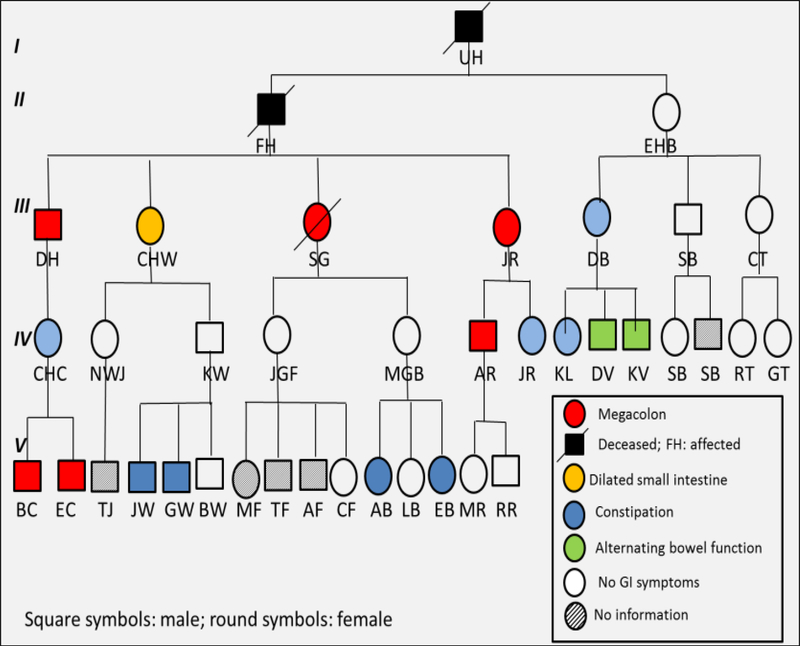
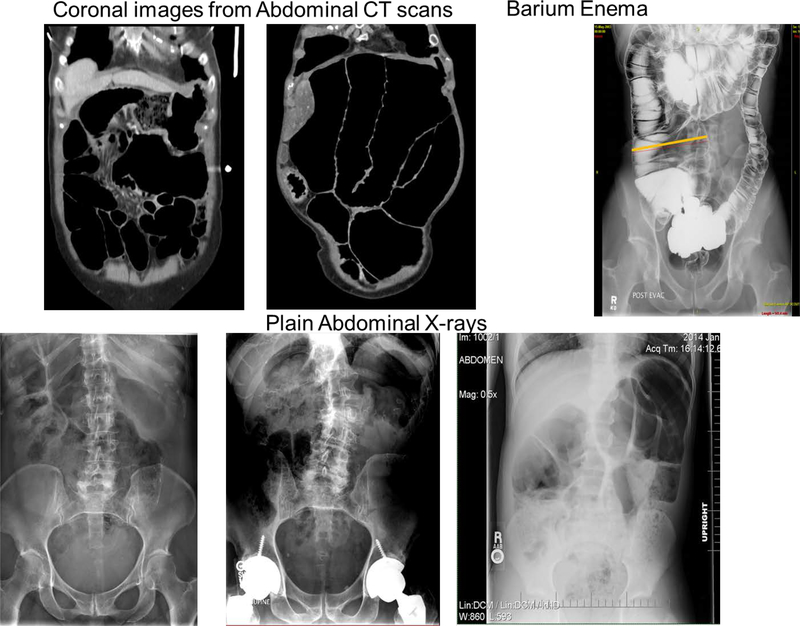
Objective: We identified a pedigree over five generations with 49 members, some of whom had chronic megacolon presenting in adolescence or adulthood. We aimed to assess the genetic cause of chronic megacolon through clinical and DNA studies.
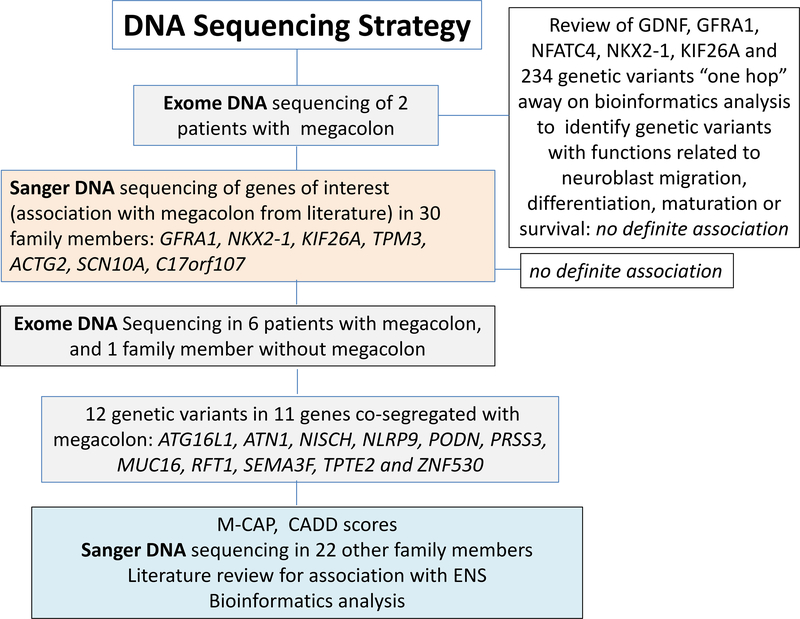
Design: After ethical approval and informed consent, family members provided answers to standard bowel disease questionnaires, radiological or surgical records, and DNA (buccal mucosal scraping). Exome DNA sequencing of colon tissue or blood DNA from seven family members with colon or duodenal dilatation, or no megacolon (n = 1) was carried out. Sanger sequencing was performed in 22 additional family members to further evaluate candidate variants. The study focused on genes of potential relevance to enteric nerve (ENS) maturation and Hirschsprung's disease or megacolon, based on the literature (GFRA1, NKX2-1, KIF26A, TPM3, ACTG2, SCN10A, and C17orf107 [CHRNE]) and other genetic variants that co-segregated with megacolon in the six affected family members.
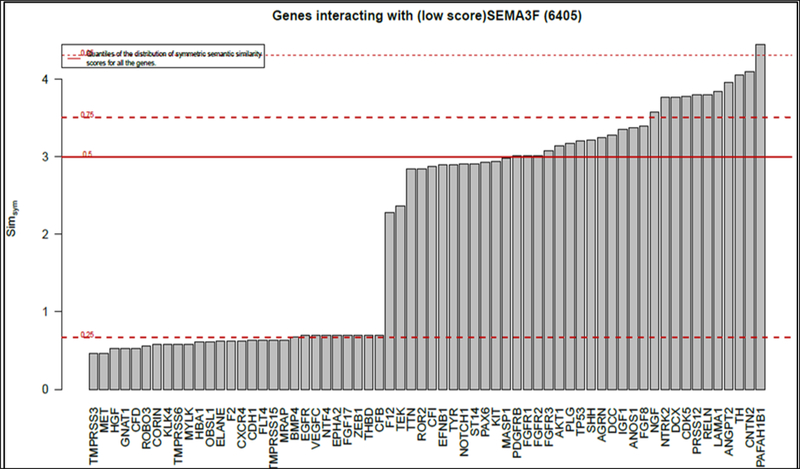
Results: Information was available in all except five members alive at time of study; among 30 members who provided DNA, six had definite megacolon, one megaduodenum, seven significant constipation without bowel dilatation, and 16 normal bowel function by questionnaire. Among genes studied, SEMA3F (g.3:50225360A>G; c1873A>G) was found in 6/6 family members with megacolon. The SEMA3F gene variant was assessed as potentially pathogenic, based on M-CAP in silico prediction. SEMA3F function is associated with genes (KIT and PDGFRB) that impact intestinal pacemaker function.
Conclusion: Familial chronic megacolon appears to be associated with SEMA3F, which is associated with genes impacting enteric nerve or pacemaker function.
Keywords: SEMA3F; congenital; pseudo-obstruction.
© 2019 John Wiley & Sons Ltd.
Conflict of interest statement
Figures
References
-
- Heuckeroth RO. Hirschsprung disease - integrating basic science and clinical medicine to improve outcomes. Nat Rev Gastroenterol Hepatol 2018;15:152–67. - PubMed
-
- Moore SW. Chromosomal and related Mendelian syndromes associated with Hirschsprung’s disease. Pediatr Surg Int 2012;28:1045–58. - PubMed
-
- Gershon MD. Developmental determinants of the independence and complexity of the enteric nervous system. Trends Neurosci 2010;33:446–56. - PubMed
Publication types
MeSH terms
Substances
Grants and funding
LinkOut - more resources
Full Text Sources
Miscellaneous
