


Hypertension self-care practice and associated factors among patients in public health facilities of Dessie town, Ethiopia
- PMID: 30665405
- PMCID: PMC6341627
- DOI: 10.1186/s12913-019-3880-0
Hypertension self-care practice and associated factors among patients in public health facilities of Dessie town, Ethiopia
Abstract
Background: Hypertension self-care practice is essential for blood pressure control and reduction of hypertension complications. Nevertheless, we know little concerning hypertension self-care practice in Ethiopia. The purpose of this study was to assess hypertension self-care practice and associated factors among patients in public health facilities in Dessie town, Ethiopia.
Methods: In this cross-sectional study, 309 hypertensive patients (mean age 58.8 years, 53.4% women) completed the interviewer-administered questionnaire in Amharic language. Descriptive and logistic regression analyses were conducted using SPSS version 22.
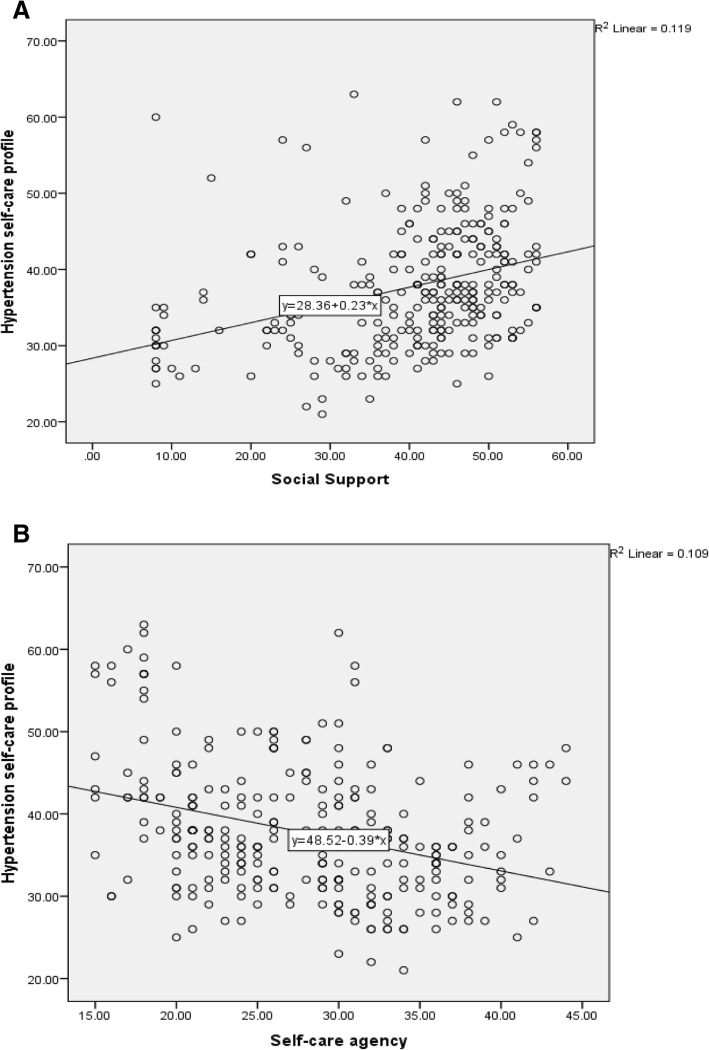
Result: The mean score for hypertension self-care was 37.7 ± 8.2 and 51% scored below the mean. Divorced participants (AOR = 0.115, 95% CI = 0.026, 0.508, p-value < 0.01) and those who lack source of information (AOR = 0.084, 95% CI = 0.022, 0.322, p-value < 0.01) were less likely to have good self-care practice. But, participants who had convenient place for exercise (AOR = 2.968, 95% CI = 1.826, 4.825, p-value < 0.01), who had good social support (AOR = 2.204, 95% CI = 1.272, 3.821, p-value < 0.01), who had traditional clergy-based teaching (AOR = 2.209, 95% CI = 1.064, 4.584, p-value < 0.05), and who had good self-care agency (AOR = 1.222, 2.956, p-value < 0.05) were more likely to have good self-care practice.
Conclusion: Most of the study participants reported poor self-care practices. Factors associated with hypertension self-care practice are marital status, education, source of self-care information, place for exercise, social support, and self-care agency. Targeted interventions are needed to improve hypertension self-care practice.
Keywords: Ethiopia; Hypertension; Self-care agency; Self-care practice; Social support.
Conflict of interest statement
Ethics approval and consent to participate
Ethical approval for this study was obtained from the Institutional Review Board (IRB) of Addis Ababa University, College of Health Sciences. Permission to conduct the research was obtained from the authorities in the study settings and informed consents were secured from each participant. Confidentiality of the participant was maintained by not including names or any personal identifier during data collection, analysis, and reporting. Participants right to refuse participation, not to answer any question they don’t want to, or withdraw participation after enrolling was fully respected.
Consent for publication
Not applicable.
Competing interests
The authors declare that they have no competing interests.
Publisher’s Note
Springer Nature remains neutral with regard to jurisdictional claims in published maps and institutional affiliations.
Figures
References
-
- Lim SS, Vos T, Flaxman AD, Daniel G, Shibuya K, Adair-Rohani H, AlMazroa MA, Amann M, Anderson HR, Andrews KG, et al. A comparative risk assessment of burden of disease and injury attributable to 67 risk factors and risk factor clusters in 21 regions, 1990–2010: a systematic analysis for the Global Burden of Disease Study 2010. Lancet. 2012;380:2224–2260. doi: 10.1016/S0140-6736(12)61766-8. - DOI - PMC - PubMed
MeSH terms
Grants and funding
LinkOut - more resources
Full Text Sources
Medical
