. 2019 Jan 21;14(1):19.
doi: 10.1186/s13023-019-0994-8.

Tracking sex-dependent differences in a mouse model of CLN6-Batten disease

Affiliations

Tracking sex-dependent differences in a mouse model of CLN6-Batten disease

McKayla J Poppens et al. Orphanet J Rare Dis. .

Abstract

Background: CLN6-Batten disease is a rare neurodevelopmental disorder characterized pathologically by the accumulation of lysosomal storage material, glial activation and neurodegeneration, and phenotypically by loss of vision, motor coordination, and cognitive ability, with premature death occurring in the second decade of life. In this study, we investigate whether sex differences in a mouse model of CLN6-Batten disease impact disease onset and progression.

Results: A number of noteworthy differences were observed including elevated accumulation of mitochondrial ATP synthase subunit C in the thalamus and cortex of female Cln6 mutant mice at 2 months of age. Moreover, female mutant mice showed more severe behavioral deficits. Beginning at 9 months of age, female mice demonstrated learning and memory deficits and suffered a more severe decline in motor coordination. Further, compared to their male counterparts, female animals succumbed to the disease at a slightly younger age, indicating an accelerated disease progression. Conversely, males showed a marked increase in microglial activation at 6 months of age in the cortex relative to females.

Conclusions: Thus, as female Cln6 mutant mice exhibit cellular and behavioral deficits that precede similar pathologies in male mutant mice, our findings suggest the need for consideration of sex-based differences in CLN6 disease progression during development of preclinical and clinical studies.

Keywords: Lysosomal storage disorder; Neurodegenerative disease; Neuronal ceroid lipofuscinoses; Pediatric disease; Rare disease.


Conflict of interest statement

Ethics approval and consent to participate

Animal protocols were approved by the Institutional Animal Care and Use Committees of each participating institute (NIH/OLAW Assurance Number: A4568–01) with all procedures conducted in strict accordance with National Institutes of Health guidelines and Institutional Animal Care and Use Committee Guidelines.

Consent for publication

No applicable.

Competing interests

The authors declare that they have no competing interests.

Publisher’s Note

Springer Nature remains neutral with regard to jurisdictional claims in published maps and institutional affiliations.

Figures

Fig. 1
Fig. 1
Sex differences evident in Cln6nclf accumulation of autofluorescent storage material (ASM) and mitochondrial ATP synthase subunit C in brain. a Male Cln6nclf mice show enhanced ASM in the somatosensory cortex at two months of age, while female Cln6nclf mice overtake their male counterparts at six months of age in the VPM/VPL and somatosensory cortex. b Female mice show enhanced subunit C expression at two months of age, that corrects as the animals age to six month. Images represent the six month time point only. N = 3–5, ***p < 0.001, ****p < 0.0001
Fig. 2
Fig. 2
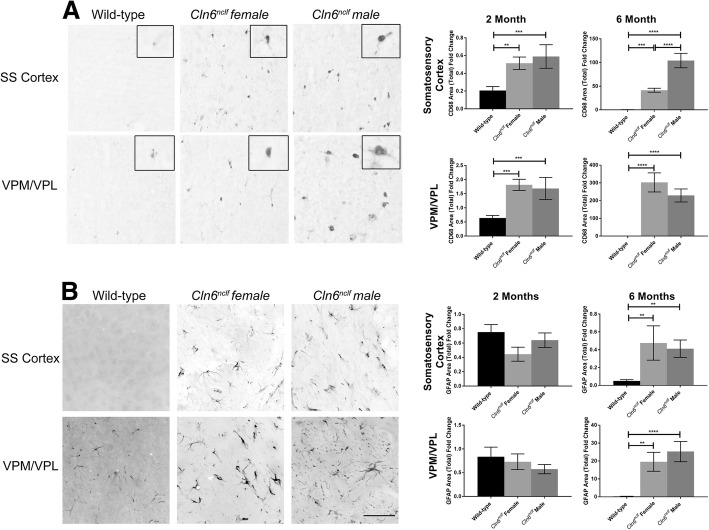
Sex differences evident in Cln6nclf glial activation in brain. a Male Cln6nclf mice show enhanced microglial expression (CD68) in the somatosensory cortex at six months of age. b Genotypic differences in astrocyte activation are not present until six months of age, and are similar between the sexes. Images represent the six month time point only. N = 4–6, *p < 0.05, ***p < 0.001, ****p < 0.0001
Fig. 3
Fig. 3
Sex differences evident in Cln6nclf behavior and survival outcomes. a Female Cln6nclf mice perform more poorly at the rotarod motor task beginning at six months of age. Male Cln6nclf mice do not begin to perform poorly until 10 months of age. b Female Cln6nclf mice perform more poorly at the Morris water maze task beginning at nine months of age. Male Cln6nclf mice do not begin to perform poorly until 11 months of age. c Swim speed shown as a control for the Morris water maze task. d Female Cln6nclf mice perish one month earlier than male Cln6nclf mice. Asterisks (*) show comparisons between wild-type and Cln6nclf animals, with light blue for female comparisons and dark blue for male comparisons. Hash signs (#) show comparisons between male and female Cln6nclf animals. N = 3–10, *p < 0.05, **p < 0.01, ***p < 0.001, ****p < 0.0001

References

    1. Cooper JD. Progress towards understanding the neurobiology of batten disease or neuronal ceroid lipofuscinosis. Curr Opin Neurol. 2003;16(2):121–128. doi: 10.1097/00019052-200304000-00001. - DOI - PubMed
    1. Mole SE, Williams RE, Goebel HH. Correlations between genotype, ultrastructural morphology and clinical phenotype in the neuronal ceroid lipofuscinoses. Neurogenetics. 2005;6(3):107–126. doi: 10.1007/s10048-005-0218-3. - DOI - PubMed
    1. Goebel HH, Wisniewski KE. Current state of clinical and morphological features in human NCL. Brain Pathol. 2004;14(1):61–69. doi: 10.1111/j.1750-3639.2004.tb00499.x. - DOI - PMC - PubMed
    1. Palmer DN, Barry LA, Tyynela J, Cooper JD. NCL disease mechanisms. Biochim Biophys Acta. 2013;1832(11):1882–1893. doi: 10.1016/j.bbadis.2013.05.014. - DOI - PubMed
    1. Haltia M. The neuronal ceroid-lipofuscinoses. J Neuropathol Exp Neurol. 2003;62(1):1–13. doi: 10.1093/jnen/62.1.1. - DOI - PubMed

Publication types

MeSH terms

Supplementary concepts

LinkOut - more resources