Review
. 2019 Jan 21;14(1):5.
doi: 10.1186/s13024-019-0306-8.

Dementia with Lewy bodies: an update and outlook

Affiliations
Review

Dementia with Lewy bodies: an update and outlook

Tiago Fleming Outeiro et al. Mol Neurodegener. .

Abstract

Dementia with Lewy bodies (DLB) is an age-associated neurodegenerative disorder producing progressive cognitive decline that interferes with normal life and daily activities. Neuropathologically, DLB is characterised by the accumulation of aggregated α-synuclein protein in Lewy bodies and Lewy neurites, similar to Parkinson's disease (PD). Extrapyramidal motor features characteristic of PD, are common in DLB patients, but are not essential for the clinical diagnosis of DLB. Since many PD patients develop dementia as disease progresses, there has been controversy about the separation of DLB from PD dementia (PDD) and consensus reports have put forward guidelines to assist clinicians in the identification and management of both syndromes. Here, we present basic concepts and definitions, based on our current understanding, that should guide the community to address open questions that will, hopefully, lead us towards improved diagnosis and novel therapeutic strategies for DLB and other synucleinopathies.

Keywords: Alpha-synuclein; Alzheimer’s disease; Biomarkers; Dementia; Dementia with Lewy bodies.


Conflict of interest statement

Ethics approval and consent to participate

This is a review article. All ethical approvals have been obtained as well as consent to participate.

Consent for publication

Not applicable.

Competing interests

The authors declare that they have no competing interests.

Publisher’s Note

Springer Nature remains neutral with regard to jurisdictional claims in published maps and institutional affiliations.

Figures
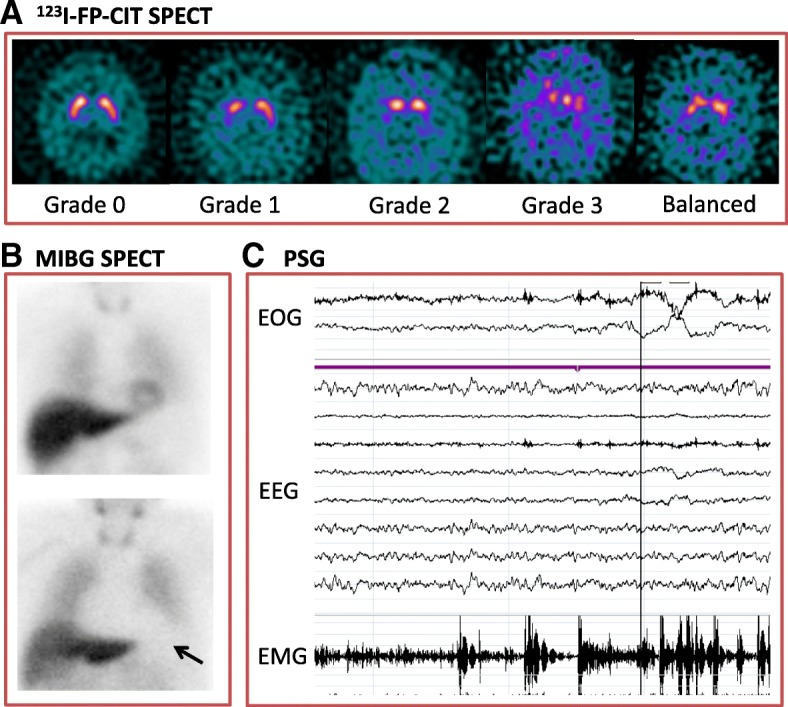
Fig. 1
Fig. 1
Indicative biomarkers for dementia with Lewy bodies. A. N-ωfluoropropyl-2β-carbomethoxy- 3β-(4-iodophenyl) nortropane (123I-FP-CIT SPECT) single photon emission tomography (SPECT). Axial images from FP-CIT SPECT at the level of the striatum. Grade 0 – normal uptake in left and right striatum. Grade 1 – unilateral decreased uptake in putamen [42]. Grade 2: bilateral uptake in putamen. Grade 3: virtually absent uptake bilaterally in the caudate and putamen. Balanced bilateral loss in the caudate and putamen is often seen in DLB, which does not fit easily into any Benamer scale category. B. Cardiac Meta-iodobenzylguanidine (MIBG SPECT) Imaging. The top image is normal, with a clear cardiac outline visible (arrow, HMR=3.14). The bottom image is abnormal with no visible cardiac outline (HMR=1.03). C. Polysomnography (PSG) recording demonstrating episodes of REM sleep without atonia on electro-oculogram (EOG) measuring eye movements, electroencephalogram (EEG) and electromyogram (EMG) measuring chin movement. With thanks to Dr Sean Colloby (a), Ms Gemma Roberts (b) and Dr Kirstie Anderson (c)
Fig. 2
Fig. 2
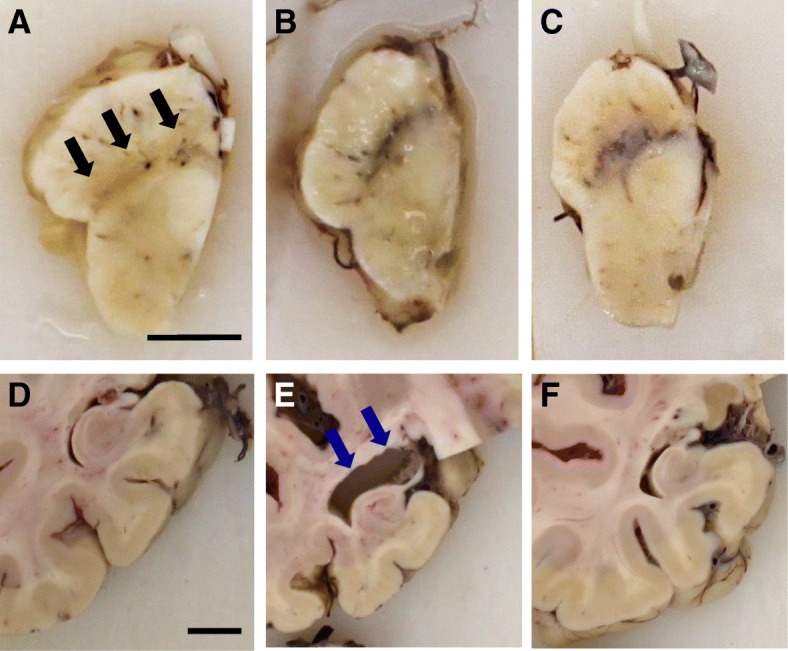
Macroscopic features of DLB. Dopaminergic cell loss is observed in the substantia nigra of a DLB patient (black arrows) (a) compared to AD (b) and control (c). In the same patients, atrophy of the medial temporal lobe is evident in AD, blue arrows (e) whilst it is relatively spared in DLB (d), and controls (f). Both scale bars represent 1cm
Fig. 3
Fig. 3
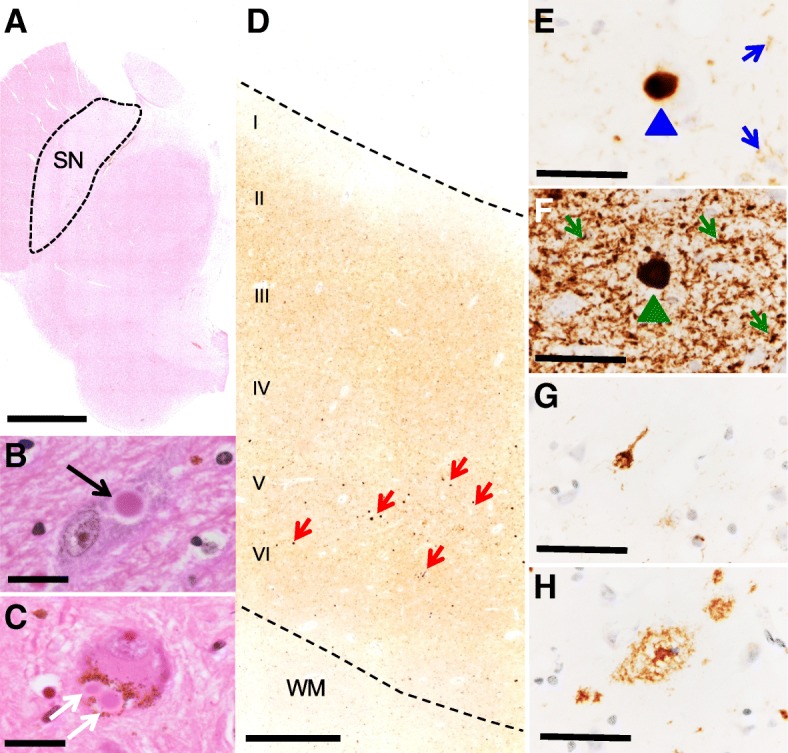
Histopathological features of DLB. Midbrain section at the level of the superior colliculus stained with H&E where dopaminergic neurons in the substantia nigra are vulnerable in DLB patients (a). Brainstem LBs are classically detected using H&E (b – black arrow) and frequently in the pigmented neurons of the SN (c – white arrows). Cortical LB pathology (e.g. cingulate cortex) affects all layers of the neocortex, most notably layers V and VI (d – red arrows). Cortical LBs and LNs can be visualised by α-syn immunohistochemistry (e - LB blue arrow head, LN blue arrow). α-syn phosphorylated at serine 129 detects a greater abundance of LB pathology compared to staining with phosphorylation independent antibodies (f - green arrows illustrate LBs, LNs, and Lewy dots). Alzheimer’s disease pathology is also a frequent finding in post-mortem tissue from DLB patients including hyperphosphorylated tau tangles (g) and Aβ plaques (h). Of note photomicrographs E-H were taken from sequential sections of the cingulate cortex of the same DLB patient. Abbreviations: SN, substantia nigra; WM, white matter; LB, Lewy body; LN, Lewy neurite; α-syn, α-synuclein. Scale bar represents 0.5cm in A, 20μm in B and C, 500 μm D, and 50μm in E-H
Fig. 4
Fig. 4
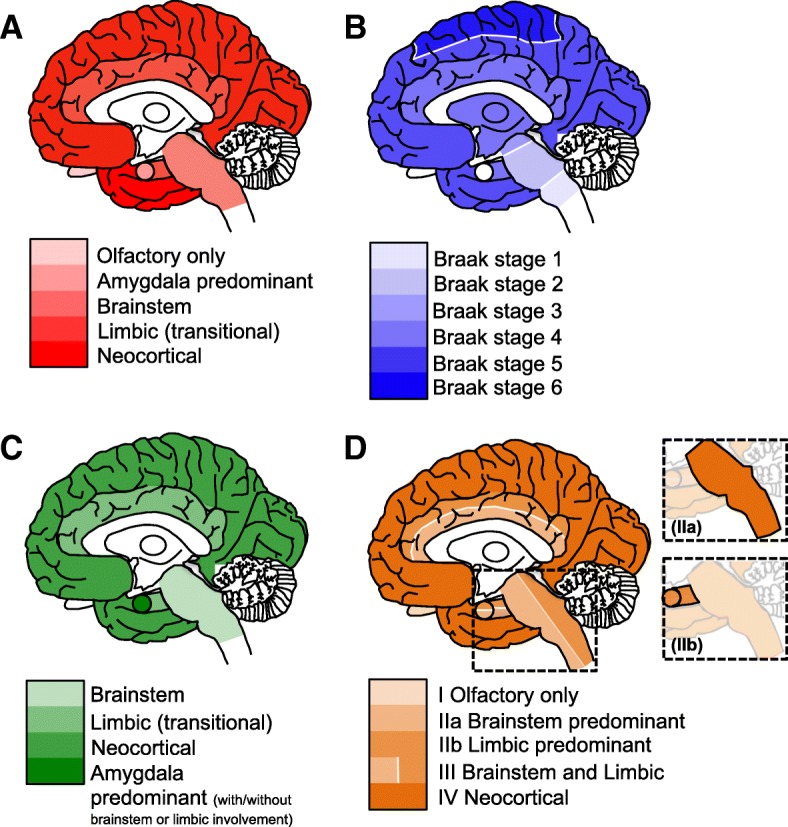
Schematic diagrams illustrating the neuropathological staging systems for LBD. The Newcastle-McKeith criteria distinguishes between brainstem predominant (regions affected including IX/X motor nucleus, locus coeruleus, and substantia nigra), limbic (transitional, regions include amygdala, transentorhinal cortex, and cingulate cortex), and diffuse neocortical (frontal, temporal, parietal, lobes are affected). N.B. the most recent consensus included the addition of olfactory only, and amygdala predominant stages [11] (a). Braak staging of α-syn deposition: Braak stage 1, IX/X motor nucleus of the medulla oblongata, Braak stage 2, addition of lesions to the locus coeruleus, Braak stage 3, α-syn progresses to the substantia nigra of the midbrain, Braak stage 4, α-syn lesions now detected in the transentorhinal region and CA2 of the hippocampus, Braak stage 5, higher association of the neocortex are affected, and Braak stage 6, α-syn is visible in the premotor and motor regions [139] (b). Leverenz and colleagues modified the original Newcastle-McKeith criteria to include cases that lack α-syn pathology in any other regions with the exception of the amygdala, known as amygdala predominant LB disease [140] (c). Beach and colleagues proposed a unified staging system to include cases that have α-syn confined to the olfactory bulb or bypass the brainstem to the limbic predominant pathway [41] (d)

References

    1. Van Den Eeden SK, Tanner CM, Bernstein AL, Fross RD, Leimpeter A, Bloch DA, et al. Incidence of Parkinson's disease: variation by age, gender, and race/ethnicity. American journal of epidemiology. 2003;157(11):1015–1022. doi: 10.1093/aje/kwg068. - DOI - PubMed
    1. Bostrom F, Jonsson L, Minthon L, Londos E. Patients with Lewy body dementia use more resources than those with Alzheimer's disease. International journal of geriatric psychiatry. 2007;22(8):713–719. doi: 10.1002/gps.1738. - DOI - PubMed
    1. Spillantini MG, Schmidt ML, Lee VM, Trojanowski JQ, Jakes R, Goedert M. Alpha-synuclein in Lewy bodies. Nature. 1997;388(6645):839–840. doi: 10.1038/42166. - DOI - PubMed
    1. Jellinger KA. Neuropathological spectrum of synucleinopathies. Movement disorders : official journal of the Movement Disorder Society. 2003;18(Suppl 6):S2–12. doi: 10.1002/mds.10557. - DOI - PubMed
    1. Polymeropoulos MH, Lavedan C, Leroy E, Ide SE, Dehejia A, Dutra A, et al. Mutation in the alpha-synuclein gene identified in families with Parkinson's disease. Science. 1997;276(5321):2045–2047. doi: 10.1126/science.276.5321.2045. - DOI - PubMed

Publication types