


Frailty Screening Using the Electronic Health Record Within a Medicare Accountable Care Organization
- PMID: 30668637
- PMCID: PMC6777083
- DOI: 10.1093/gerona/glz017
Frailty Screening Using the Electronic Health Record Within a Medicare Accountable Care Organization
Abstract
Background: The accumulation of deficits model for frailty has been used to develop an electronic health record (EHR) frailty index (eFI) that has been incorporated into British guidelines for frailty management. However, there have been limited applications of EHR-based approaches in the United States.
Methods: We constructed an adapted eFI for patients in our Medicare Accountable Care Organization (ACO, N = 12,798) using encounter, diagnosis code, laboratory, medication, and Medicare Annual Wellness Visit (AWV) data from the EHR. We examined the association of the eFI with mortality, health care utilization, and injurious falls.
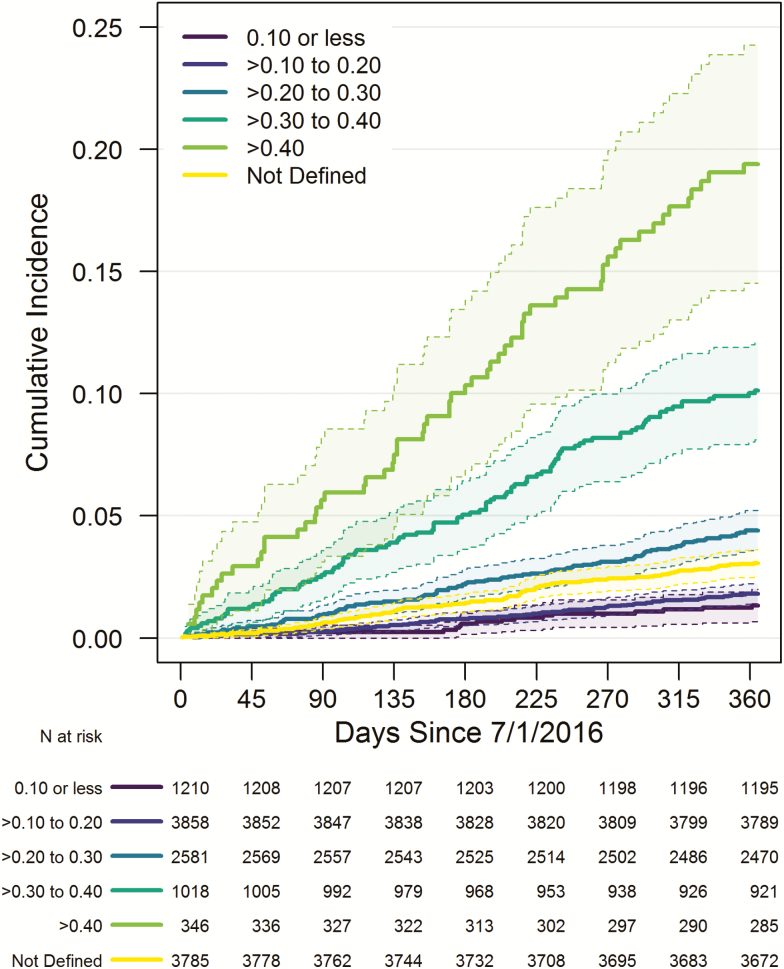
Results: The overall cohort was 55.7% female, 85.7% white, with a mean age of 74.9 (SD = 7.3) years. In the prior 2 years, 32.1% had AWV data. The eFI could be calculated for 9,013 (70.4%) ACO patients. Of these, 46.5% were classified as prefrail (0.10 < eFI ≤ 0.21) and 40.1% frail (eFI > 0.21). Accounting for age, comorbidity, and prior health care utilization, the eFI independently predicted all-cause mortality, inpatient hospitalizations, emergency department visits, and injurious falls (all p < .001). Having at least one functional deficit captured from the AWV was independently associated with an increased risk of hospitalizations and injurious falls, controlling for other components of the eFI.
Conclusions: Construction of an eFI from the EHR, within the context of a managed care population, is feasible and can help to identify vulnerable older adults. Future work is needed to integrate the eFI with claims-based approaches and test whether it can be used to effectively target interventions tailored to the health needs of frail patients.
Keywords: Falls; Frailty; Health Services; Multimorbidities.
© The Author(s) 2019. Published by Oxford University Press on behalf of The Gerontological Society of America. All rights reserved. For permissions, please e-mail: journals.permissions@oup.com.
Figures
References
-
- Fried LP, Tangen CM, Walston J, et al. Frailty in older adults: evidence for a phenotype. J Gerontol A Biol Sci Med Sci. 2001;56(3):M146–M156. doi:10.1093/gerona/56.3.M146 - PubMed
-
- Rockwood K, Mitnitski A. Frailty in relation to the accumulation of deficits. J Gerontol A Biol Sci Med Sci. 2007;62(7):722–727. doi:10.1093/gerona/62.7.722 - PubMed
Publication types
MeSH terms
Grants and funding
LinkOut - more resources
Full Text Sources
Medical
