Review
. 2019 Jan 18;19(2):392.
doi: 10.3390/s19020392.

Non-Covalent Functionalization of Carbon Nanotubes for Electrochemical Biosensor Development

Affiliations
Review

Non-Covalent Functionalization of Carbon Nanotubes for Electrochemical Biosensor Development

Yan Zhou et al. Sensors (Basel). .

Abstract

Carbon nanotubes (CNTs) have been widely studied and used for the construction of electrochemical biosensors owing to their small size, cylindrical shape, large surface-to-volume ratio, high conductivity and good biocompatibility. In electrochemical biosensors, CNTs serve a dual purpose: they act as immobilization support for biomolecules as well as provide the necessary electrical conductivity for electrochemical transduction. The ability of a recognition molecule to detect the analyte is highly dependent on the type of immobilization used for the attachment of the biomolecule to the CNT surface, a process also known as biofunctionalization. A variety of biofunctionalization methods have been studied and reported including physical adsorption, covalent cross-linking, polymer encapsulation etc. Each method carries its own advantages and limitations. In this review we provide a comprehensive review of non-covalent functionalization of carbon nanotubes with a variety of biomolecules for the development of electrochemical biosensors. This method of immobilization is increasingly being used in bioelectrode development using enzymes for biosensor and biofuel cell applications.

Keywords: aromatic molecules; bio-functionalization; carbon nanotubes; conjugated polymers; electrochemical biosensors; enzyme immobilization; non-covalent functionalization.


Conflict of interest statement

The authors declare no conflict of interest.

Figures
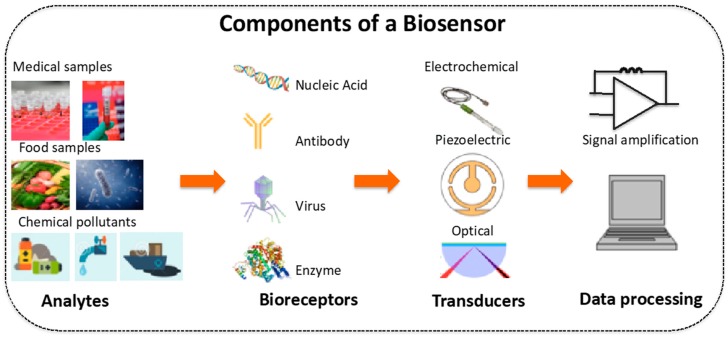
Figure 1
Figure 1
Components of a typical biosensor.
Figure 2
Figure 2
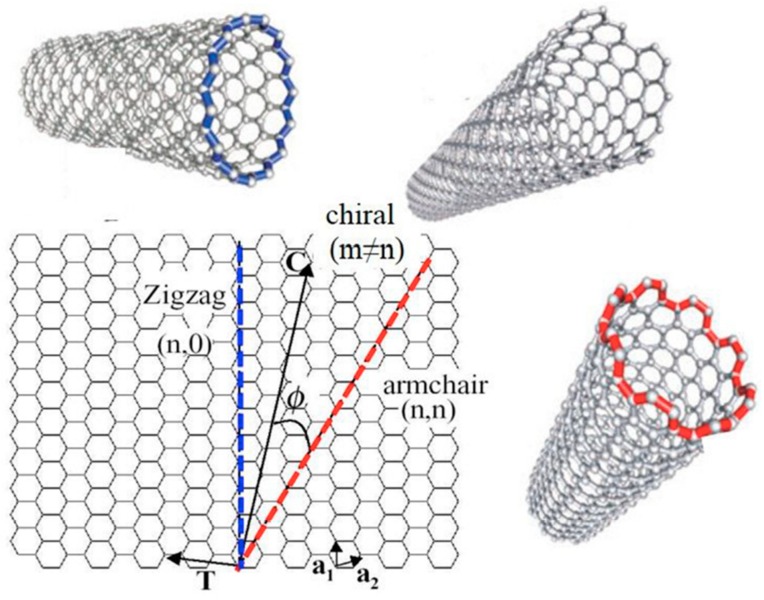
Diagram showing the various possible rolling directions of graphene that results in single wall carbon nanotubes with different chiralities [14].
Figure 3
Figure 3
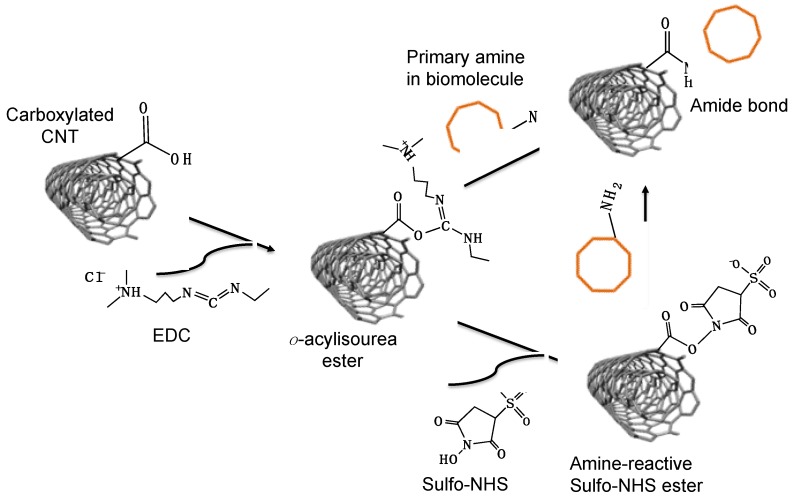
Reaction scheme for EDC and EDC-NHS based covalent crosslinking of biomolecule with carbon nanotube.
Figure 4
Figure 4
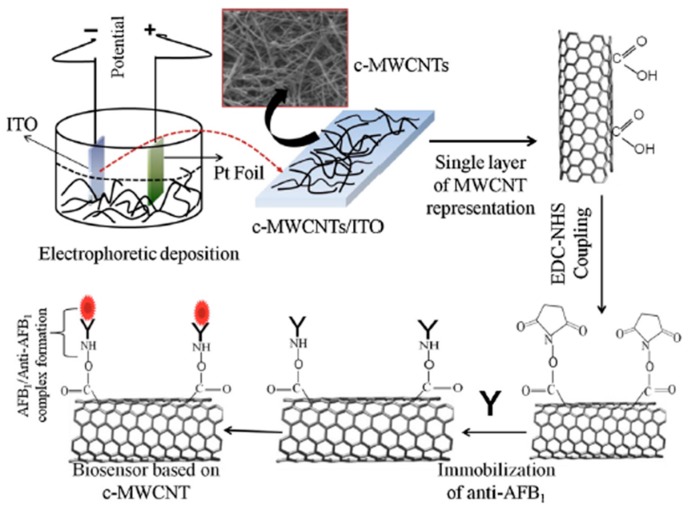
Schematic of MWCNT based biosensor for aflatoxin B1 detection [37].
Figure 5
Figure 5
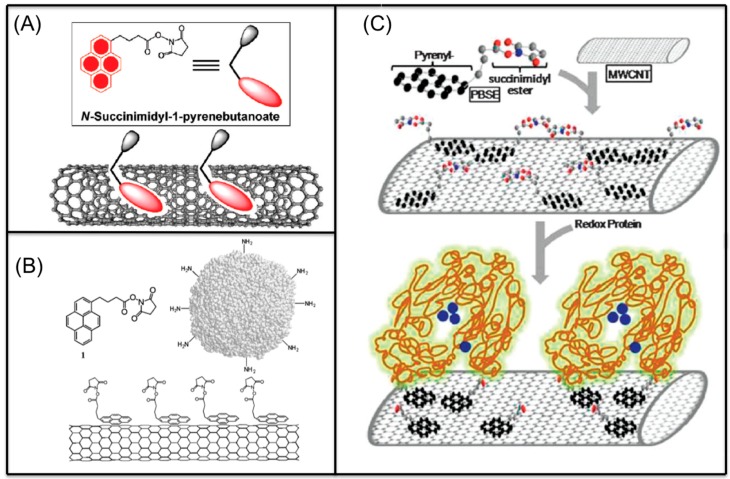
(A) SWCNT functionalized with pyrene-based molecular tether, 1-pyrenebutanoic acid, succinimidyl ester (PBSE) (adapted with permission from Zhao et al. Copyright (2018) American Chemical Society) [45]; (B) Anchored PBSE for immobilization of proteins on SWCNT (adapted with permission from Chen et al. Copyright (2018) American Chemical Society) [50]; (C) Multicopper oxidase immobilized on MWCNT using PBSE [55].
Figure 6
Figure 6
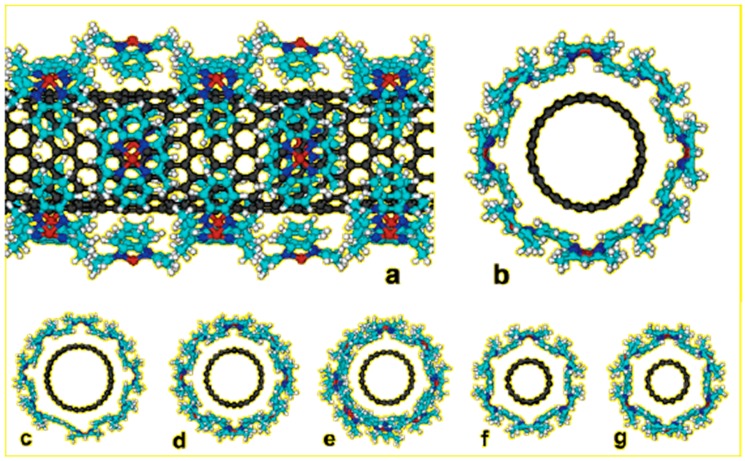
Aromatic annulene adsorbed on SWCNT walls. Exemplified for NiTMTAA and zigzag SWNTs: (a, b) (14, 0); (c) (16, 0); (d) (13, 0); (e) (12, 0); (f) (9, 0); and (g) (8, 0). Side view (a) and cross sections (bg). Atom coloring: carbon, black (nanotube) and light-blue (complex); hydrogen, white; nitrogen [60].
Figure 7
Figure 7
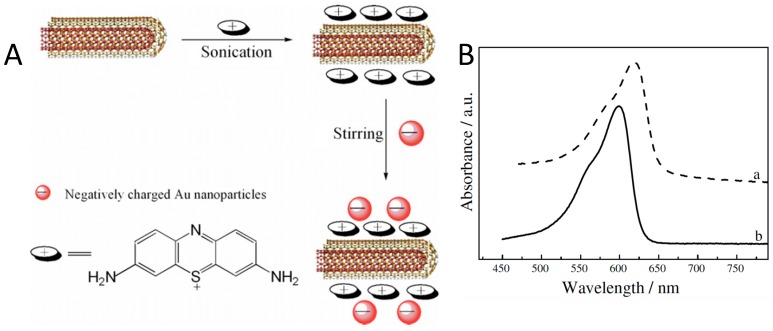
(A) Proposed mechanism of thionine-mediated adsorption of gold nanoparticles on MWCNTs; (B) UV–Vis absorption spectra of: (a) MWCNT/thionine solution and(b) aqueous thionine solution.
Figure 8
Figure 8
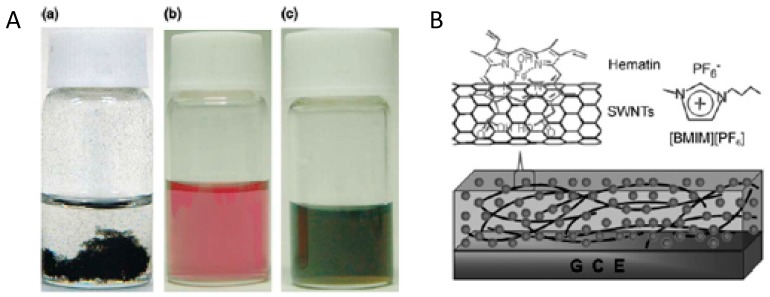
Photos of (A): (a) a DMF dispersion of p-SWCNT solely, (b) a DMF solution of ZnPP and (c) a transparent DMF solution/ dispersion of p-SWCNT–ZnPP [77]. (B): Diagram of a porphyrin/SWCNT-[BMIM][PF6]-modified glassy carbon electrode (GCE) [78].
Figure 9
Figure 9
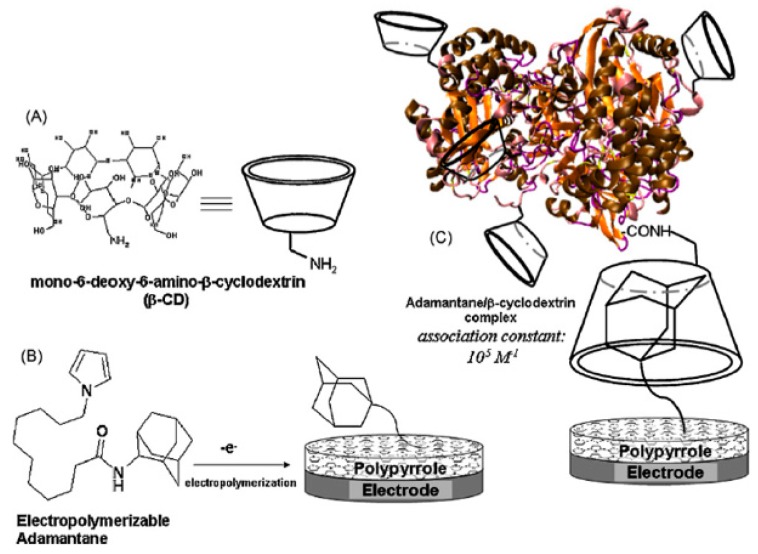
(A) Schematic of β-CD; (B) Electrogeneration of poly(adamantane-pyrrole) on the electrode surface; (C) β-CD-tagged GOx and adamantane-modified electrodes [98].
Figure 10
Figure 10
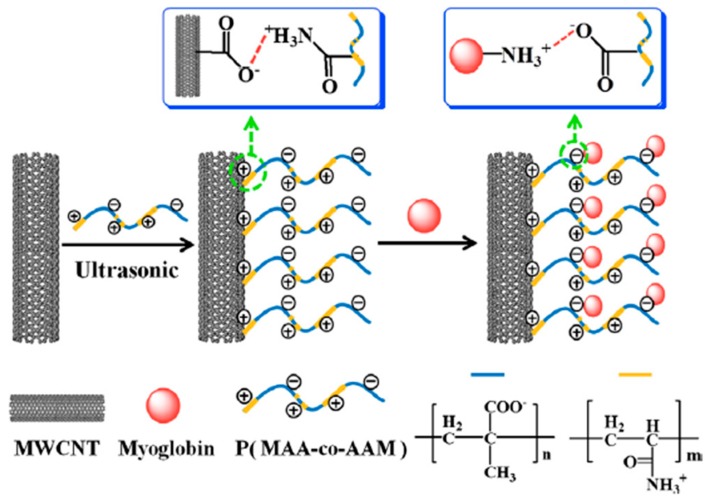
Fabrication process for the preparation of Mb-P(MAA-co-AAM)-MWCNT nanocomposites [100].
Figure 11
Figure 11
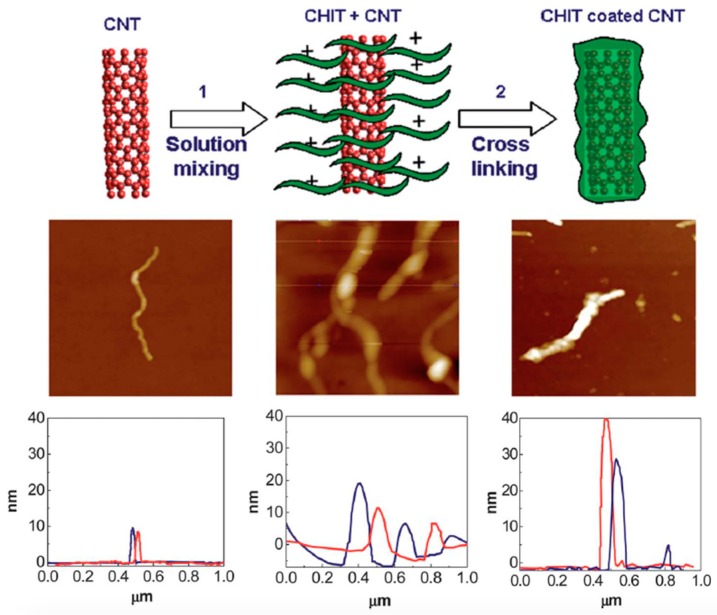
Schematic representations of Chit-f-CNT preparation (top), corresponding AFM height images (middle) and profile measurements (bottom) for pure CNT (left), Chit non-covalent functionalized CNT (center) and Chit covalently linked CNT (right).
Figure 12
Figure 12
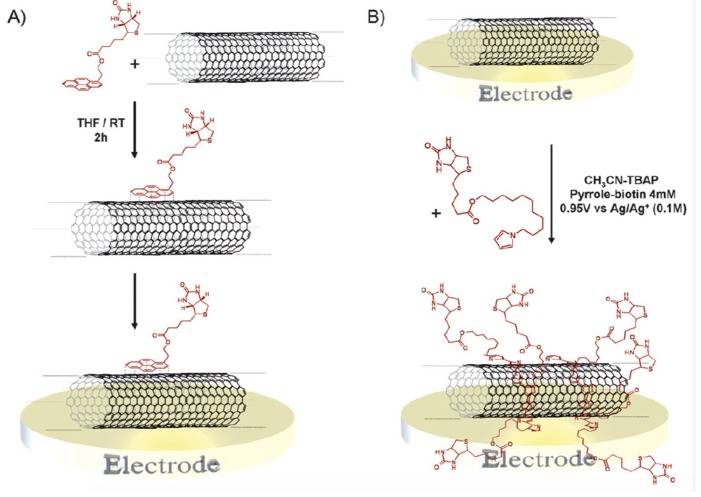
Biotin functionalization on nanotubes using (A) π-π stacking interaction between pyrene-biotin derivatives and the nanotube side walls; (B) Electropolymerization of the pyrrole-biotin monomer on the SWCNT [124].
Figure 13
Figure 13
Schematic illustration of methyl salicylate detection using two types of bi-enzyme based carbon nanotube/PBSE modified biosensor with (A) Alcohol oxidase and horseradish peroxidase and (B) salicylate hydroxylase and tyrosinase [125,126].
Figure 14
Figure 14
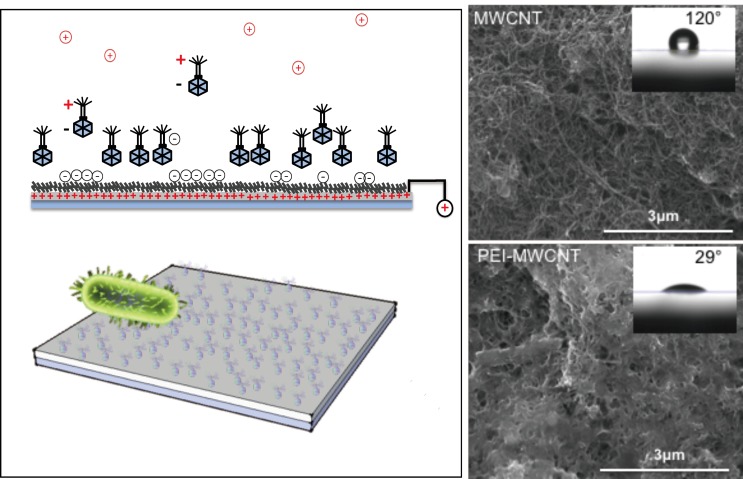
Schematic of the charge-directed orientation and immobilization of bacteriophages onto PEI-functionalized CNT on electrode surface, and the SEM images of CNT before and after PEI modification [130].
Figure 15
Figure 15
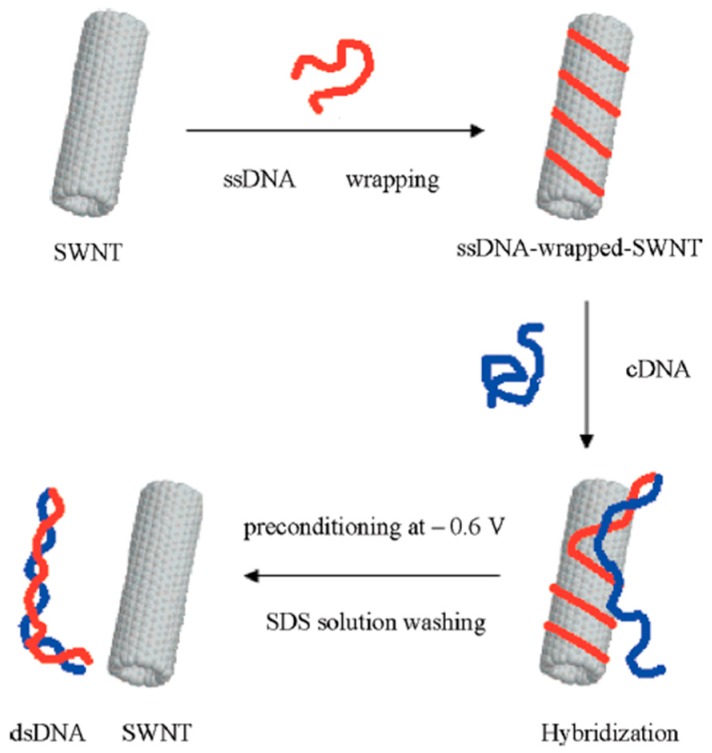
Schematic illustration of the interaction between SWCNT and DNA [136].

References

    1. Grieshaber D., MacKenzie R., Vörös J., Reimhult E. Electrochemical Biosensors Sensor Principles and Architectures. Sensors. 2008;8:1400–1458. doi: 10.3390/s80314000. - DOI - PMC - PubMed
    1. Pangule R.C., Brooks S.J., Dinu C.Z., Bale S.S., Salmon S.L., Zhu G., Metzger D.W., Kane R.S., Dordick J.S. Antistaphylococcal Nanocomposite Films Based on Enzyme−Nanotube Conjugates. ACS Nano. 2010;7:3993–4000. doi: 10.1021/nn100932t. - DOI - PMC - PubMed
    1. Senthil Kumar A., Gayathri P., Barathi P., Vijayaraghavan R. Improved Electric Wiring of Hemoglobin with Impure-Multiwalled Carbon Nanotube/Nafion Modified Glassy Carbon Electrode and Its Highly Selective Hydrogen Peroxide Biosensing. J. Phys. Chem. C. 2012;116:23692–23703. doi: 10.1021/jp3064933. - DOI
    1. Turner A.P. Biosensors: Sense and sensibility. Chem. Soc. Rev. 2013;42:3184–3196. doi: 10.1039/c3cs35528d. - DOI - PubMed
    1. Holzinger M., Le Goff A., Cosnier S. Nanomaterials for biosensing applications: A review. Front. Chem. 2014;2:63. doi: 10.3389/fchem.2014.00063. - DOI - PMC - PubMed

MeSH terms

LinkOut - more resources