Review
. 2019 Jan 18;8(1):71.
doi: 10.3390/cells8010071.

Prohibitins: A Critical Role in Mitochondrial Functions and Implication in Diseases

Affiliations
Review

Prohibitins: A Critical Role in Mitochondrial Functions and Implication in Diseases

Anna Signorile et al. Cells. .

Abstract

Prohibitin 1 (PHB1) and prohibitin 2 (PHB2) are proteins that are ubiquitously expressed, and are present in the nucleus, cytosol, and mitochondria. Depending on the cellular localization, PHB1 and PHB2 have distinctive functions, but more evidence suggests a critical role within mitochondria. In fact, PHB proteins are highly expressed in cells that heavily depend on mitochondrial function. In mitochondria, these two proteins assemble at the inner membrane to form a supra-macromolecular structure, which works as a scaffold for proteins and lipids regulating mitochondrial metabolism, including bioenergetics, biogenesis, and dynamics in order to determine the cell fate, death, or life. PHB alterations have been found in aging and cancer, as well as neurodegenerative, cardiac, and kidney diseases, in which significant mitochondrial impairments have been observed. The molecular mechanisms by which prohibitins regulate mitochondrial function and their role in pathology are reviewed and discussed herein.

Keywords: apoptosis; mitochondria; mitochondrial dynamics; oxidative phosphorylation; prohibitins.


Conflict of interest statement

The authors declare no conflict of interest.

Figures
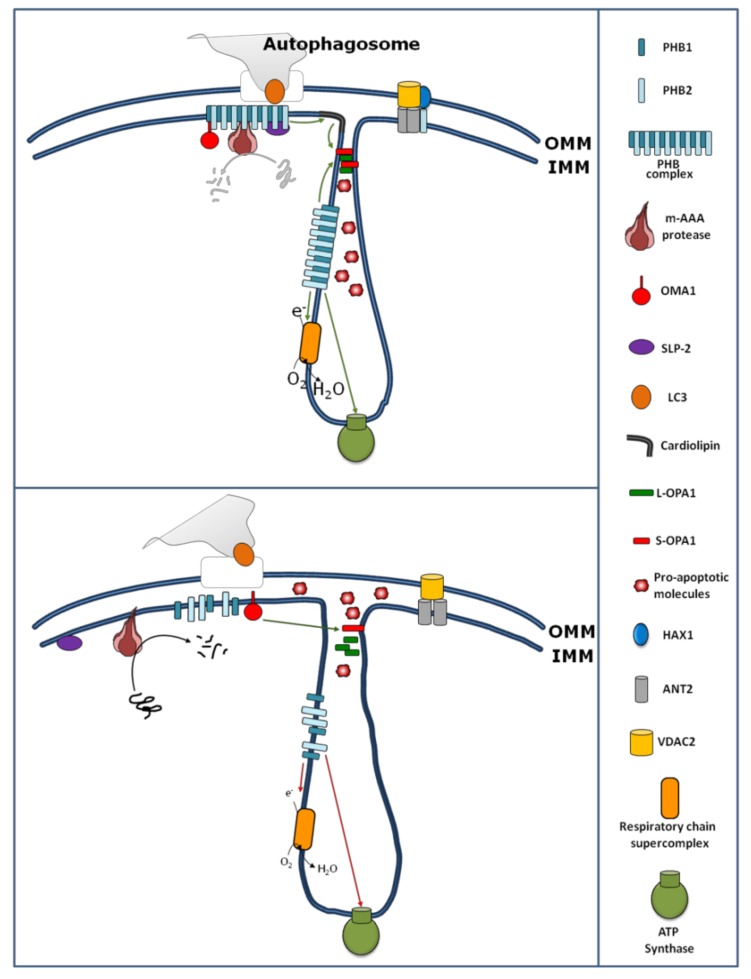
Figure 1
Figure 1
Role of the PHB complex and PHB proteins in mitochondrial functions. (Upper panel) The PHB complex interacts with m-AAA [11] and OMA1 proteases [30], inhibiting their activity, and with SLP-2 protein [31], resulting in a reciprocal protein stabilization. The stabilization of the PHB complex affects the maturation of cardiolipin [32] that, in turn, together with the PHB complex, promotes the stabilization of OPA1 [24,33] and the formation of the respiratory chain supercomplex [34,35]. The PHB complex also ensures a correct biogenesis of the ATP synthase [36]. PHB2 protein also has a role as a receptor for selective autophagy (mitophagy) by interacting with LC3 through its LC3-interacting domain [37]. Independently to its binding to PHB1, PHB2 forms another complex with HAX1, VDAC, and ANT3 [23]. (Lower panel) The down-regulation of PHBs and the loss of the PHB complex results in the activation of m-AAA [11] and OMA1 [30] proteases, degradation of SLP-2 [31], and a defect in cardiolipin maturation [32]. The increased m-AAA protease activity alters the turnover of unassembled mitochondrial respiratory chain subunits [11]. The increased activity of OMA1 [30] and the altered maturation of cardiolipin [32] result in an increased processing or decreased stability of L-OPA1 [33]. The altered balance between L-OPA1 and S-OPA1 causes mitochondrial fragmentation and alteration of mitochondrial cristae ultrastructure, with a consequent release of pro-apoptotic molecules from the intermembrane space, leading to apoptosis [38]. As with OPA1, the down-regulation of PHB2 leads to proteolysis of HAX1, which is implicated in the mitochondrial permeability transition during apoptosis [23]. OMM: Outer mitochondrial membrane; IMM: Inner mitochondrial membrane.

References

    1. Papa S., Martino P.L., Capitanio G., Gaballo A., De Rasmo D., Signorile A., Petruzzella V. The oxidative phosphorylation system in mammalian mitochondria. Adv. Exp. Med. Biol. 2012;942:3–37. - PubMed
    1. Estaquier J., Vallette F., Vayssiere J.L., Mignotte B. The mitochondrial pathways of apoptosis. Adv. Exp. Med. Biol. 2012;942:157–183. - PubMed
    1. Holloszy J.O. Biochemical adaptations in muscle. Effects of exercise on mitochondrial oxygen uptake and respiratory enzyme activity in skeletal muscle. J. Biol. Chem. 1967;242:2278–2282. - PubMed
    1. Huttemann M., Lee I., Samavati L., Yu H., Doan J.W. Regulation of mitochondrial oxidative phosphorylation through cell signalling. Biochim. Biophys. Acta. 2007;1773:1701–1720. doi: 10.1016/j.bbamcr.2007.10.001. - DOI - PubMed
    1. De Rasmo D., Signorile A., Papa F., Roca E., Papa S. cAMP/Ca2+ response element-binding protein plays a central role in the biogenesis of respiratory chain proteins in mammalian cells. IUBMB Life. 2010;62:447–452. doi: 10.1002/iub.342. - DOI - PubMed

Publication types
