Review
. 2019 Jan 20;11(1):84.
doi: 10.3390/v11010084.

Meta-Analysis of Human IgG anti-HEV Seroprevalence in Industrialized Countries and a Review of Literature

Affiliations
Review

Meta-Analysis of Human IgG anti-HEV Seroprevalence in Industrialized Countries and a Review of Literature

Lisandru Capai et al. Viruses. .

Abstract

Although Hepatitis E is increasingly described as a major cause of liver disease in industrialized countries, the epidemiology is far from being fully elucidated. We provide here a comprehensive review of documented clusters of cases, and of serological studies conducted in populations with distinct types of exposure. Seroprevalence rates range from <5% to >50% depending on the countries and the groups of population. Such discrepancies can be attributed to the type of serological assay used, but this solves only a part of the problem. We performed a meta-analysis of studies performed with the broadly used Wantai HEV-IgG ELISA and found striking differences that remain difficult to understand with the current knowledge of transmission pathways.

Keywords: Hepatitis E virus; Meta-analysis; epidemiology; industrialized countries; seroprevalence.


Conflict of interest statement

The authors declare no conflict of interest.

Figures
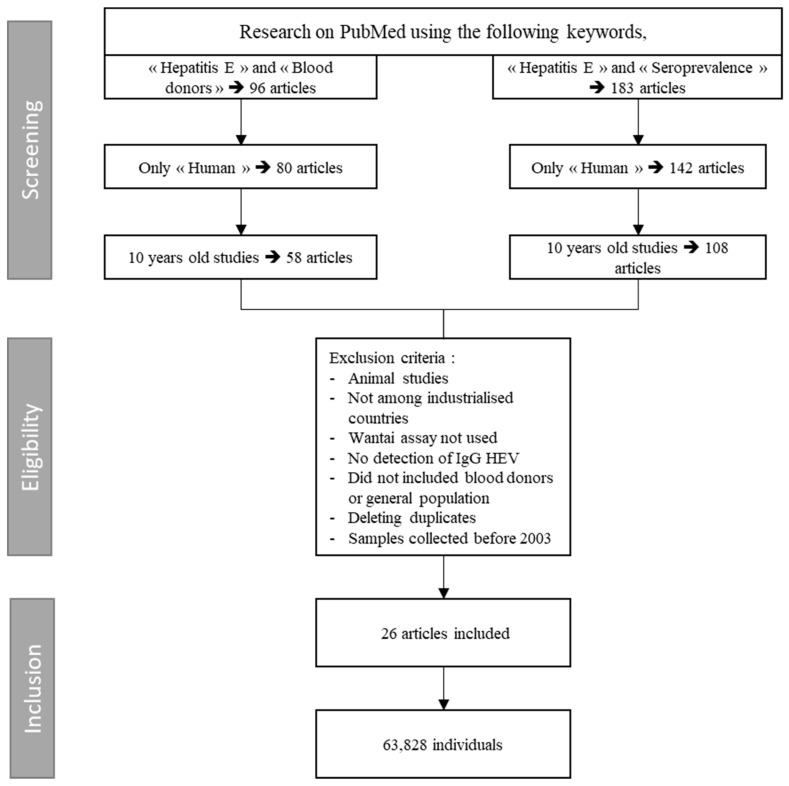
Figure 1
Figure 1
Search algorithm for meta-analysis: HEV IgG seroprevalence among blood donors.
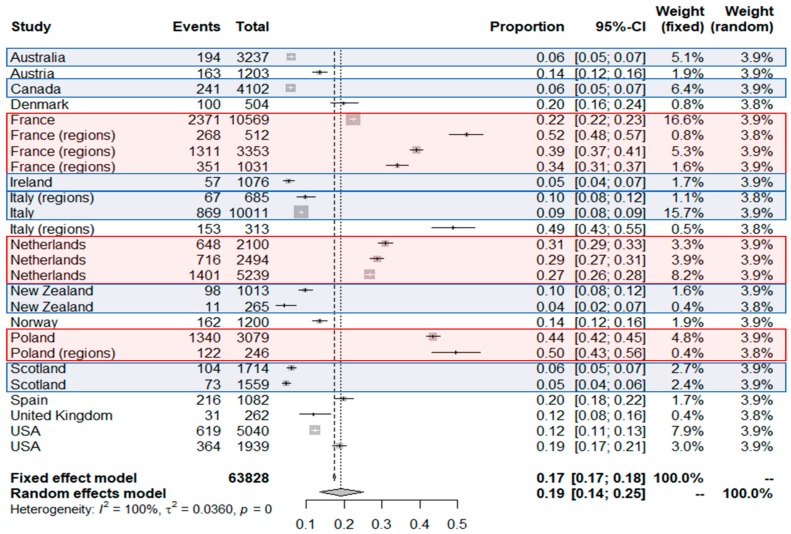
Figure 2
Figure 2
Results of the meta-analysis: Seroprevalence among blood donors in industrialized countries using Wantai HEV-IgG ELISA assay. Red areas correspond to countries with seroprevalence higher than the overall seroprevalence and blue areas to those with lower value. Black crosses correspond to the seroprevalence value of each study. The size of the grey square around the cross depend on the number of samples of each study included (weight). Black bars around the point correspond to the confidential interval. The additional data for each study included in the meta-analysis are presented in Table 2.

References

    1. Debing Y., Moradpour D., Neyts J., Gouttenoire J. Update on hepatitis e virology: Implications for clinical practice. J. Hepatol. 2016;65:200–212. doi: 10.1016/j.jhep.2016.02.045. - DOI - PubMed
    1. Purcell R.H., Emerson S.U. Hepatitis e: An emerging awareness of an old disease. J. Hepatol. 2008;48:494–503. doi: 10.1016/j.jhep.2007.12.008. - DOI - PubMed
    1. Kamar N., Bendall R., Legrand-Abravanel F., Xia N.S., Ijaz S., Izopet J., Dalton H.R. Hepatitis e. Lancet. 2012;379:2477–2488. doi: 10.1016/S0140-6736(11)61849-7. - DOI - PubMed
    1. Dalton H.R., Bendall R., Ijaz S., Banks M. Hepatitis e: An emerging infection in developed countries. Lancet Infect Dis. 2008;8:698–709. doi: 10.1016/S1473-3099(08)70255-X. - DOI - PubMed
    1. Tam A.W., Smith M.M., Guerra M.E., Huang C.C., Bradley D.W., Fry K.E., Reyes G.R. Hepatitis e virus (hev): Molecular cloning and sequencing of the full-length viral genome. Virology. 1991;185:120–131. doi: 10.1016/0042-6822(91)90760-9. - DOI - PMC - PubMed

LinkOut - more resources