


Impact of palliative home care support on the quality and costs of care at the end of life: a population-level matched cohort study
- PMID: 30670524
- PMCID: PMC6347879
- DOI: 10.1136/bmjopen-2018-025180
Impact of palliative home care support on the quality and costs of care at the end of life: a population-level matched cohort study
Abstract
Objectives: To evaluate the impact of palliative home care support on the quality of care and costs in the last 14 days of life.
Design: Matched cohort study using linked administrative databases.
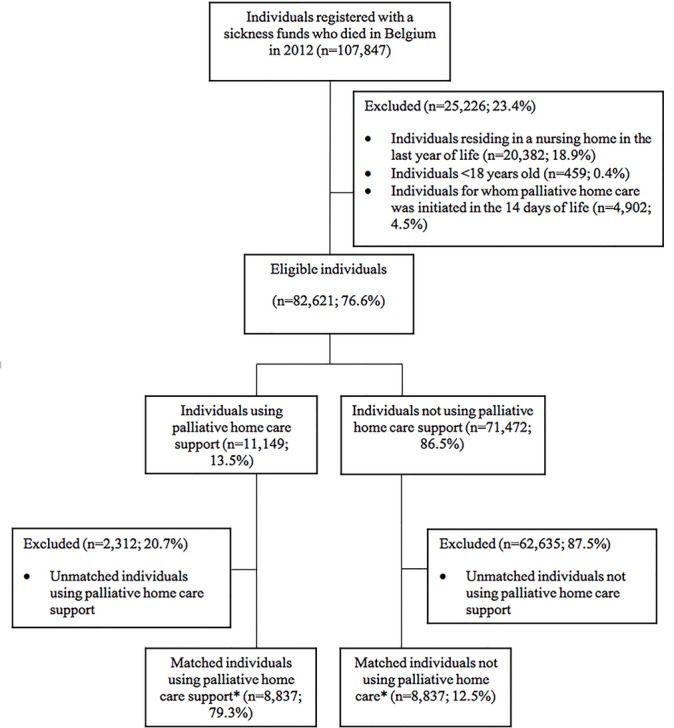
Setting: All people who died in Belgium in 2012 (n=107 847).
Participants: 8837 people who received palliative home care support in the last 720 to 15 days of life matched 1:1 by propensity score to 8837 people who received usual care.
Intervention: Receiving the allowance for palliative home patients, multidisciplinary palliative home care team visit or palliative nurse or physiotherapist visit at home.
Main outcome measures: Home death, number of family physician contacts, number of primary caregiver contacts, hospital death, hospital admission, intensive care unit (ICU) admission, emergency department (ED) admission, diagnostic testing, blood transfusion and surgery. Total inpatient and outpatient costs. All outcomes were measured in the last 14 days of life.
Results: In the unmatched cohort, 11 149 (13.5%) people received palliative home care support in the last 720 to 15 days of life. After matching, those using palliative home care support had, compared with those who did not, more family physician contacts (mean 3.1 [SD=6.5] vs 0.8 [SD=1.2]), more chance of home death (56.2%vs13.8%; relative risk [RR]=4.08, 95% CI 3.86 to 4.31), lower risk of hospital admission (27.4%vs60.8%; RR=0.45, 95% CI 0.43 to 0.46), ICU admission (18.3%vs40.4%; RR=0.45, 95% CI 0.43 to 0.48) or ED admission (15.2%vs28.1%; RR=0.54, 95% CI 0.51 to 0.57). Mean total costs of care were lower for those using palliative home care support (€3081 [95% CI €3025 to €3136] vs €4698 [95% CI €4610 to €4787]; incremental cost: -€1617 [p<0.001]).
Conclusions: Palliative home care support use positively impacts quality of care and reduces total costs of care at the end of life in Belgium. Policy makers and healthcare practitioners should increasingly focus on communicating the existing options for palliative home care support to patients and their caregivers.
Keywords: health Policy; health economics; palliative care; quality In health care.
© Author(s) (or their employer(s)) 2019. Re-use permitted under CC BY-NC. No commercial re-use. See rights and permissions. Published by BMJ.
Conflict of interest statement
Competing interests: None declared.
Figures
References
-
- Connor S, Bermedo M. Global atlas of palliative care at the end of life. 2014. http://www.who.int/cancer/publications/palliative-care-atlas/en/ (Accessed 9 Oct 2015).
-
- Palliative care. The solid facts. 2004. http://www.euro.who.int/en/health-topics/environment-and-health/urban-he... (Accessed 14 Apr 2017).
Publication types
MeSH terms
LinkOut - more resources
Full Text Sources
Medical
