. 2019 Mar 13;201(7):e00772-18.
doi: 10.1128/JB.00772-18. Print 2019 Apr 1.

Characterization of l-Carnitine Metabolism in Sinorhizobium meliloti

Affiliations

Characterization of l-Carnitine Metabolism in Sinorhizobium meliloti

Pascal Bazire et al. J Bacteriol. .

Abstract

l-Carnitine is a trimethylammonium compound mostly known for its contribution to fatty acid transport into mitochondria. In bacteria, it is synthesized from γ-butyrobetaine (GBB) and can be used as a carbon source. l-Carnitine can be formed directly by GBB hydroxylation or synthesized via a biosynthetic route analogous to fatty acid degradation. However, this multistep pathway has not been experimentally characterized. In this work, we identified by gene context analysis a cluster of l-carnitine anabolic genes next to those involved in its catabolism and proceeded to the complete in vitro characterization of l-carnitine biosynthesis and degradation in Sinorhizobium meliloti The five enzymes catalyzing the seven steps that convert GBB to glycine betaine are described. Metabolomic analysis confirmed the multistage synthesis of l-carnitine in GBB-grown cells but also revealed that GBB is synthesized by S. meliloti To our knowledge, this is the first report of aerobic GBB synthesis in bacteria. The conservation of l-carnitine metabolism genes in different bacterial taxonomic classes underscores the role of l-carnitine as a ubiquitous nutrient.IMPORTANCE The experimental characterization of novel metabolic pathways is essential for realizing the value of genome sequences and improving our knowledge of the enzymatic capabilities of the bacterial world. However, 30% to 40% of genes of a typical genome remain unannotated or associated with a putative function. We used enzyme kinetics, liquid chromatography-mass spectroscopy (LC-MS)-based metabolomics, and mutant phenotyping for the characterization of the metabolism of l-carnitine in Sinorhizobium meliloti to provide an accurate annotation of the corresponding genes. The occurrence of conserved gene clusters for carnitine metabolism in soil, plant-associated, and marine bacteria underlines the environmental abundance of carnitine and suggests this molecule might make a significant contribution to ecosystem nitrogen and carbon cycling.

Keywords: l-carnitine; LC-MS; bacterial metabolism; enzymology; functional genomics; metabolomics; orbitrap; trimethylammonium compounds.


Figures

FIG 1
FIG 1
Metabolism of l-carnitine in bacteria. Enzymes involved are GBB dioxygenase (1), γ-butyrobetainyl-CoA synthetase (2), γ-butyrobetainyl-CoA dehydrogenase (3), crotonobetainyl-CoA hydratase (4), l-carnitinyl-CoA thiolase (5), l-carnitine dehydrogenase (6), dehydrocarnitine cleavage enzyme (BKACE) (7), and betainyl-CoA thiolase (8).
FIG 2
FIG 2
Detection of the biosynthetic intermediates of l-carnitine in S. meliloti strain 3D0a2 (DSMZ-30135). Metabolome analysis of cells grown on GBB (A) and sucrose (B). Samples were analyzed by LC-MS in the positive ionization mode. Extracted ion chromatograms correspond to the protonated forms ([M+H]+) at 5-ppm accuracy of γ-butyrobetainyl-CoA (1) at m/z 895.2222, crotonobetainyl-CoA (2) at m/z 893.2066, carnitinyl-CoA (3) at m/z 911.2171, and carnitine (4) at m/z 162.1125.
FIG 3
FIG 3
l-Carnitine metabolism gene cluster in P. aeruginosa PAO1 and S. meliloti Rm2011. Physical colocalization of genetic loci was observed through the MicroScope platform (57). Transporter genes are colored gray and predicted transcriptional regulators are colored yellow. The uncolored gene symbol is used for a gene apparently unrelated to carnitine metabolism. PA, Pseudomonas aeruginosa PAO1; SM2011_c, Sinorhizobium meliloti Rm2011.
FIG 4
FIG 4
Collision-induced dissociation γ-butyrobetainyl-CoA. (A) Extracted ion chromatograms correspond to the protonated form ([M+H]+) of γ-butyrobetainyl-CoA at m/z 895.2222 (5-ppm accuracy). (B) Collision-induced dissociation tandem mass spectra (25% normalized collision energy). (1) γ-Butyrobetainyl-CoA from the metabolome of GBB-grown cells. (2) Enzymatic formation of γ-butyrobetainyl-CoA analyzed after 60 min in 100 μl of Tris-HCl 100 mM (pH 8.0) containing 2.7 μg of BcoA/B, 5 mM GBB, 200 μM CoA, 2 mM ATP, and 10 mM MgCl2. LC-MS analyses were conducted in the positive ionization mode.
FIG 5
FIG 5
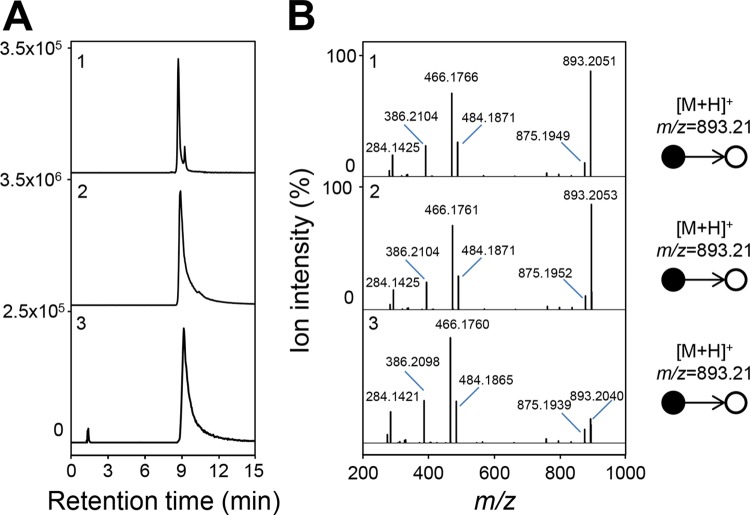
Collision-induced dissociation crotonobetainyl-CoA. (A) Extracted ion chromatograms correspond to the protonated form ([M+H]+) of crotonobetainyl-CoA at m/z 893.2066 (5-ppm accuracy). (B) Collision-induced dissociation tandem mass spectra (25% normalized collision energy). (1) Crotonobetainyl-CoA from the metabolome of GBB-grown cells. (2) Enzymatic formation of crotonobetainyl-CoA analyzed after 60 min in 100 μl of 50 mM Tris-HCl (pH 8.0) containing 3.9 μg of BcoC and 90 μM γ-butyrobetainyl-CoA 50, μM FAD, and 500 μM FC+PF6. (3) Crotonobetainyl-CoA reference standard. LC-MS analyses were conducted in the positive ionization mode.
FIG 6
FIG 6
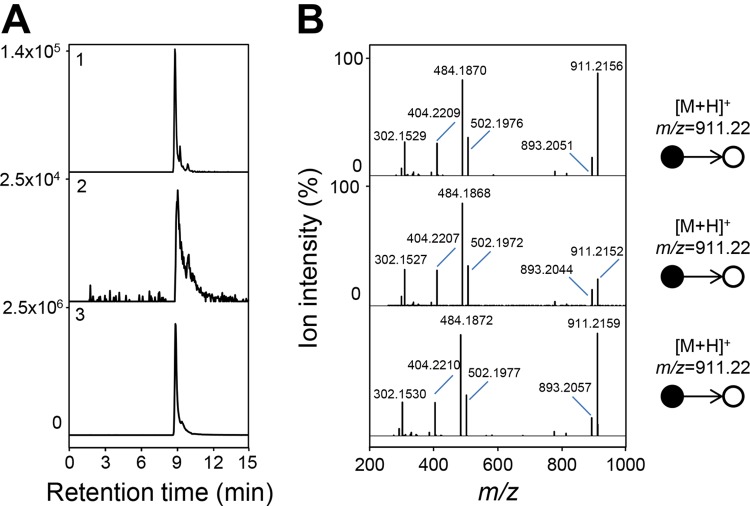
Collision-induced dissociation l-carnitinyl-CoA. (A) Extracted ion chromatograms correspond to the protonated form ([M+H]+) of l-carnitinyl-CoA at m/z 911.2171 (5-ppm accuracy). (B) Collision-induced dissociation tandem mass spectra (25% normalized collision energy). (1) l-Carnitinyl-CoA from the metabolome of GBB-grown cells. (2) Enzymatic formation of l-carnitinyl-CoA analyzed after 60 min in 100 μl of 20 mM Tris-HCl (pH 8.0) containing 3.9 μg of BcoC and 1.7 μg of BcoD in the presence of 90 μM GBB, 50 μM FAD, and 500 μM FC+PF6. (3) l-Carnitinyl-CoA synthesized by CaiC from E. coli by enzymatic conversion of l-carnitine; 2.6 μg of CaiC was incubated with 5 mM l-carnitine, 200 μM CoA, and 2 mM ATP in 100 μl of 100 mM Tris-HCl (pH 8.0) for 60 min. LC-MS analyses were conducted in the positive ionization mode.
FIG 7
FIG 7
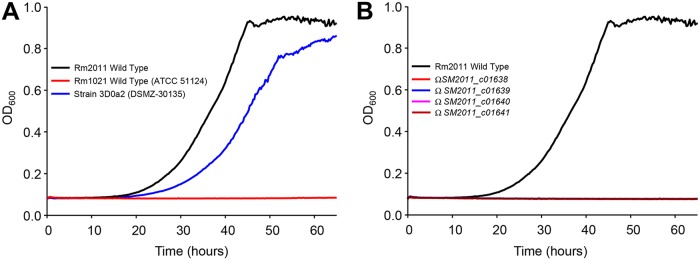
Growth kinetics of S. meliloti strains on M9 mineral medium containing γ-butyrobetaine as the carbon source. (A) Growth behavior of wild-type S. meliloti strains. (B) Growth behavior of wild-type and mutant strains of S. meliloti Rm2011. All cultures were successfully pregrown in M9 with 10 mM succinate as the carbon source, washed twice, and finally inoculated at an OD600 of 0.08 in M9 medium containing 10 mM γ-butyrobetaine. OD600 was continuously recorded by an automated growth curve analysis system (Bioscreen-C; Thermo Fisher Scientific). Values correspond to the averages from three replicates. Cultures were supplemented with 5 μM biotin.
FIG 8
FIG 8
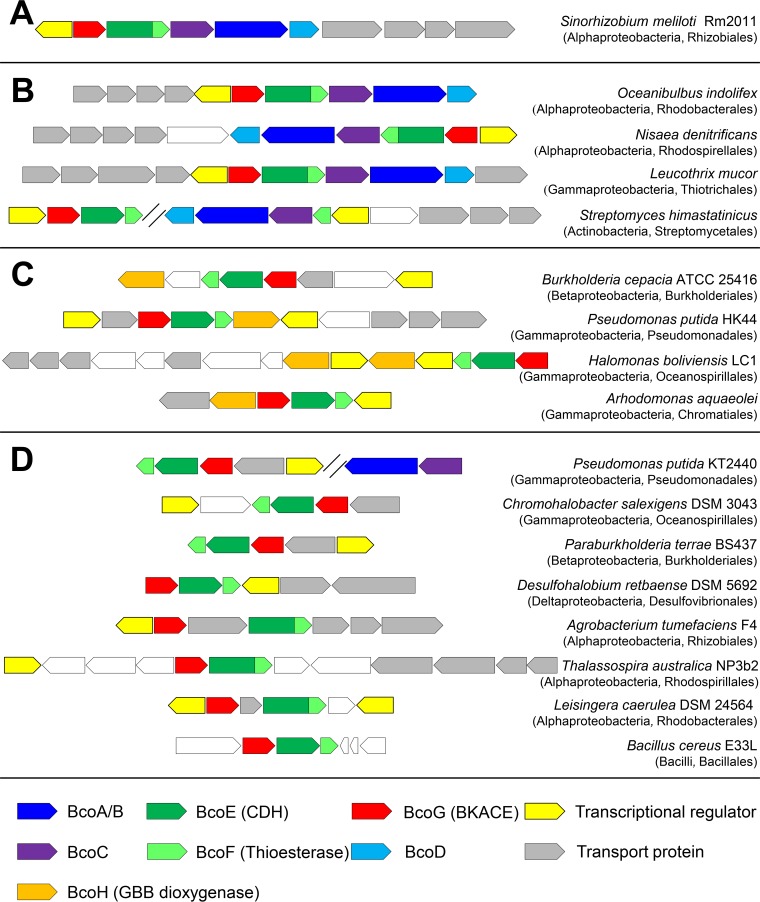
Illustration of the taxonomic diversity of homologous predicted l-carnitine metabolism gene clusters. Homologous gene clusters in bacterial genomes were retrieved using MicroScope. (A) Gene cluster in S. meliloti Rm2011. (B) Gene clusters that contain homologous genes for both the multistep synthesis of l-carnitine and its degradation. (C) Gene clusters that contain the gene coding for the GBB hydroxylase and the genes for l-carnitine degradation. (D) Gene clusters that only contain genes for l-carnitine degradation. Taxonomic classes and orders are indicated in brackets. Candidate genes for transporters and transcriptional regulators were frequently found to be conserved within these clusters. Genes indicated in white are not predicted to be related to l-carnitine metabolism.

References

    1. Vaz FM, Wanders RJ. 2002. Carnitine biosynthesis in mammals. Biochem J 361:417–429. - PMC - PubMed
    1. Vaz FM, Fouchier SW, Ofman R, Sommer M, Wanders RJ. 2000. Molecular and biochemical characterization of rat gamma-trimethylaminobutyraldehyde dehydrogenase and evidence for the involvement of human aldehyde dehydrogenase 9 in carnitine biosynthesis. J Biol Chem 275:7390–7394. - PubMed
    1. Kaufman RA, Broquist HP. 1977. Biosynthesis of carnitine in Neurospora crassa. J Biol Chem 252:7437–7439. - PubMed
    1. Strijbis K, van Roermund CW, Hardy GP, van den Burg J, Bloem K, de Haan J, van Vlies N, Wanders RJ, Vaz FM, Distel B. 2009. Identification and characterization of a complete carnitine biosynthesis pathway in Candida albicans. FASEB J 23:2349–2359. doi: 10.1096/fj.08-127985. - DOI - PubMed
    1. Nguyen P-J, Rippa S, Rossez Y, Perrin Y. 2016. Acylcarnitines participate in developmental processes associated to lipid metabolism in plants. Planta 243:1011–1022. doi: 10.1007/s00425-016-2465-y. - DOI - PubMed

Publication types

LinkOut - more resources