Review
. 2019 Feb 1;202(3):637-644.
doi: 10.4049/jimmunol.1800904.

Dual TCR T Cells: Identity Crisis or Multitaskers?

Affiliations
Review

Dual TCR T Cells: Identity Crisis or Multitaskers?

Nathaniel J Schuldt et al. J Immunol. .

Abstract

Dual TCR T cells are a common and natural product of TCR gene rearrangement and thymocyte development. As much as one third of the T cell population may have the capability to express two different TCR specificities on the cell surface. This discovery provoked a reconsideration of the classic model of thymic selection. Many potential roles for dual TCR T cells have since been hypothesized, including posing an autoimmune hazard, dominating alloreactive T cell responses, inducing allergy, and expanding the TCR repertoire to improve protective immunity. Yet, since the initial wave of publications following the discovery of dual TCR T cells, research in the area has slowed. In this study, we aim to provide a brief but comprehensive history of dual TCR T cell research, re-evaluate past observations in the context of current knowledge of the immune system, and identify key issues for future study.


Conflict of interest statement

Disclosures

The authors have no financial conflicts of interest.

Figures
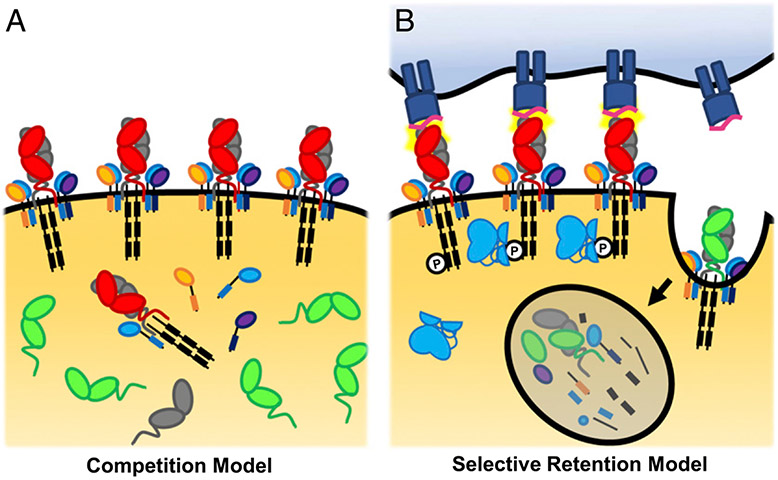
FIGURE 1.
FIGURE 1.
Competition model versus selective retention model. (A) The competition model of phenotypic allelic exclusion proposes that the two rearranged TCR α-chains (red and green) compete for either the pairing TCR β-chain (gray) or CD3 chains (blue, orange, purple, and black). The TCR α-chain with the highest binding affinity for TCRβ and/or the CD3 chains will preferentially form complete TCRs and gain access to the cell surface, whereas the lower-affinity binding TCR α-chain would be excluded from the cell surface. (B) The selective retention model is based on the observation that TCRs that recognize self-peptide–MHC are retained on the cell surface because of signaling-mediated protection from the TCR internalization machinery. TCRαβ pairs that do not recognize self-peptide–MHC are endocytosed and degraded and are, therefore, excluded from the cell surface.
FIGURE 2.
FIGURE 2.
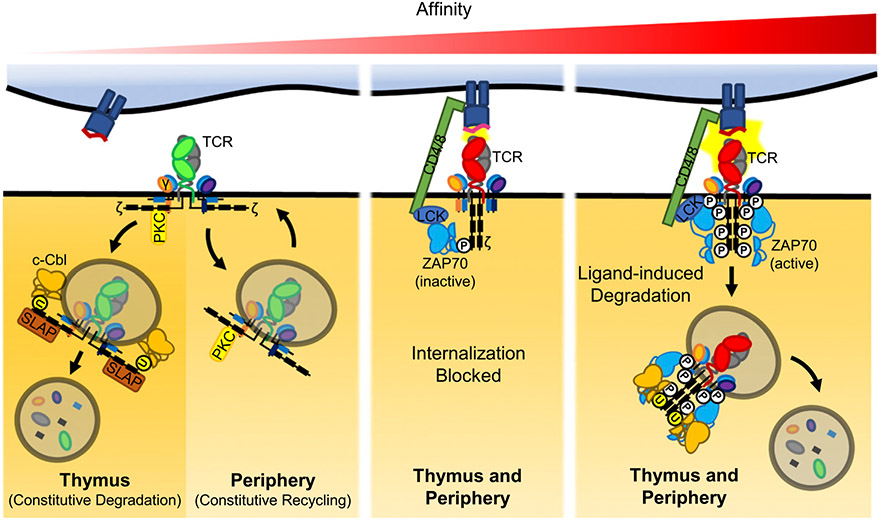
TCR ligand affinity dictates surface expression. TCR are constitutively internalized in developing thymocytes and mature T cells. In DP thymocytes, internalized TCR are constitutively degraded. ZAP70 or SLAP serve as adaptors to mediate the ubiquitination of the CD3 ζ-chain by c-Cbl, which directs the cell to the lysosome for degradation. In contrast, internalized TCR are routinely recycled to the cell surface via the CD3γ–PKC pathway in mature T cells. During positive selection, TCRs engaged with self-peptide–MHC are retained on the cell surface. In dual TCR T cells, this method could result in preferential surface expression of one TCR, whereas the other is constitutively degraded, thus establishing phenotypic allelic exclusion. We predict that similar low-level self-peptide–MHC recognition in the periphery maintains phenotypic allelic exclusion. Conformational changes to CD3 ζ-chain following TCR engagement free the CD3ζ ITAMs from the lipid bilayer to be phosphorylated and serve as docking sites for inactive ZAP70. We suspect this interferes with the constitutive recycling pathway machinery to maintain surface expression of the engaged TCR. Higher-affinity TCR interactions result in Lck-mediated activation of ZAP70, which leads to the spread of CD3 chain ITAM phosphorylation. Strongly activated TCR is then internalized and degraded through a distinct mechanism. Selective downmodulation of TCR following high-affinity interactions also have the potential to alter TCR composition on dual TCR T cells, indicating dual TCR surface composition is a likely dynamic.
FIGURE 3.
FIGURE 3.
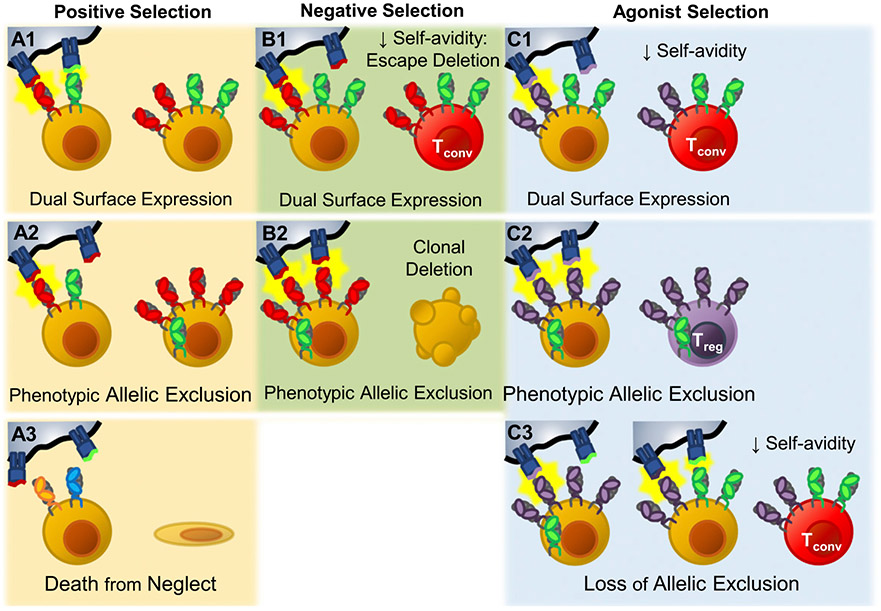
Effects of dual TCR expression on thymic selection. During positive selection, dual TCR–expressing thymocytes have three potential outcomes. (A1) Both TCRs are retained on the cell surface (Dual TCR T cell). (A2) Only one of the two TCRs is retained. The excluded TCR is preferentially internalized and degraded, leaving the other TCR to populate the cell surface, establishing phenotypic allelic exclusion. Phenotypic allelic exclusion is likely plastic; thus, these cells retain the potential to recognize both specificities. (A3) Neither TCR induces positive selection, and the cell dies from neglect. (B1) During negative selection, thymocytes that express two surface TCRs may experience decreased overall avidity to self-peptide–MHC relative to sole expression of the self-reactive TCR. In this situation dual TCR expression has the potential to allow the strongly self-reactive TCRs to escape clonal deletion. (B2) If phenotypic allelic exclusion has been established and the self-reactive TCR dominates the cell surface, avidity would likely be similar to sole expression of the self-reactive TCR, and the cell would undergo clonal deletion normally. Agonist selection of Treg cells takes place in the medulla where thymocytes are tested against new self-peptide–MHC combinations. (C1) If the thymocyte enters the medulla expressing two TCR specificities on its cell surface, it is possible that the resulting decrease in avidity could limit agonist-mediated commitment to the Treg cell lineage. (C2) If the phenotypic allelic exclusion established in the cortex is maintained in the medulla, agonist selection would be expected to function normally, and Treg cell–biasing TCRs would drive Treg cell commitment. (C3) However, if encountering new self-peptide–MHC combinations alters phenotypic allelic exclusion, it is possible that self-avidity could be reduced, effectively rerouting Treg cell–biasing TCRs into conventional T cell lineages.

References

    1. Burnet FM 1959. The Clonal Selection Theory of Acquired Immunity. Vanderbilt University Press, Nashville.
    1. Matis LA, Ezquerra A, and Coligan JE. 1988. Expression of two distinct T cell receptor alpha/beta heterodimers by an antigen-specific T cell clone. J. Exp. Med 168: 2379–2384. - PMC - PubMed
    1. Triebel F, Breathnach R, Graziani M, Hercend T, and Debre P. 1988. Evidence for expression of two distinct T cell receptor beta-chain transcripts in a human diphtheria toxoid-specific T cell clone. J. Immunol 140: 300–304. - PubMed
    1. Furutani M, Yanagi Y, Fujisawa I, Nakayama T, Kishimoto H, Kuida K, Asano Y, and Tada T. 1989. Post-transcriptional allelic exclusion of two functionally rearranged T cell receptor alpha genes. Int. Immunol 1: 281–288. - PubMed
    1. Kuida K, Furutani-Seiki M, Saito T, Kishimoto H, Sano K, and Tada T. 1991. Post-translational attainment of allelic exclusion of the T cell receptor alpha chain in a T cell clone. Int. Immunol 3: 75–82. - PubMed

Publication types

Substances