. 2019 Feb 5;116(6):1929-1933.
doi: 10.1073/pnas.1802427116. Epub 2019 Jan 22.

Spectral dynamics of shift current in ferroelectric semiconductor SbSI

Affiliations

Spectral dynamics of shift current in ferroelectric semiconductor SbSI

M Sotome et al. Proc Natl Acad Sci U S A. .

Abstract

Photoexcitation in solids brings about transitions of electrons/holes between different electronic bands. If the solid lacks an inversion symmetry, these electronic transitions support spontaneous photocurrent due to the geometric phase of the constituting electronic bands: the Berry connection. This photocurrent, termed shift current, is expected to emerge on the timescale of primary photoexcitation process. We observe ultrafast evolution of the shift current in a prototypical ferroelectric semiconductor antimony sulfur iodide (SbSI) by detecting emitted terahertz electromagnetic waves. By sweeping the excitation photon energy across the bandgap, ultrafast electron dynamics as a source of terahertz emission abruptly changes its nature, reflecting a contribution of Berry connection on interband optical transition. The shift excitation carries a net charge flow and is followed by a swing over of the electron cloud on a subpicosecond timescale. Understanding these substantive characters of the shift current with the help of first-principles calculation will pave the way for its application to ultrafast sensors and solar cells.

Keywords: bulk matter; ferroelectricity; photovoltaic effect; picosecond techniques; solar cells.


Conflict of interest statement

The authors declare no conflict of interest.

Figures
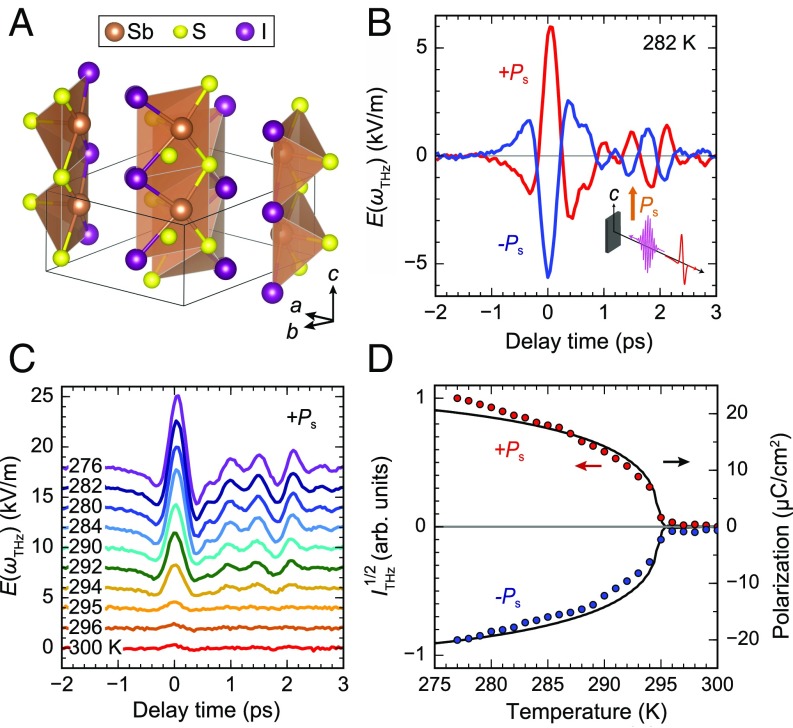
Fig. 1.
Fig. 1.
Emission of terahertz waves from SbSI. (A) Crystal structure of SbSI. (B) Terahertz waves emitted from SbSI in the ferroelectric phase after ±Ps poling (±2.0 kV/cm, respectively). (C) Temperature dependence of the terahertz waveform (offset for clarity). (D) Temperature dependence of the terahertz intensity plotted together with the pyroelectric polarization. ITHz stands for the frequency integration of the power spectrum in the Fourier space, which is proportional to the square of the source current. Excitation photon energy (ℏωexc) is 2.3 eV (400 nJ), and photon polarization is E(ωexc)E(ωTHz)c.
Fig. 2.
Fig. 2.
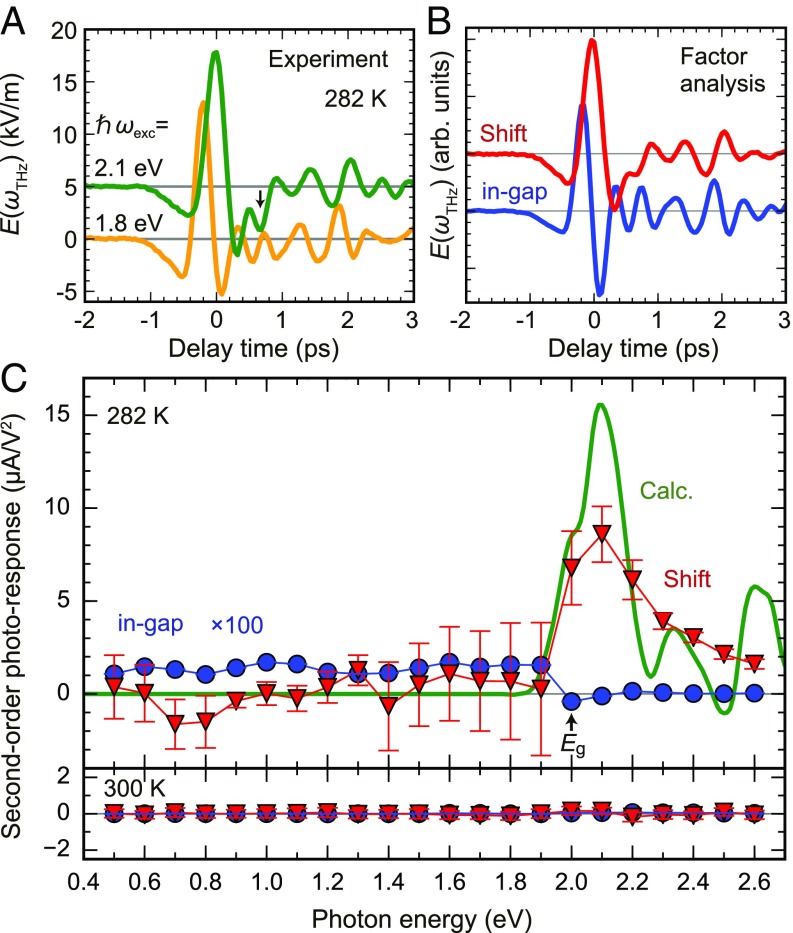
Action spectra of the shift current deduced by the factor analysis. (A) Experimental terahertz waveforms for the excitation above and below the band gap (offset for clarity). (B) Extracted base waveforms by using the factor analysis (covariance matrix calculation) from 22 datasets. (C) Action spectra of shift current (Shift) and in-gap OR at 282 and 300 K (below and above TC, respectively). Error bars reflect the unique variance in the factor analysis, which is smaller than the marker for the case of in-gap OR. The result of the first-principles calculation is also shown. Excitation intensity is 400 nJ in the linear regime to the incident pulse energy, and photon polarization is E(ωexc)E(ωTHz)c.
Fig. 3.
Fig. 3.
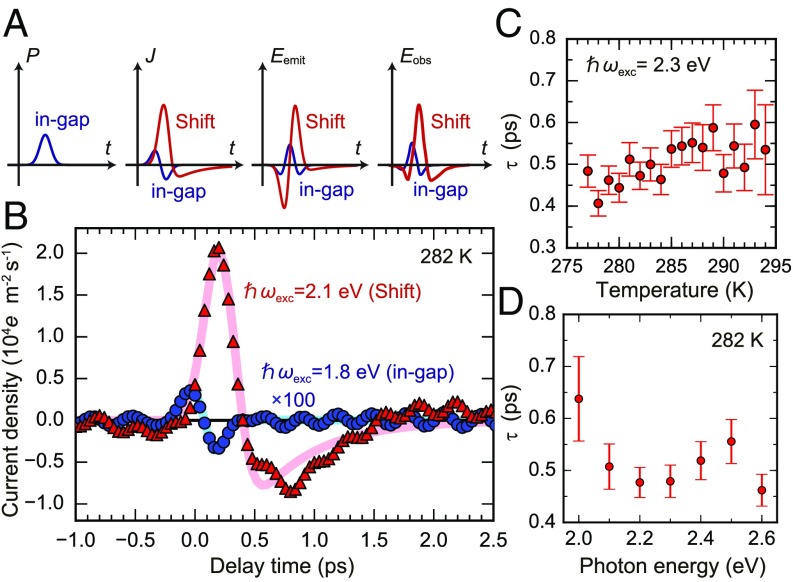
Transient nonlinear polarization and carrier dynamics. (A) Schematics of the nonlinear polarization (P), transient current (J), and emitted electric field (Eemit) for the shift current (Shift) and in-gap photoexcitation (in-gap). The detected terahertz electric fields are further modified (Eobs) due to the diffraction and instrumental factors. (B) Retrieved current dynamics for the shift current and in-gap photoexcitation. Solid lines represent the fitting curves. Shift current accompanies a swing over (relaxation) of the charge with a decay time of ∼0.5 ps, whereas the in-gap photoexcitation appears only within the incident pulse duration. (C and D) Temperature and incident photon energy dependence of the decay time τ. Excitation intensity is 400 nJ, and photon polarization is E(ωexc)E(ωTHz)c.
Fig. 4.
Fig. 4.
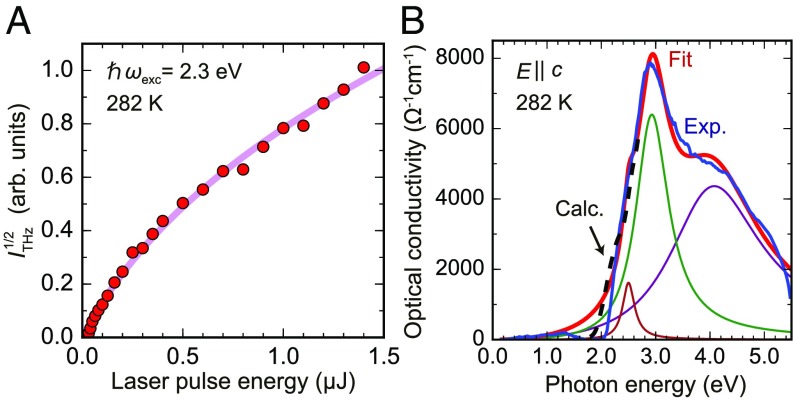
Incident laser power dependence of terahertz emission and linear optical conductivity. (A) Terahertz absolute amplitude (ITHz1/2) showing sublinear incident power dependence. The solid line is a fit by Eq. 1. Photon polarization is E(ωexc)E(ωTHz)c. (B) Linear optical conductivity plotted together with the first-principles data (dashed curve; up to 2.7 eV) and fitting curves.
Fig. 5.
Fig. 5.
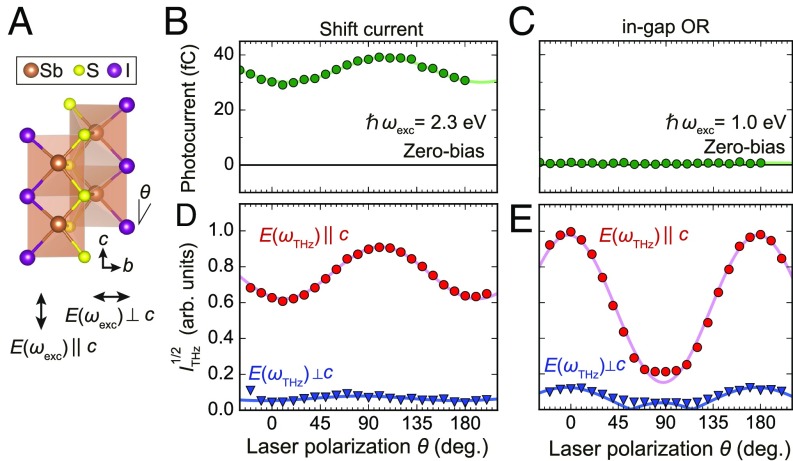
Polarimetry of shift current and in-gap OR. (A) Schematic illustration of the connected polyhedra and definition of angle θ. (B and C) Incident polarization dependence of the pulsed zero-bias photocurrent with excitation photon energy above and below the bandgap, respectively, measured by a transimpedance amplifier through the electrodes at 282 K. The zero degree corresponds to the polarization parallel to the c axis. (D and E) Corresponding amplitude spectra of the emitted terahertz wave (ITHz1/2). The wire-grid analyzer is fixed at E(ωTHz)c or E(ωTHz)c, and incident laser polarization is rotated from E(ωexc)c. Solid lines represent the fittings considering the symmetry-allowed tensor elements (Eq. 4).

References

    1. Resta R, Vanderbilt D. 2007. Theory of polarization: A modern approach. Physics of Ferroelectrics, Topics in Applied Physics (Springer, Berlin), Vol 105, pp 31–68.
    1. Resta R. Electrical polarization and orbital magnetization: The modern theories. J Phys Condens Matter. 2010;22:123201. - PubMed
    1. Morimoto T, Nagaosa N. Topological nature of nonlinear optical effects in solids. Sci Adv. 2016;2:e1501524. - PMC - PubMed
    1. Morimoto T, Nagaosa N. 2018. Current-voltage characteristics and shot noise of shift current photovoltaics. arXiv:1805.09908v1.
    1. von Baltz R, Kraut W. Theory of the bulk photovoltaic effect in pure crystals. Phys Rev B Condens Matter. 1981;23:5590–5596.

Publication types

LinkOut - more resources