. 2019 Jan 22;10(1):383.
doi: 10.1038/s41467-018-08159-w.

Central body fatness is a stronger predictor of cancer risk than overall body size

Affiliations

Central body fatness is a stronger predictor of cancer risk than overall body size

Amanda M Barberio et al. Nat Commun. .

Abstract

The importance of body size versus weight distribution for cancer risk is unclear. We investigated associations between measures of body size and shape and the risk of developing cancer. The study population consisted of 26,607 participants from the Alberta's Tomorrow Project cohort. Two main measures of body shape and size were examined: i) body mass index (BMI) and ii) waist circumference (WC). Incident cancers were identified via linkage to the Alberta Cancer Registry. Cox proportional hazards models were used. Males and females classified as obese (BMI ≥ 30 kg /m-2) have a 33% and 22% increased risk of all-cancer, respectively, than their normal weight counterparts. Similar all-cancer risk increases are observed for those above sex-specific WC guidelines. Mutual adjustment for WC attenuates the association between BMI and all-cancer risk, especially among females. Central adiposity appears to be a stronger predictor of all-cancer risk than body size.


Conflict of interest statement

The authors declare no competing interests.

Figures
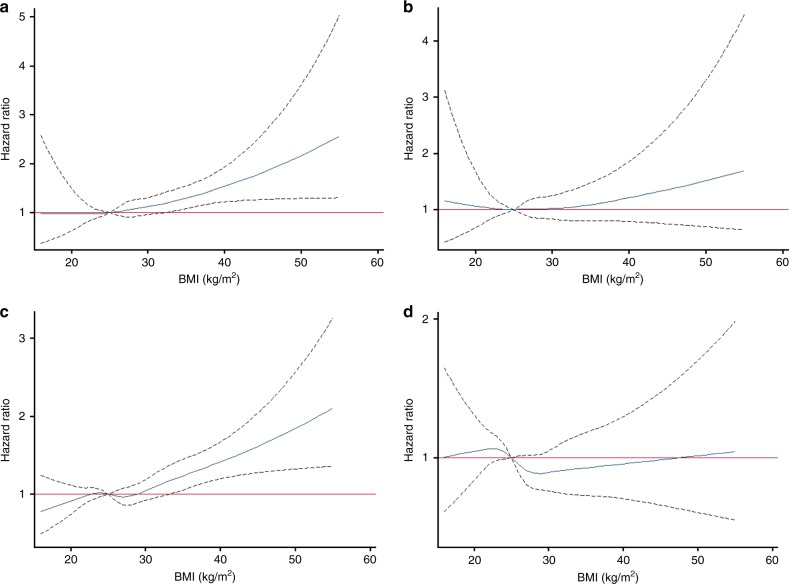
Fig. 1
Fig. 1
a Effect of BMI on all-cancer risk among males (989 cancer cases) in the Alberta’s Tomorrow Project (N = 9790) adjusted for covariates. b Effect of BMI on all-cancer risk among males (986 cancer cases) in the Alberta’s Tomorrow Project (N = 9761) adjusted for covariates and continuous waist circumference. c Effect of BMI on all-cancer risk among females (1292 cancer cases) in the Alberta’s Tomorrow Project (N = 15,945) adjusted for covariates. d Effect of BMI on all-cancer risk among females (1287 cancer cases) in the Alberta’s Tomorrow Project (N = 15,886) adjusted for covariates and continuous waist circumference. For ease of presentation, those with a BMI > 55 kg/m2 were excluded. All models were adjusted for age (continuous), ethnicity (white/other), marital status (married or living with someone/divorced, separated, or widowed/single, never married), highest level of education (high school or less/some post-high school education/post-high school certificate or degree), total household income ($0–$49,999/$50,000 to $99,999/≥$100,000), geographical area of residence (urban/rural), smoking status (current/former/never), alcohol consumption (grams of ethanol per day), energy intake (kilocalories per day), total physical activity (MET-hours per week), history of diabetes (yes/no), and family history of cancer (yes/no). This figure contains the hazard ratio represented by the blue line and the 95% confidence intervals represented by the dashed black lines on either side of the blue line. The red line represents the null value of 1 for the hazard ratio
Fig. 2
Fig. 2
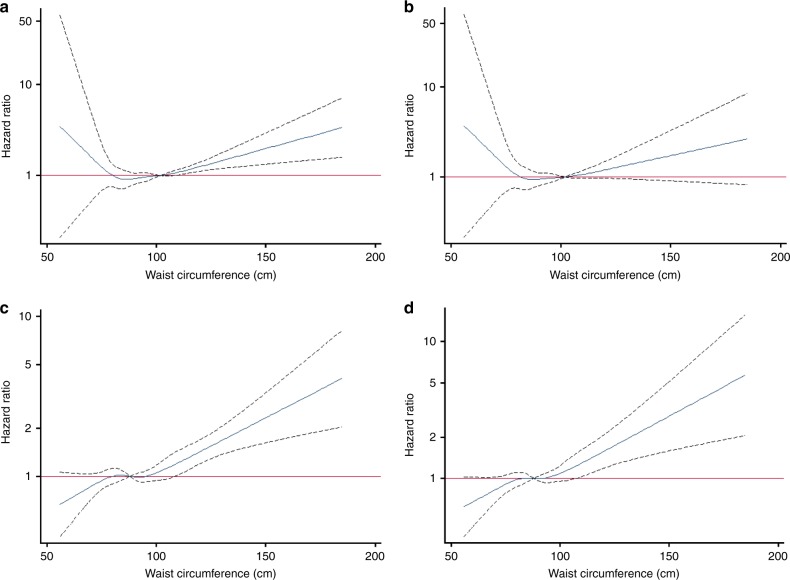
a Effect of waist circumference on all-cancer risk among males (987 cancer cases) in the Alberta’s Tomorrow Project (N = 9780) adjusted for covariates. b Effect of waist circumference on all-cancer risk among males (986 cancer cases) in the Alberta’s Tomorrow Project (N = 9763) adjusted for covariates and continuous BMI. c Effect of waist circumference on all-cancer risk among females (1291 cancer cases) in the Alberta’s Tomorrow Project (N = 15,935) adjusted for covariates. d Effect of waist circumference on all-cancer risk among females (1289 cancer cases) in the Alberta’s Tomorrow Project (N = 15,911) adjusted for covariates and continuous BMI. All models were adjusted for age (continuous), ethnicity (white/other), marital status (married or living with someone/divorced, separated, or widowed/single, never married), highest level of education (high school or less/some post-high school education/post-high school certificate or degree), total household income ($0–$49,999/$50,000 to $99,999/≥$100,000), geographical area of residence (urban/rural), smoking status (current/former/never), alcohol consumption (grams of ethanol per day), energy intake (kilocalories per day), total physical activity (MET-hours per week), history of diabetes (yes/no) and family history of cancer (yes/no). This figure contains the hazard ratio represented by the blue line and the 95% confidence intervals represented by the dashed black lines on either side of the blue line. The red line represents the null value of 1 for the hazard ratio
Fig. 3
Fig. 3
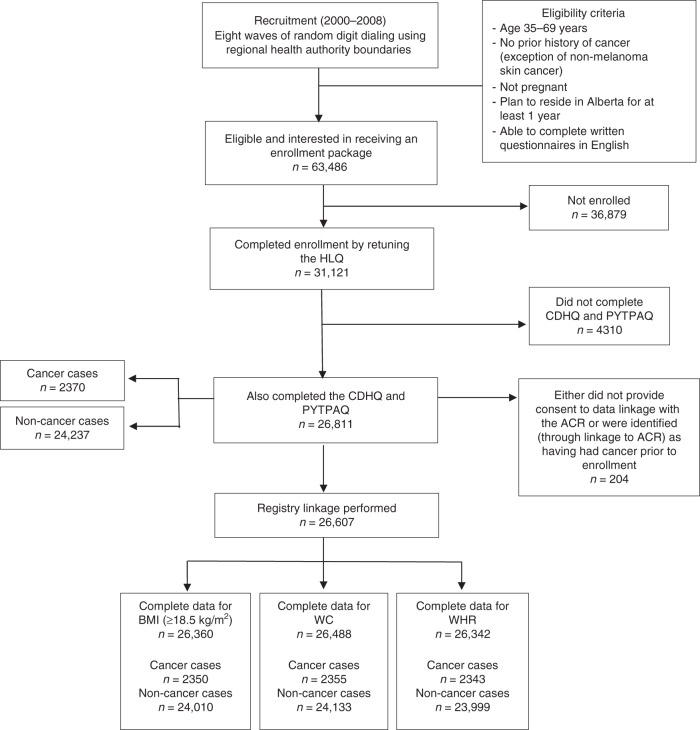
Recruitment, enrollment, and analytic sample selection flow diagram for Alberta’s Tomorrow Project, resulting in an analytic sample of 26,607 participants

References

    1. Statistics Canada. Overweight and Obese Adults (self-reported), 2014, https://www150.statcan.gc.ca/n1/pub/82-625-x/2015001/article/14185-eng.htm (2014).
    1. Twells LK, Gregory DM, Reddigan J, Midodzi WK. Current and predicted prevalence of obesity in Canada: a trend analysis. CMAJ Open. 2014;2:E18–E26. doi: 10.9778/cmajo.20130016. - DOI - PMC - PubMed
    1. Must, A. & McKeown, N. M. in Endotext (eds. De Groot, L. J. et al.) (MDText.com, Inc., South Dartmouth, MA, 2000).
    1. World Cancer Research Fund/American Institute for Cancer Research. Continuous Update Project: Diet, Nutrition, Physical Activity and Oesophageal Cancer. wcrf.org/oesophageal-cancer-2016 (2016).
    1. World Cancer Research Fund/American Institute for Cancer Research. Continuous Update Project: Diet, Nutrition, Physical Activity, and the Prevention of Pancreatic Cancer. http://www.wcrf.org/sites/default/files/Pancreatic-Cancer-2012-Report.pdf (2012).

Publication types

MeSH terms