


Conserved sex chromosomes and karyotype evolution in monitor lizards (Varanidae)
- PMID: 30670841
- PMCID: PMC6781170
- DOI: 10.1038/s41437-018-0179-6
Conserved sex chromosomes and karyotype evolution in monitor lizards (Varanidae)
Abstract
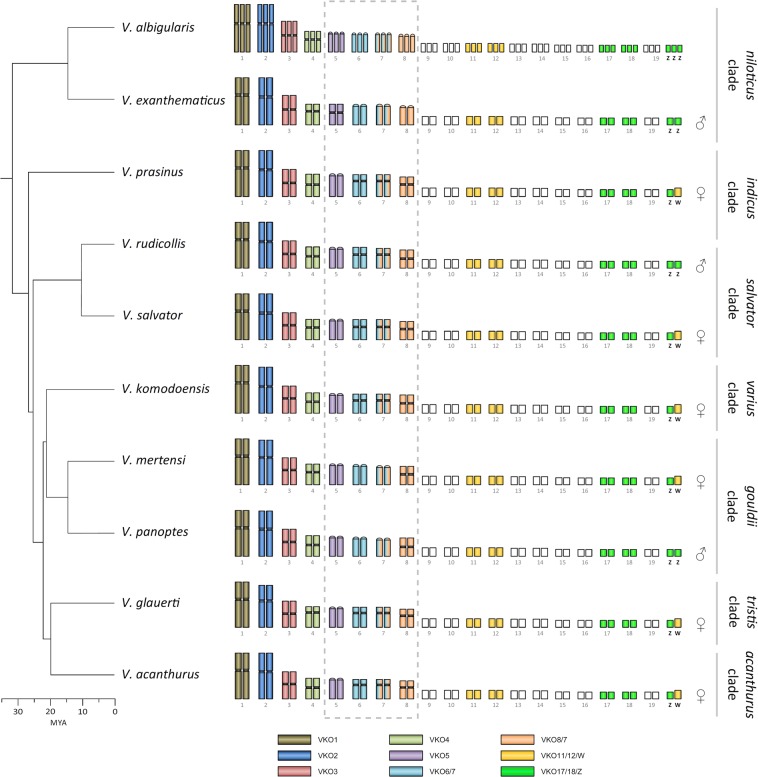
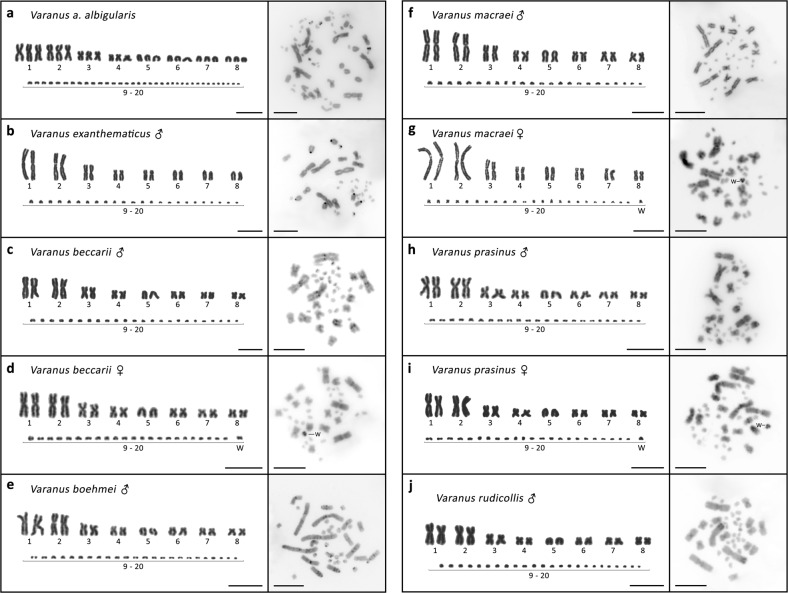
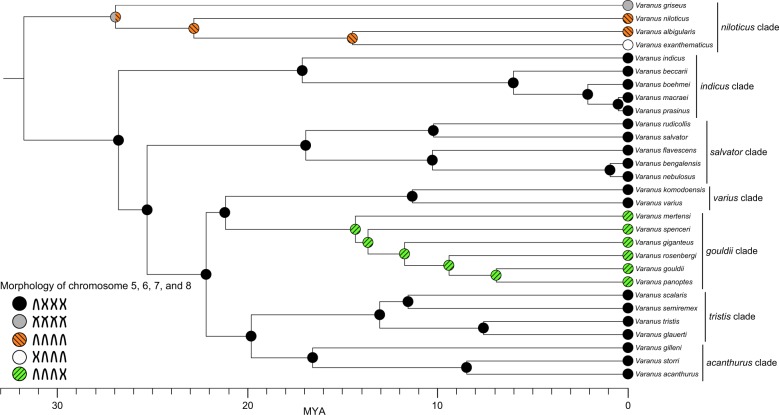
Despite their long history with the basal split dating back to the Eocene, all species of monitor lizards (family Varanidae) studied so far share the same chromosome number of 2n = 40. However, there are differences in the morphology of the macrochromosome pairs 5-8. Further, sex determination, which revealed ZZ/ZW sex microchromosomes, was studied only in a few varanid species and only with techniques that did not test their homology. The aim of this study was to (i) test if cryptic interchromosomal rearrangements of larger chromosomal blocks occurred during the karyotype evolution of this group, (ii) contribute to the reconstruction of the varanid ancestral karyotype, and (iii) test homology of sex chromosomes among varanids. We investigated these issues by hybridizing flow sorted chromosome paints from Varanus komodoensis to metaphases of nine species of monitor lizards. The results show that differences in the morphology of the chromosome pairs 5-8 can be attributed to intrachromosomal rearrangements, which led to transitions between acrocentric and metacentric chromosomes in both directions. We also documented the first case of spontaneous triploidy among varanids in Varanus albigularis. The triploid individual was fully grown, which demonstrates that polyploidization is compatible with life in this lineage. We found that the W chromosome differs between species in size and heterochromatin content. The varanid Z chromosome is clearly conserved in all the analyzed species. Varanids, in addition to iguanas, caenophidian snakes, and lacertid lizards, are another squamate group with highly conserved sex chromosomes over a long evolutionary time.
Conflict of interest statement
The authors declare that they have no conflict of interest.
Figures


References
-
- Acosta MJ, Marchal JA, Mitsainas GP, Rovatsos MT, Fernández-Espartero CH, Giagia-Athanasopoulou EB, et al. A new pericentromeric repeated DNA sequence in Microtus thomasi. Cytogenet Genome Res. 2009;124:27–36. - PubMed
-
- Altmanová M, Rovatsos M, Johnson Pokorná M, Veselý M, Wagner F, Kratochvíl L. All iguana families with the exception of basilisks share sex chromosomes. Zoology. 2018;126:98–102. - PubMed
-
- Altmanová M, Rovatsos M, Kratochvíl L, Johnson Pokorná M. Minute Y chromosomes and karyotype evolution in Madagascan iguanas (Squamata: Iguania: Opluridae) Biol J Linn Soc. 2016;118:618–633.
Publication types
MeSH terms
Substances
Grants and funding
LinkOut - more resources
Full Text Sources
