


Predictors of Remission of Early-Onset Poststroke Depression and the Interaction Between Depression and Cognition During Follow-Up
- PMID: 30670990
- PMCID: PMC6331416
- DOI: 10.3389/fpsyt.2018.00738
Predictors of Remission of Early-Onset Poststroke Depression and the Interaction Between Depression and Cognition During Follow-Up
Abstract
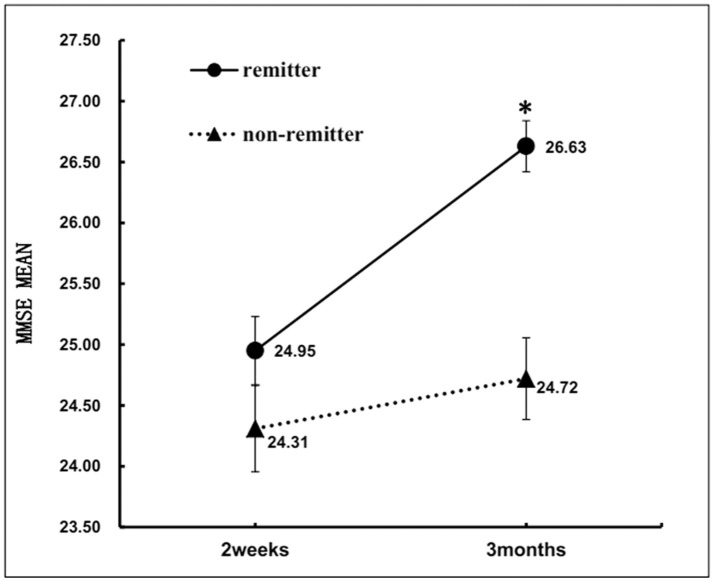
Objectives: This study aimed to examine the rate of remission in individuals experiencing early-onset poststroke depression (PSD) in China and to identify predictors of remission during a 3-month follow-up. This study also explored the interaction between cognitive impairment and depression. Methods: A total of 820 patients with PSD from a massive multicenter prospective cohort project in China (PRIOD) were included in the present study. Depressive symptoms were measured with the Hamilton Depression Rating Scale (17 Items, HDRS-17) at 2 weeks and the endpoint of the 3-month follow-up. The cut-off score of HDRS-17 (< 8) was used to define remission of depression at the endpoint. The Mini-Mental State Exam (MMSE) was used to evaluate the cognitive impairment of the patients (at the 2-week follow-up and 3-month endpoint). The National Institutes of Health Stroke Scale (NIHSS) was used to measure the severity of stroke. Results: (1) Six hundred and forty-two patients completed the 3-month follow-up, and 332 (51.7%) patients remitted by the end of the study. Univariate analyses indicated that there was a higher proportion of patients who had hypertension, frontal lobe lesion, basal ganglia lesion, poor outcome at 2 weeks, high scores on the NIHSS at 2 weeks, major life events within 3 months, and major medical diseases within 3 months in the nonremission group. In stepwise multiple logistic regression analyses, remission was significantly predicted by lower NIHSS scores at 2 weeks (p = 0.001, OR = 1.086, 95% CI 1.035-1.139), fewer major life events (p = 0.036, OR = 5.195, 95% CI 1.111-27.283), fewer major medical comorbidities (p = 0.015, OR = 2.434, 95% CI 1.190-4.979), and fewer frontal lobe lesions (p = 0.042, OR = 1.717, 95% CI 1.019-2.891). (2) After controlling for confounding variables, repeated measures analysis of variance revealed a significant interaction between time (2 weeks vs. 3 months) and group (remitters vs. nonremitters) on MMSE scores [F (1, 532) = 20.2, p < 0.001]. Conclusions: Early-onset PSD patients with milder neurological impairment, fewer major life events, fewer major medical comorbidities and no frontal lobe lesion at baseline were more likely to achieve remission 3 months after stroke. Only remitters of PSD improved significantly in cognitive impairment after stroke. The PRIOD trial is registered at http://www.isrctn.com/, number ISRCTN62169508.
Keywords: cognitive impairment; early-onset; follow-up; poststroke depression; predictors of remission.
Figures


References
-
- Krishnamurthi RV, Feigin VL, Forouzanfar MH, Mensah GA, Connor M, Bennett DA, et al. . Global and regional burden of first-ever ischaemic and haemorrhagic stroke during 1990–2010: findings from the Global Burden of Disease Study 2010. Lancet Global Health (2013) 1:e259–e81. 10.1016/S2214-109X(13)70089-5 - DOI - PMC - PubMed
LinkOut - more resources
Full Text Sources
