


Long-term survival in visceral transplant recipients in the new era: A single-center experience
- PMID: 30672105
- PMCID: PMC6591067
- DOI: 10.1111/ajt.15269
Long-term survival in visceral transplant recipients in the new era: A single-center experience
Abstract
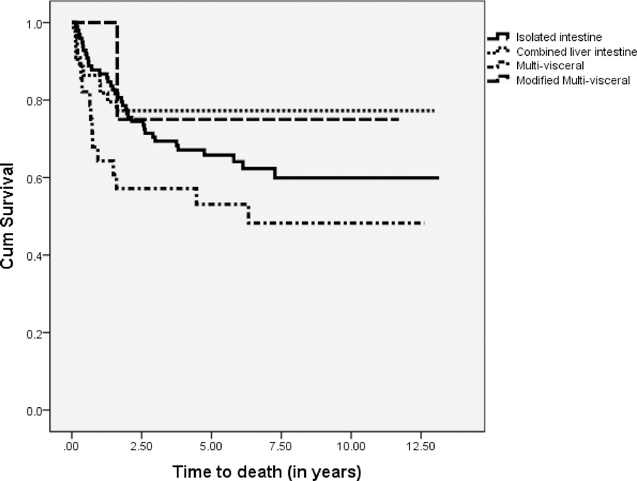
There is a paucity of data on long-term outcomes following visceral transplantation in the contemporary era. This is a single-center retrospective analysis of all visceral allograft recipients who underwent transplant between November 2003 and December 2013 with at least 3-year follow-up data. Clinical data from a prospectively maintained database were used to assess outcomes including patient and graft survival. Of 174 recipients, 90 were adults and 84 were pediatric patients. Types of visceral transplants were isolated intestinal transplant (56.3%), combined liver-intestinal transplant (25.3%), multivisceral transplant (16.1%), and modified multivisceral transplant (2.3%). Three-, 5-, and 10-year overall patient survival was 69.5%, 66%, and 63%, respectively, while 3-, 5-, and 10-year overall graft survival was 67%, 62%, and 61%, respectively. In multivariable analysis, significant predictors of survival included pediatric recipient (P = .001), donor/recipient weight ratio <0.9 (P = .008), no episodes of severe acute rejection (P = .021), cold ischemia time <8 hours (P = .014), and shorter hospital stay (P = .0001). In conclusion, visceral transplantation remains a good option for treatment of end-stage intestinal failure with parenteral nutritional complications. Proper graft selection, shorter cold ischemia time, and improvement of immunosuppression regimens could significantly improve the long-term survival.
Keywords: clinical research/practice; health services and outcomes research; immunosuppressive regimens - induction; intestinal (allograft) function/dysfunction; intestine/multivisceral transplantation.
© 2019 The American Society of Transplantation and the American Society of Transplant Surgeons.
Conflict of interest statement
Disclosure
The authors of this manuscript have no conflicts of interest to disclose as described by the
Figures




References
-
- Abu-Elmagd KM, Costa G, Bond GJ, Soltys K, Sindhi R, Wu T, et al. Five hundred intestinal and multivisceral transplantations at a single center: major advances with new challenges. Annals of surgery. 2009;250(4):567–81. - PubMed
-
- Grant D, Abu-Elmagd K, Mazariegos G, Vianna R, Langnas A, Mangus R, et al. Intestinal transplant registry report: global activity and trends. Am J Transplant. 2015;15(1):210–9. - PubMed
-
- Cunha-Melo JR, Costa G. Intestinal transplantation: evolution and current status. Medical Express. 2014;1(6).
-
- Kubal CA, Mangus RS, Tector AJ. Intestine and multivisceral transplantation: current status and future directions. Current gastroenterology reports. 2015;17(1):427. - PubMed
-
- Abu-Elmagd KM, Kosmach-Park B, Costa G, Zenati M, Martin L, Koritsky DA, et al. Long-term survival, nutritional autonomy, and quality of life after intestinal and multivisceral transplantation. Annals of surgery. 2012;256(3):494–508. - PubMed
Publication types
MeSH terms
Substances
Grants and funding
LinkOut - more resources
Full Text Sources
Medical
