


Long Term Exposure to Tenofovir Disoproxil Fumarate-Containing Antiretroviral Therapy Is Associated with Renal Impairment in an African Cohort of HIV-Infected Adults
- PMID: 30672363
- PMCID: PMC6546287
- DOI: 10.1177/2325958218821963
Long Term Exposure to Tenofovir Disoproxil Fumarate-Containing Antiretroviral Therapy Is Associated with Renal Impairment in an African Cohort of HIV-Infected Adults
Abstract
Objectives and method: There are growing concerns of tenofovir disoproxil fumarate (TDF)-associated renal toxicity. We evaluated the effect of long-term TDF exposure on renal function in a cohort of HIV-1-infected Nigerians between 2006 and 2015. Multivariate logistic regression was used to identify predictors of renal impairment at different time over 144 weeks of antiretroviral therapy (ART).
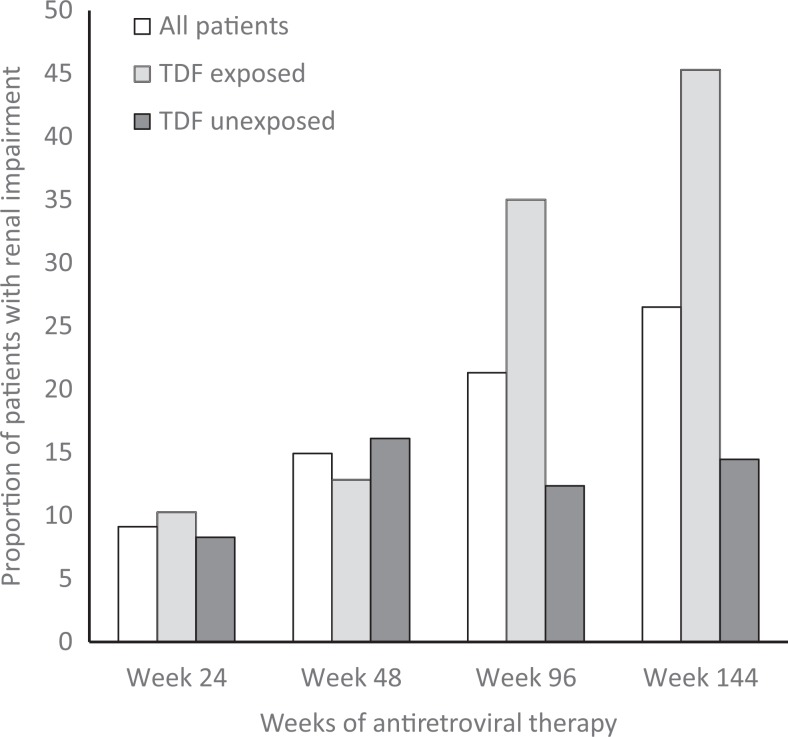
Results: Data of 4897 patients, median age 42 years (interquartile range: 36-49), and 61% females were analyzed. The prevalence of renal impairment increased from 10% at week 24 to 45% at 144 weeks in TDF-exposed participants compared to an increase from 8% at 24 weeks to 14% at 144 weeks in TDF-unexposed participants. Tenofovir disoproxil fumarate exposure predicted the risk of renal impairment at 144 weeks of ART (odds ratio: 2.36; 95% confidence interval: 1.28-4.34).
Conclusion: Long-term exposure to TDF-based ART significantly increases the likelihood of renal impairment. The continued use of TDF-based regimen in our setting should be reviewed. We recommend the urgent introduction of tenofovir alafenamide-based regimen in the HIV treatment guidelines of Nigeria and other resource-limited countries.
Keywords: ART; HIV; Nigeria; renal impairment; tenofovir.
Conflict of interest statement
Figures
References
-
- Ray AS, Fordyce MW, Hitchcock MJM. Tenofovir alafenamide: a novel prodrug of tenofovir for the treatment of human immunodeficiency virus. Antiviral Res. 2016;125:63–70. doi:10.1016/j.antiviral.2015.11.009. - PubMed
-
- Gilks CF, Crowley S, Ekpini R, et al. The WHO public-health approach to antiretroviral treatment against HIV in resource-limited settings. Lancet. 2006;368(9534):505–510. doi:10.1016/S0140-6736(06)69158-7. - PubMed
-
- Abgrall S, Ingle SM, May MT, et al. Durability of first ART regimen and risk factors for modification, interruption or death in HIV-positive patients starting ART in Europe and North America 2002-2009. AIDS. 2013;27(5):803–813. doi:10.1097/QAD.0b013e32835cb997. - PubMed
-
- Bartlett JA, Chen S-S, Quinn JB. Comparative efficacy of nucleoside/nucleotide reverse transcriptase inhibitors in combination with efavirenz: results of a systematic overview. HIV Clin Trials. 2007;8(4):221–226. doi:10.1310/hct0804-221. - PubMed
Publication types
MeSH terms
Substances
Grants and funding
LinkOut - more resources
Full Text Sources
Medical
