


Urinary incontinence and its relation to delivery circumstances: A population-based study from rural Kilimanjaro, Tanzania
- PMID: 30673696
- PMCID: PMC6343883
- DOI: 10.1371/journal.pone.0208733
Urinary incontinence and its relation to delivery circumstances: A population-based study from rural Kilimanjaro, Tanzania
Abstract
Objectives: To investigate the prevalence and risk factors of urinary incontinence (UI), the different UI subtypes and the association between UI and delivery circumstances.
Design: Cross-sectional population-based study conducted in Kilimanjaro Region, Tanzania.
Participants and settings: 1048 women aged 18-90 women living in rural Kilimanjaro. Simple random sampling was done to select villages, households and participants. Community health workers helped in identifying eligible women and trained nurses/midwives conducted face-to-face interviews. Data were analysed using descriptive statistics and Univariate and Multivariate logistic regression modelling.
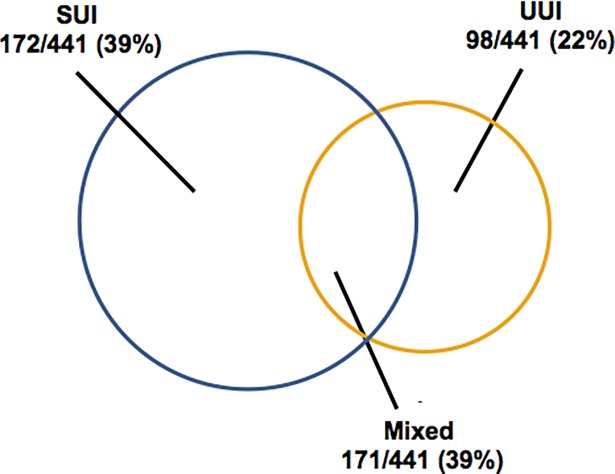
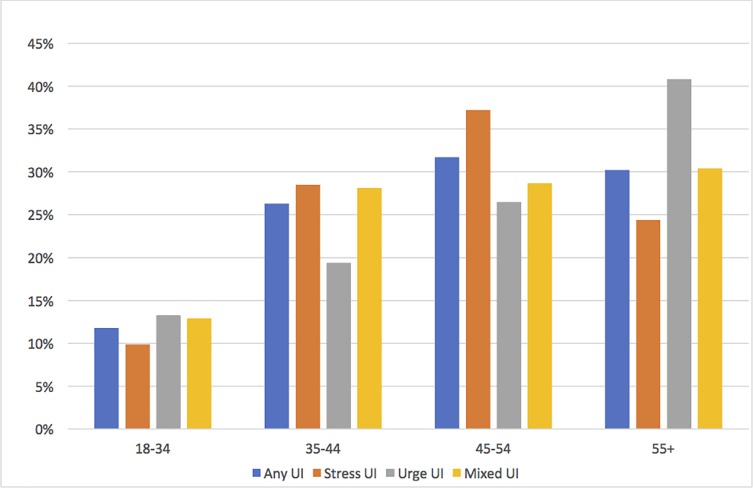
Results: The overall prevalence rate of UI was 42%. When focusing on the different types of UI, 17% of the women had stress UI, 9% had urge UI and 16% had mixed UI. Only one woman (0.1%) with vesico-vaginal fistula was identified. UI was found to be significantly associated with increasing parity (OR = 2.41 (1.55-3.74). In addition, women who in relation to their first delivery had delivered at home or had been in labour for more than 24 hours, had increased adjusted ORs of 1.70(1.08-2.68) and 2.10(1.08-4.10), respectively, for having UI.
Conclusion: UI is common in rural Tanzania and of the subtypes of UI, Stress Urinary Incontinence (SUI) is the commonest followed by Mixed Urinary Incontinence (MUI). Home delivery, prolonged labour and increasing parity especially having 5 or more deliveries are associated with increased risk for developing UI.
Conflict of interest statement
The authors have declared that no competing interests exist.
Figures
References
-
- Schreiber Pedersen L, Lose G, Hoybye MT, Elsner S, Waldmann A, Rudnicki M. Prevalence of urinary incontinence among women and analysis of potential risk factors in Germany and Denmark. Acta obstetricia et gynecologica Scandinavica. 2017;96(8):939–48. Epub 2017/04/13. 10.1111/aogs.13149 . - DOI - PubMed
Publication types
MeSH terms
LinkOut - more resources
Full Text Sources
Medical
Molecular Biology Databases
