


Postmortem neurodegenerative markers and trajectories of decline in cognitive systems
- PMID: 30674595
- PMCID: PMC6396970
- DOI: 10.1212/WNL.0000000000006949
Postmortem neurodegenerative markers and trajectories of decline in cognitive systems
Abstract
Objective: To assess whether neurodegenerative pathologies are differentially related to trajectories of change in different cognitive abilities.
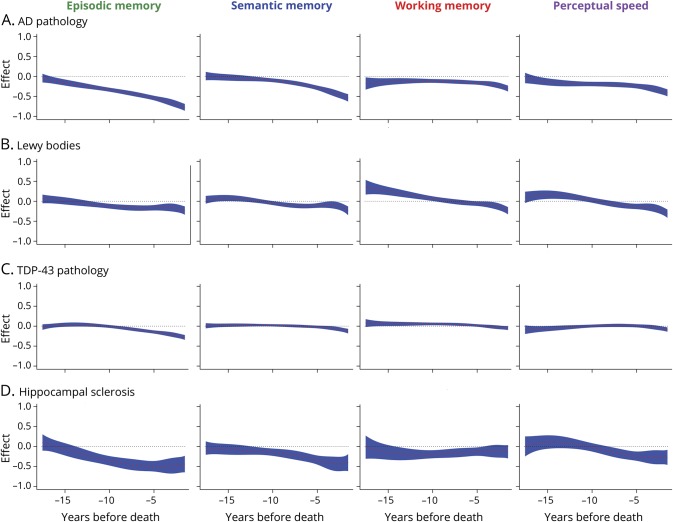
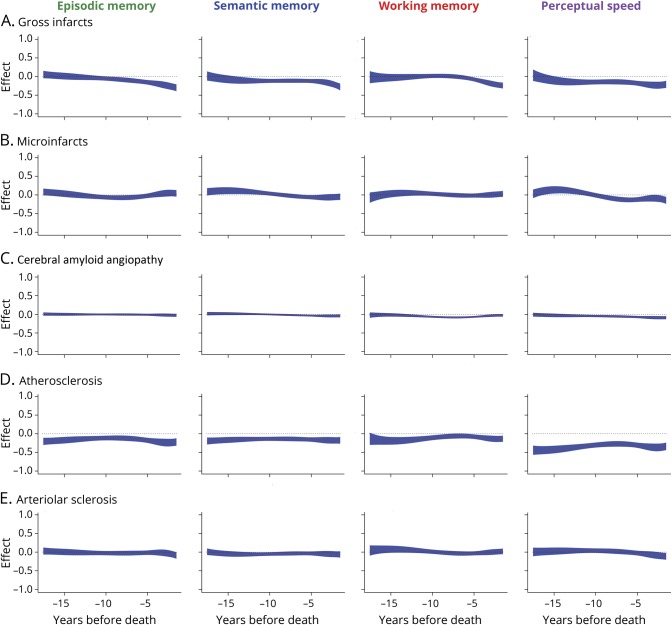
Methods: At annual intervals for up to 21 years, 915 older participants in a longitudinal clinical-pathologic cohort study completed a battery of 15 tests from which previously established composite measures of episodic memory, semantic memory, working memory, and perceptual speed were derived. At death, they underwent a neuropathologic examination to quantify Alzheimer disease pathology, Lewy bodies, transactive response DNA-binding protein 43 (TDP-43) pathology, and hippocampal sclerosis plus multiple markers of cerebrovascular disease. Time-varying effect models were used to assess change over time in the relation of neuropathologic markers to cognitive trajectories.
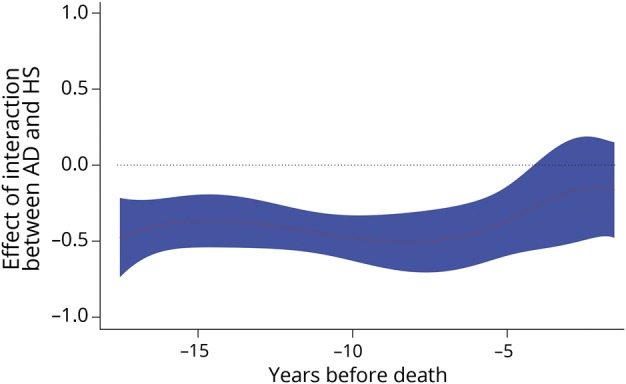
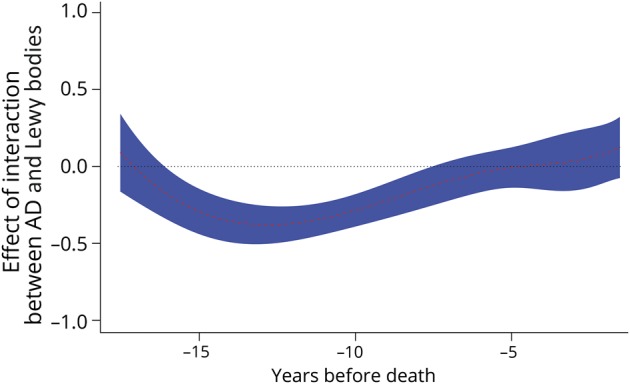
Results: Controlling for pathology, decline in perceptual speed was evident about 15 years before death; modest decline in semantic and working memory occurred later; and there was little change in episodic memory. Each neurodegenerative marker was associated with lower episodic memory function beginning about 10 to 16 years before death. As time before death decreased, Alzheimer disease pathology, Lewy bodies, and hippocampal sclerosis were associated with impairment in other cognitive domains but the association of TDP-43 pathology with cognition continued to be mainly confined to episodic memory.
Conclusions: The results suggest that episodic memory impairment is an early sign of multiple neurodegenerative conditions, which primarily differ in their associations with other cognitive systems.
© 2019 American Academy of Neurology.
Figures

References
-
- Stephan BC, Matthews FE, Hunter S, et al. ; Medical Research Council Cognitive Function and Aging Study. Neuropathological profile of mild cognitive impairment from a population perspective. Alzheimer Dis Assoc Discord 2012;26:205–212. - PubMed
-
- Wilson RS, Bienias JL, Evans DA, Bennett DA. Religious Orders Study: overview and change in cognitive and motor speed. Aging Neuropsychol Cogn 2004;11:280–303.
Publication types
MeSH terms
Substances
Grants and funding
- UL1 TR000430/TR/NCATS NIH HHS/United States
- U01 AG029824/AG/NIA NIH HHS/United States
- RF1 AG057471/AG/NIA NIH HHS/United States
- RF1 AG057532/AG/NIA NIH HHS/United States
- R01 AG050631/AG/NIA NIH HHS/United States
- RF1 AG051641/AG/NIA NIH HHS/United States
- R01 AG050431/AG/NIA NIH HHS/United States
- RF1 AG022018/AG/NIA NIH HHS/United States
- R01 AG034374/AG/NIA NIH HHS/United States
- R01 NS089674/NS/NINDS NIH HHS/United States
- R01 AG033570/AG/NIA NIH HHS/United States
- RF1 AG036042/AG/NIA NIH HHS/United States
- U01 AG046152/AG/NIA NIH HHS/United States
- R01 AG042210/AG/NIA NIH HHS/United States
- UH2 NS100599/NS/NINDS NIH HHS/United States
- RF1 AG015819/AG/NIA NIH HHS/United States
- R01 AG051635/AG/NIA NIH HHS/United States
- R01 AG052488/AG/NIA NIH HHS/United States
- R01 AG053446/AG/NIA NIH HHS/United States
- R01 AG056533/AG/NIA NIH HHS/United States
- R01 AG057907/AG/NIA NIH HHS/United States
- R01 AG056352/AG/NIA NIH HHS/United States
- RF1 AG052476/AG/NIA NIH HHS/United States
- P20 MD006886/MD/NIMHD NIH HHS/United States
- R01 AG020048/AG/NIA NIH HHS/United States
- U24 AG056270/AG/NIA NIH HHS/United States
- R01 AG017917/AG/NIA NIH HHS/United States
- R01 AG043379/AG/NIA NIH HHS/United States
- R01 AG057911/AG/NIA NIH HHS/United States
- R01 DK099269/DK/NIDDK NIH HHS/United States
- R01 AG054058/AG/NIA NIH HHS/United States
- R01 AG033678/AG/NIA NIH HHS/United States
- RF1 AG054057/AG/NIA NIH HHS/United States
- R01 AG055430/AG/NIA NIH HHS/United States
- P30 AG010161/AG/NIA NIH HHS/United States
- R01 NS086736/NS/NINDS NIH HHS/United States
- R01 AG054476/AG/NIA NIH HHS/United States
- P01 AG014449/AG/NIA NIH HHS/United States
- R01 NS093870/NS/NINDS NIH HHS/United States
- RF1 AG057473/AG/NIA NIH HHS/United States
- R01 AG057912/AG/NIA NIH HHS/United States
- R01 NS084965/NS/NINDS NIH HHS/United States
- U01 AG046161/AG/NIA NIH HHS/United States
- RF1 AG048056/AG/NIA NIH HHS/United States
- RF1 AG057457/AG/NIA NIH HHS/United States
- R01 AG048108/AG/NIA NIH HHS/United States
- R01 AG040039/AG/NIA NIH HHS/United States
- R01 AG046174/AG/NIA NIH HHS/United States
- R01 AG015819/AG/NIA NIH HHS/United States
- R01 AG047976/AG/NIA NIH HHS/United States
- R01 AG057914/AG/NIA NIH HHS/United States
- UM1 HG009443/HG/NHGRI NIH HHS/United States
LinkOut - more resources
Full Text Sources
Other Literature Sources
Medical
Research Materials
