. 2019 Jan 23;9(1):409.
doi: 10.1038/s41598-018-36789-z.

3D printing of sacrificial templates into hierarchical porous materials

Affiliations

3D printing of sacrificial templates into hierarchical porous materials

Lauriane Alison et al. Sci Rep. .

Abstract

Hierarchical porous materials are widespread in nature and find an increasing number of applications as catalytic supports, biological scaffolds and lightweight structures. Recent advances in additive manufacturing and 3D printing technologies have enabled the digital fabrication of porous materials in the form of lattices, cellular structures and foams across multiple length scales. However, current approaches do not allow for the fast manufacturing of bulk porous materials featuring pore sizes that span broadly from macroscopic dimensions down to the nanoscale. Here, ink formulations are designed and investigated to enable 3D printing of hierarchical materials displaying porosity at the nano-, micro- and macroscales. Pores are generated upon removal of nanodroplets and microscale templates present in the initial ink. Using particles to stabilize the droplet templates is key to obtain Pickering nanoemulsions that can be 3D printed through direct ink writing. The combination of such self-assembled templates with the spatial control offered by the printing process allows for the digital manufacturing of hierarchical materials exhibiting thus far inaccessible multiscale porosity and complex geometries.


Conflict of interest statement

The authors declare no competing interests.

Figures
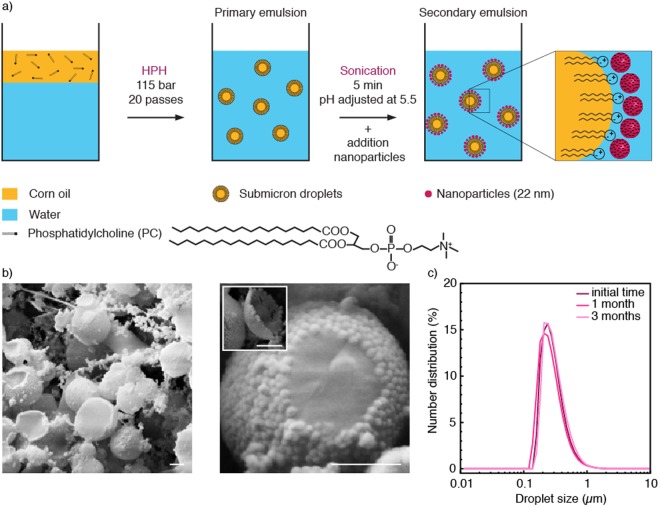
Figure 1
Figure 1
(a) Formation of nanoemulsions via a synergistic stabilization mechanism involving a zwitterionic surfactant phosphatidylcholine (PC) and silica nanoparticles. HPH stands for high-pressure homogenizer. (b) Cryo-SEM images of the resulting particle-stabilized nanodroplets. The inset shows a silica particle monolayer that detached from the droplet surface during sample preparation. Scale bars in B: 200 nm. (c) Evolution of the droplet size distribution over time for nanoemulsions stabilized by 7 wtO/W% particles and 1 wtoil% surfactant.
Figure 2
Figure 2
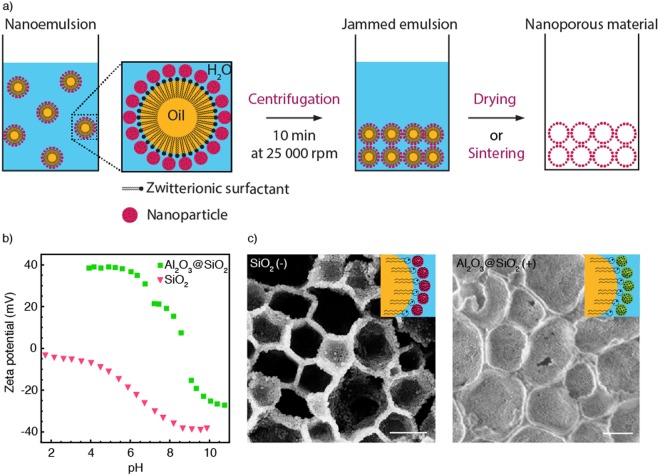
(a) Schematics illustrating the preparation of nanoporous structures from particle-stabilized nanoemulsions. (b) Zeta potential measurements of bare silica and alumina-coated silica particles used for emulsion stabilization. (c) SEM images of the porous structures obtained after ultracentrifugation and sintering of nanodroplets stabilized using negatively (left) and positively charged (right) nanoparticles and prepared with corn oil (non-volatile). Scale bars: c, 400 nm.
Figure 3
Figure 3
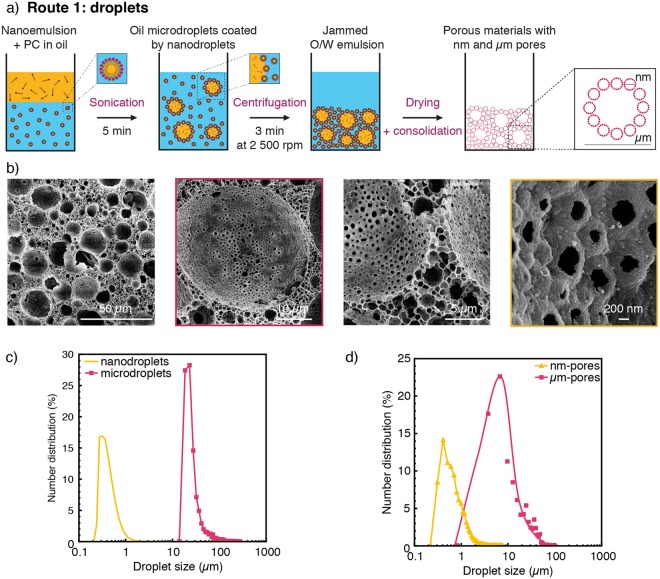
(a) Schematics of the processing route used to fabricate hierarchical porous materials from nanoemulsions and microdroplets (Route 1) (b) SEM images of the porous structure obtained after drying of the soft precursors. (c,d) Size distributions of the µm-templates and the nm-sized droplets (c) before and (d) after drying.
Figure 4
Figure 4
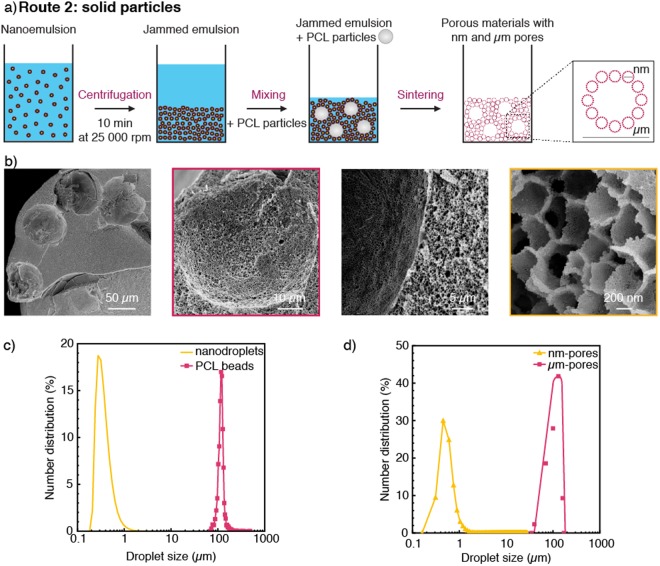
(a) Schematics of the processing route used to fabricate hierarchical porous materials from nanoemulsions and PCL particles (Route 2). (b) SEM images of the resulting porous structure after sintering. (c,d) Size distributions of the µm-templates and the nm-sized droplets in (c) the wet state and (d) after sintering at 850 °C.
Figure 5
Figure 5
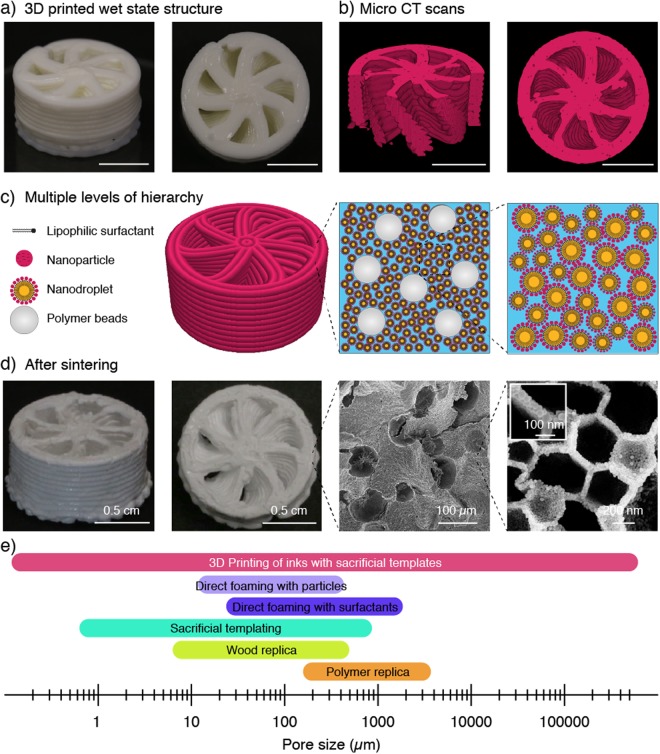
(a,b) Complex helicoidal structure that was 3D printed using a concentrated nanoemulsion as ink loaded with PCL particles. Images in (a) shows the structure in the wet state right after printing, whereas images in (b) display reconstructed representations of the printed object from micro-CT scans. Scale bars: 1 cm. (c) Schematics of the different building blocks and levels of hierarchy present in the 3D printed structure. (d) Photographs and SEM images of the 3D printed structures after drying and sintering. The inset shows that the cell wall of the structure is formed by a single layer of nanoparticles. (e) The proposed additive manufacturing technology covers a range of pore sizes that has previously not been accessible by a single processing technique. Scale bars: (a) and (b), 0.5 cm; (d), 0.5 cm, 0.5 cm, 100 µm, 200 nm (left to right) and 100 nm (inset).

References

    1. Ashby, M. F. In Cellular Ceramics (eds Michael Scheffler & Paolo Colombo) Ch. 1.1, 1–17 (Wiley-VCH Verlag GmbH & Co. KGaA 2006).
    1. Wegst UGK, Bai H, Saiz E, Tomsia AP, Ritchie RO. Bioinspired structural materials. Nature Materials. 2014;14:23–36. doi: 10.1038/nmat4089. - DOI - PubMed
    1. Tao P, et al. Bioinspired Engineering of Thermal Materials. Advanced Materials. 2015;27:428–463. doi: 10.1002/adma.201401449. - DOI - PubMed
    1. Yokoi, T. & Tatsumi, T. In Hierarchically StructuredPorous Materials (eds Bao-Lian Su, C. Sanchez, & Xiao-Yu Yang) Ch. 16, 481–515 (Wiley-VCH Verlag GmbH & Co. KGaA 2011).
    1. Stein A, Melde BJ, Schroden RC. Hybrid Inorganic–Organic Mesoporous Silicates—Nanoscopic Reactors Coming of Age. Advanced Materials. 2000;12:1403–1419. doi: 10.1002/1521-4095(200010)12:19<1403::AID-ADMA1403>3.0.CO;2-X. - DOI

Publication types