


In vivo assessment of increased oxidation of branched-chain amino acids in glioblastoma
- PMID: 30674979
- PMCID: PMC6344513
- DOI: 10.1038/s41598-018-37390-0
In vivo assessment of increased oxidation of branched-chain amino acids in glioblastoma
Abstract
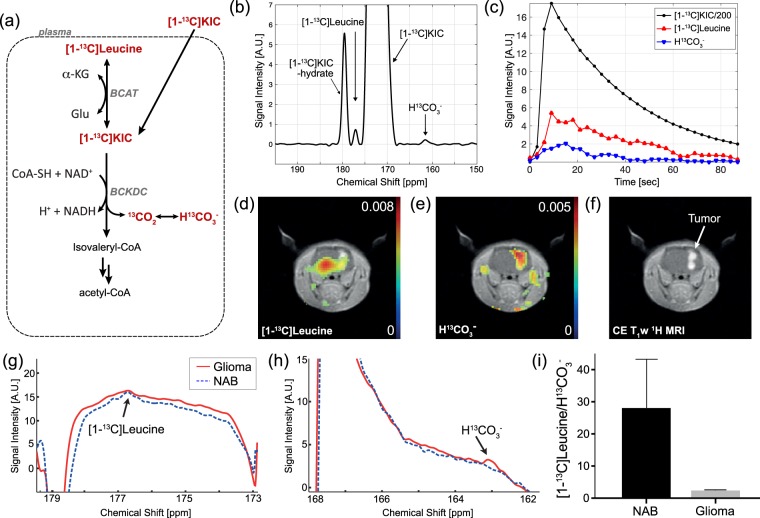
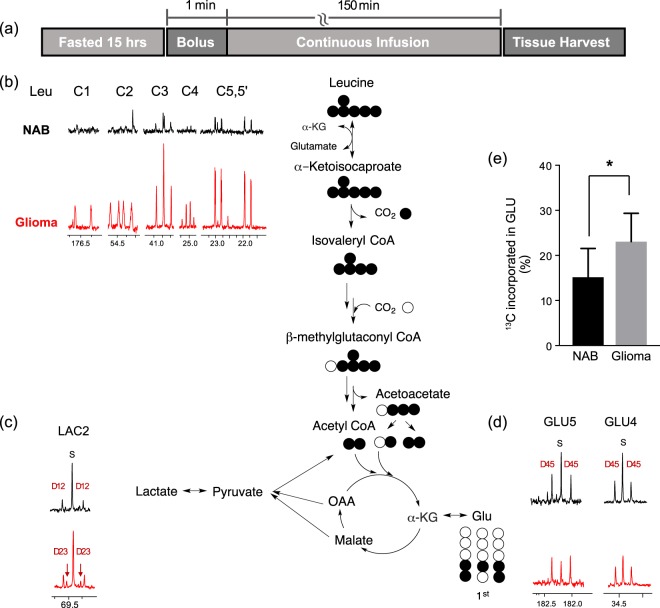
Altered branched-chain amino acids (BCAAs) metabolism is a distinctive feature of various cancers and plays an important role in sustaining tumor proliferation and aggressiveness. Despite the therapeutic and diagnostic potentials, the role of BCAA metabolism in cancer and the activities of associated enzymes remain unclear. Due to its pivotal role in BCAA metabolism and rapid cellular transport, hyperpolarized 13C-labeled α-ketoisocaproate (KIC), the α-keto acid corresponding to leucine, can assess both BCAA aminotransferase (BCAT) and branched-chain α-keto acid dehydrogenase complex (BCKDC) activities via production of [1-13C]leucine or 13CO2 (and thus H13CO3-), respectively. Here, we investigated BCAA metabolism of F98 rat glioma model in vivo using hyperpolarized 13C-KIC. In tumor regions, we observed a decrease in 13C-leucine production from injected hyperpolarized 13C-KIC via BCAT compared to the contralateral normal-appearing brain, and an increase in H13CO3-, a catabolic product of KIC through the mitochondrial BCKDC. A parallel ex vivo 13C NMR isotopomer analysis following steady-state infusion of [U-13C]leucine to glioma-bearing rats verified the increased oxidation of leucine in glioma tissue. Both the in vivo hyperpolarized KIC imaging and the leucine infusion study indicate that KIC catabolism is upregulated through BCAT/BCKDC and further oxidized via the citric acid cycle in F98 glioma.
Conflict of interest statement
The authors declare no competing interests.
Figures


References
-
- Warburg O. über den Stoffwechsel der Carcinomzelle. Klinische Wochenschrift. 1925;4:534–536. doi: 10.1007/BF01726151. - DOI
Publication types
MeSH terms
Substances
Grants and funding
LinkOut - more resources
Full Text Sources
