. 2019 Jun;122(6):770-784.
doi: 10.1038/s41437-018-0174-y. Epub 2019 Jan 23.

The hidden side of a major marine biogeographic boundary: a wide mosaic hybrid zone at the Atlantic-Mediterranean divide reveals the complex interaction between natural and genetic barriers in mussels

Affiliations

The hidden side of a major marine biogeographic boundary: a wide mosaic hybrid zone at the Atlantic-Mediterranean divide reveals the complex interaction between natural and genetic barriers in mussels

Tahani El Ayari et al. Heredity (Edinb). 2019 Jun.

Abstract

The Almeria-Oran Front (AOF) is a recognised hotspot of genetic differentiation in the sea, with genetic discontinuities reported in more than 50 species. The AOF is a barrier to dispersal and an ecological boundary; both can determine the position of these genetic breaks. However, the maintenance of genetic differentiation is likely reinforced by genetic barriers. A general drawback of previous studies is an insufficient density of sampling sites at the transition zone, with a conspicuous lack of samples from the southern coastline. We analysed the fine-scale genetic structure in the mussel Mytilus galloprovincialis using a few ancestry-informative loci previously identified from genome scans. We discovered a 600-km-wide mosaic hybrid zone eastward of the AOF along the Algerian coasts. This mosaic zone provides a new twist to our understanding of the Atlantic-Mediterranean transition because it demonstrates that the two lineages can live in sympatry with ample opportunities to interbreed in a large area, but they hardly do so. This implies that some form of reproductive isolation must exist to maintain the two genetic backgrounds locally cohesive. The mosaic zone ends with an abrupt genetic shift at a barrier to dispersal in the Gulf of Bejaia, Eastern Algeria. Simulations of endogenous or exogenous selection in models that account for the geography and hydrodynamic features of the region support the hypothesis that sister hybrid zones could have been differentially trapped at two alternative barriers to dispersal and/or environmental boundaries, at Almeria in the north and Bejaia in the south. A preponderantly unidirectional north-south gene flow next to the AOF can also maintain a patch of intrinsically maintained genetic background in the south and the mosaic structure, even in the absence of local adaptation. Our results concur with the coupling hypothesis that suggests that natural barriers can explain the position of genetic breaks, while their maintenance depends on genetic barriers.


Conflict of interest statement

The authors declare that they have no conflict of interest.

Figures
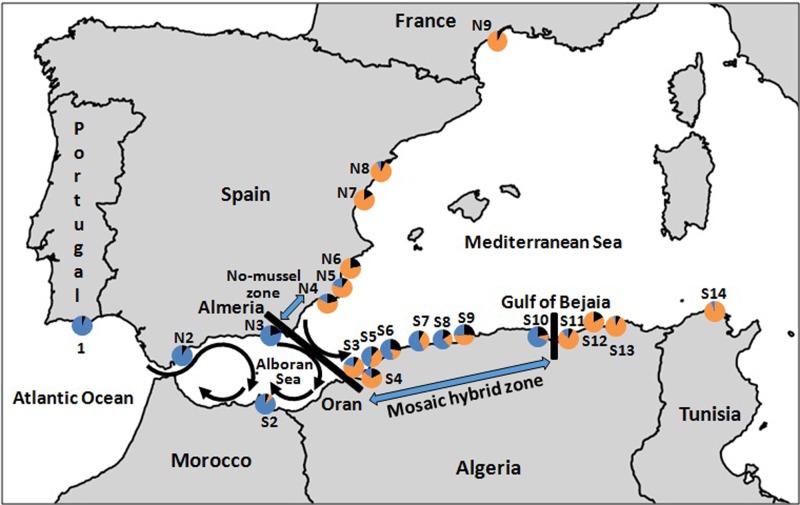
Fig. 1
Fig. 1
Sampling localities of Mytilus galloprovincialis in the north-eastern Atlantic and the Mediterranean Sea. Proportion of individuals assigned to the Atlantic cluster (in red), the Mediterranean cluster (in green) and unassigned (in black), based on a DAPC analysis with the four loci (COIII, Precol-D, EFbis and EF2). Sample names and their GPS positions are given in supplementary Table S1
Fig. 2
Fig. 2
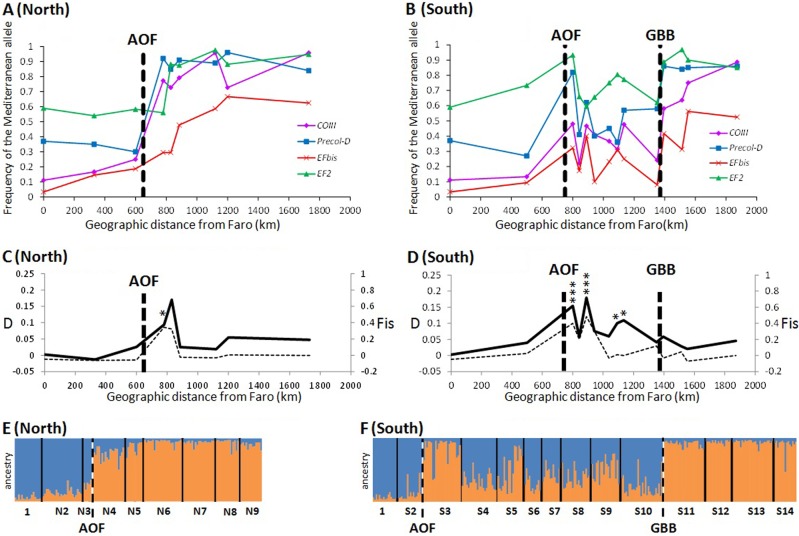
Mytilus galloprovincialis Mediterranean allele frequencies at the four semi-diagnostic loci analysed (COIII, Precol-D, EFbis and EF2) for a the 9 samples of the northern coastline and b the 14 samples of the southern coastline. AOF: Almeria Oran Front, GBB: Gulf of Bejaïa Barrier. c Average multilocus linkage disequilibrium (D, bold line, left axis) and Hardy–Weinberg disequilibrium (Fis, dashed line, right axis) in samples of the northern coastline and d samples of the southern coastline. Bar plot of the estimated ancestry proportions (Q values) estimated by STRUCTURE with the three nuclear markers (Precol-D, EFbis and EF2) for e samples of the northern coastline and f the southern coastline
Fig. 3
Fig. 3
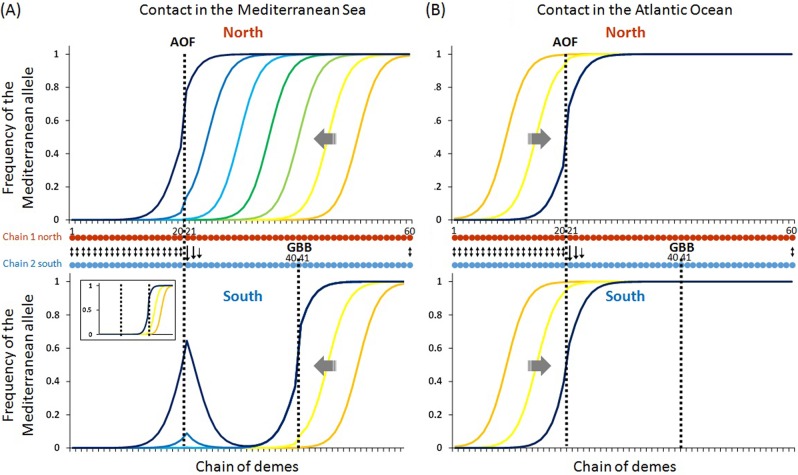
a Simulation output obtained with a bi-locus deterministic model with selection against recombinant genotypes (s = 0.1) and a slight advantage of the Mediterranean background (a = 0.01) in a 60-deme Y-shaped stepping-stone model (m = 0.3), including two weak barriers to gene flow (mbar = 0.1) between demes 20 and 21 (AOF) in the northern chain, and between demes 40 and 41 (GBB) in the southern chain of demes, a contact between demes 50 and 51, and unidirectional migration right to the AOF. Above: northern chain, below: southern chain. The inset shows the output when migration is bidirectional between the two chains. Clines are represented for every 500 generations with a rainbow colour code from orange to dark blue. Blue clines superimposed green clines in the southern chain because they remain at the same position (trapping). b Simulation with a contact between demes 10 and 11 and an advantage of the Atlantic background (a = 0.01). Clines are represented for every 500 generations with a rainbow colour code from orange to dark blue. Dark blue clines superimpose light blue and green clines because they remain at the same position (trapping)
Fig. 4
Fig. 4
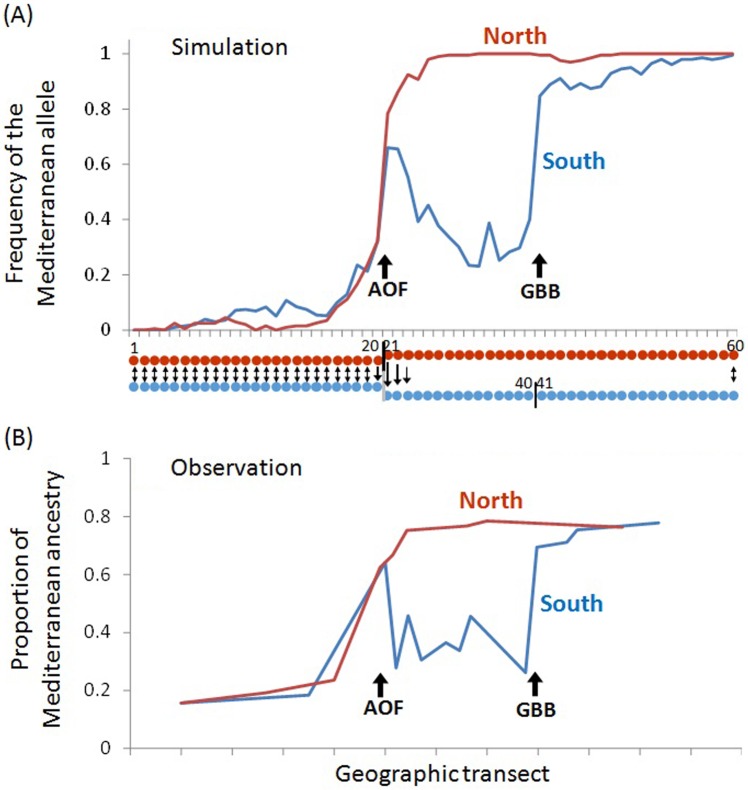
a A simulation output obtained at a neutral locus at a genetic map length of 1 cM to one intrinsic incompatibility after 1000 generations with the Y-shaped bi-unidimensional stepping-stone model, including two weak barriers to gene flow between demes 25 and 26 (AOF) in the northern chain and between demes 40 and 41 (GBB) in the southern chain of demes, and unidirectional migration right to the AOF. b Proportion of Mediterranean ancestry under an admixture model (STRUCTURE Q values). Geographic positions are rescaled so that Almeria superposes to Oran
Fig. 5
Fig. 5
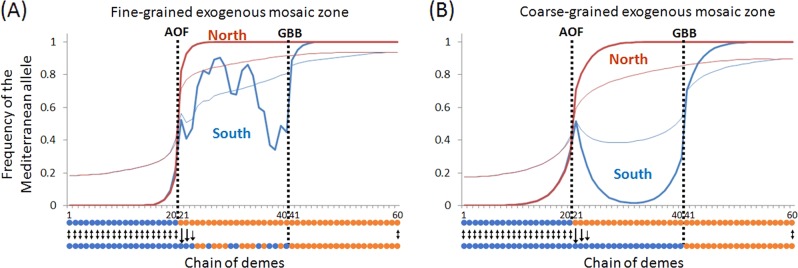
a Simulation output obtained with a deterministic model with exogenous selection in a fine-grained environment between AOF and GBB in the southern coasts (in which habitat type was assigned randomly). Other parameters are the same as in the previous figure. Thick line: selected locus; thin line: neutral locus after 1000 generations (r = 1 cM). b Simulation output obtained with a deterministic model with exogenous selection in a coarse-grained environment. Thick line: selected locus; thin line: neutral locus after 1000 generations (r = 1 cM)

References

    1. Abbott R, Albach D, Ansell S, Arntzen JW, Baird SJE, Bierne N, et al. Hybridization and speciation. J Evol Biol. 2013;26:229–246. - PubMed
    1. Anderson E, Thompson E. A model-based method for identifying species hybrids using multilocus genetic data. Genetics. 2002;160:1217–1229. - PMC - PubMed
    1. Andrello M, Jacobi MN, Manel S, Thuiller W, Mouillot D. Extending networks of protected areas to optimize connectivity and population growth rate. Ecography. 2015;38:273–282.
    1. Arnold (2006) Evolution through genetic exchange. Oxford University Press, Oxford
    1. Aurelle D, Guillemaud T, Afonso P, Morato T, Wirtz P, Santos RS, et al. Genetic study of Coris julis (Osteichtyes, Perciformes, Labridae) evolutionary history and dispersal abilities. C R Biol. 2003;326:771–785. - PubMed

Publication types

LinkOut - more resources