. 2019 Feb;566(7742):105-109.
doi: 10.1038/s41586-019-0875-2. Epub 2019 Jan 23.

Super-Mendelian inheritance mediated by CRISPR-Cas9 in the female mouse germline

Affiliations

Super-Mendelian inheritance mediated by CRISPR-Cas9 in the female mouse germline

Hannah A Grunwald et al. Nature. 2019 Feb.

Erratum in

Abstract

A gene drive biases the transmission of one of the two copies of a gene such that it is inherited more frequently than by random segregation. Highly efficient gene drive systems have recently been developed in insects, which leverage the sequence-targeted DNA cleavage activity of CRISPR-Cas9 and endogenous homology-directed repair mechanisms to convert heterozygous genotypes to homozygosity1-4. If implemented in laboratory rodents, similar systems would enable the rapid assembly of currently impractical genotypes that involve multiple homozygous genes (for example, to model multigenic human diseases). To our knowledge, however, such a system has not yet been demonstrated in mammals. Here we use an active genetic element that encodes a guide RNA, which is embedded in the mouse tyrosinase (Tyr) gene, to evaluate whether targeted gene conversion can occur when CRISPR-Cas9 is active in the early embryo or in the developing germline. Although Cas9 efficiently induces double-stranded DNA breaks in the early embryo and male germline, these breaks are not corrected by homology-directed repair. By contrast, Cas9 expression limited to the female germline induces double-stranded breaks that are corrected by homology-directed repair, which copies the active genetic element from the donor to the receiver chromosome and increases its rate of inheritance in the next generation. These results demonstrate the feasibility of CRISPR-Cas9-mediated systems that bias inheritance of desired alleles in mice and that have the potential to transform the use of rodent models in basic and biomedical research.


Figures
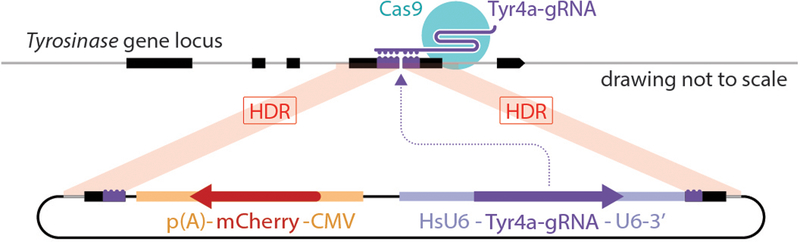
Extended data figure 1.
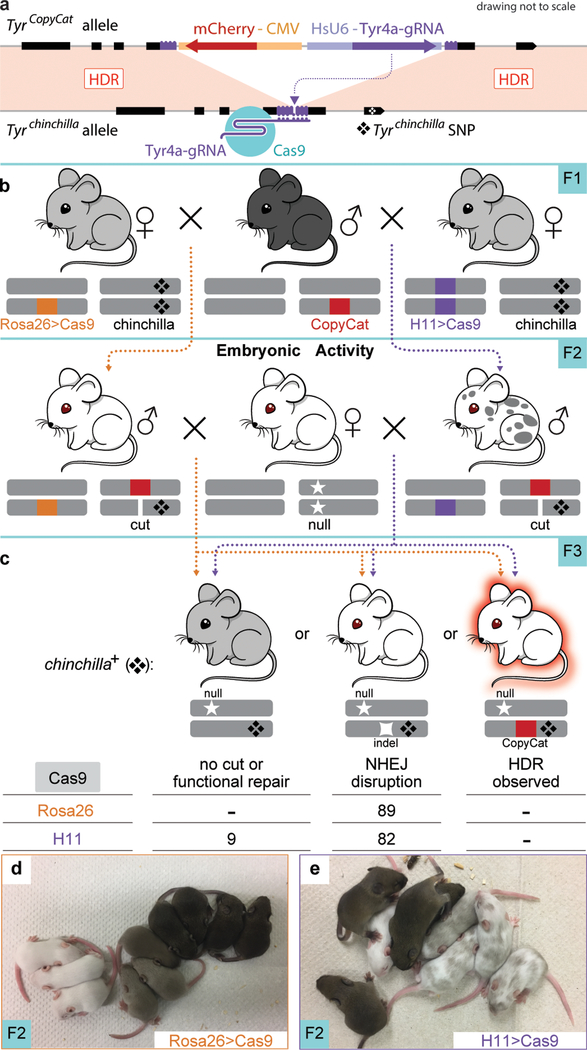
Extended data figure 1.. Knock-in strategy using the TyrCopyCat targeting vector.
The U6-Tyr4a-gRNA and CMV-mCherry were inserted into the cut site of the Tyr4a-gRNA by homology directed repair after CRISPR/Cas9 DSB formation targeted by the Tyr4a-gRNA. See Supplemental Methods and Supplementary Fig. 1 and 2 for additional details.
Extended data figure 2
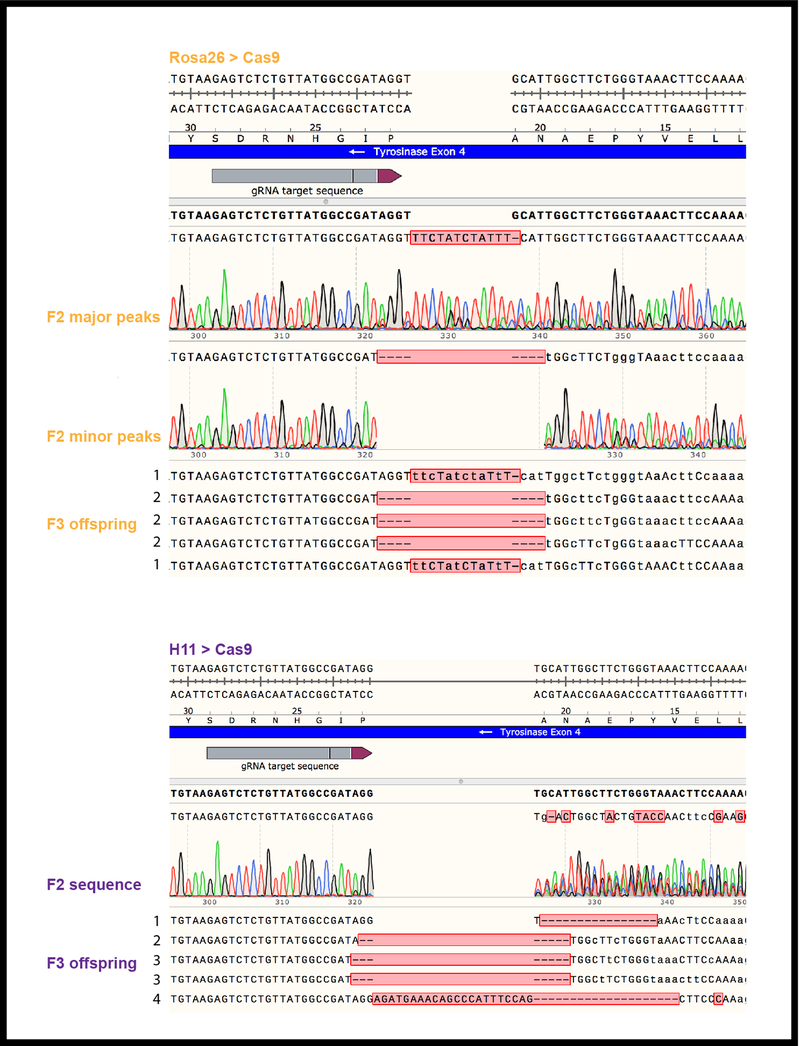
Extended data figure 2. Rosa26-Cas9 and H11-Cas9 constitutive lineages have different numbers of unique NHEJ indels.
Sanger sequencing of the Tyr4a-gRNA target exon amplified from tail tip genomic DNA using TyrHALF2 and TyrHARR2 primers as specified in Supplementary Table 3. Above: A single representative Sanger sequence trace of the bulk PCR product amplified from a Rosa26-Cas9, TyrCopyCat+ F2 animal (Rosa26 Family 1 in Extended Data Table 3) with either major or minor peaks called revealing two distinct alleles. Five Tyrchinchilla+ F3 offspring of this F2 individual each match one of the two alleles [marked 1 (insertion) and 2 (deletion)]. Below: A single representative sequence trace of the bulk PCR product amplified from an H11-Cas9, TyrCopyCat+ F2 animal (H11 Family 1 in Extended Data Table 3). Alternate alleles cannot be called because of the complexity of overlapping peaks. Five Tyrchinchilla+ F3 offspring each have one of four different alleles (marked 1, 2, 3, 4). Sequence trace data is representative of all 90 individuals total in five families of each constitutive strategy detailed in Extended Data Table 3.
Figure 1 |
Figure 1 |. Embryonic Cas9 activity does not copy the TyrosinaseCopyCat allele from the donor to the receiver chromosome.
(a) The genetically encoded TyrCopyCat element, when combined with a transgenic source of Cas9, is expected to induce a DSB in the Tyrchinchilla-marked receiver chromosome, which could be repaired by inter-homologue HDR. (b) Breeding strategy to unite TyrCopyCat with a constitutive Cas9 transgene followed by test cross to Tyrnull. (c) Sum of F3 test cross offspring from five independent families for each Rosa26-Cas9 and H11-Cas9 genotype. (d) A representative of six Rosa26-Cas9 F2 litters. Black mice did not inherit TyrCopyCat. Grey mice inherited TyrCopyCat but not Cas9. White mice inherited both transgenes. (e) A representative of five F2 litters in which all offspring inherited H11-Cas9. The mosaic mice also inherited TyrCopyCat.
Figure 2 |
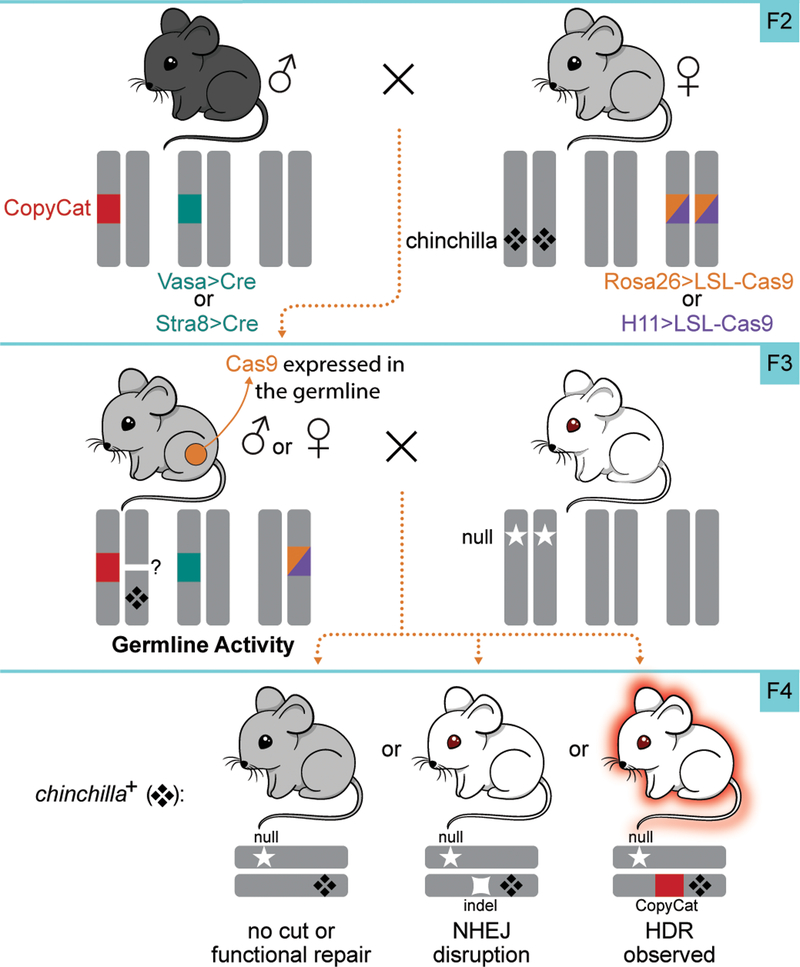
Figure 2 |. Breeding strategy to produce TyrCopyCat/chinchilla mice with a conditional Cas9 transgene and a germline restricted Cre transgene.
F3 offspring were test crossed to Tyrnull animals to assess F4 phenotypes and genotypes. Quantification of observed outcomes in F4 test cross offspring are presented in Table 1.
Figure 3 |
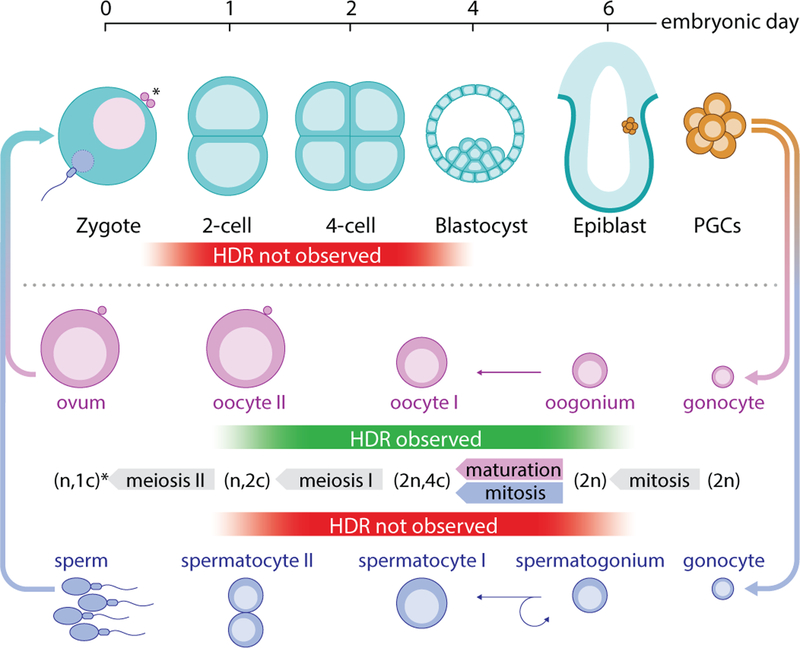
Figure 3 |. Gene conversion by an active genetic element was observed in the female germline and not in the male germline or in the early embryo.
Schematic representation of early embryonic and male and female germline development overlaid with the presence or absence of observed HDR. [PGCs: primordial germ cells, n: number of homologous chromosomes, c: chromosome copy number. Asterisk indicates the difference between male sperm (n, 1c) and female ovum, which remains (n, 2c) until second polar body extrusion after fertilization.]

Comment in

References

    1. Gantz VM & Bier E The mutagenic chain reaction: A method for converting heterozygous to homozygous mutations. Science 348, 442–444 (2015). - PMC - PubMed
    1. Gantz VM et al. Highly efficient Cas9-mediated gene drive for population modification of the malaria vector mosquito Anopheles stephensi. PNAS 112, E6736–E6743 (2015). - PMC - PubMed
    1. Hammond A et al. A CRISPR-Cas9 gene drive system targeting female reproduction in the malaria mosquito vector Anopheles gambiae. Nature Biotechnology 34, 78–83 (2016). - PMC - PubMed
    1. Kyrou K et al. A CRISPR–Cas9 gene drive targeting doublesex causes complete population suppression in caged Anopheles gambiae mosquitoes. Nature Biotechnology (2018). doi:10.1038/nbt.4245 - PMC - PubMed
    1. Gantz VM & Bier E The dawn of active genetics. Bioessays 38, 50–63 (2016). - PMC - PubMed

Publication types

MeSH terms