Review
. 2016 Apr;6(1):7-15.
doi: 10.1016/j.kisu.2016.01.006. Epub 2016 Mar 14.

Potassium homeostasis and dyskalemias: the respective roles of renal, extrarenal, and gut sensors in potassium handling

Affiliations
Review

Potassium homeostasis and dyskalemias: the respective roles of renal, extrarenal, and gut sensors in potassium handling

Murray Epstein et al. Kidney Int Suppl (2011). 2016 Apr.

Abstract

Integrated mechanisms controlling the maintenance of potassium homeostasis are well established and are defined by the classic "feedback control" of potassium balance. Recently, increasing investigative attention has focused on novel physiological paradigms that increase the complexity and precision of homeostasis. This review briefly considers the classic and well-established feedback control of potassium and then considers subsequent investigations that inform on an intriguing and not widely recognized complementary paradigm: the "feed-forward control of potassium balance." Feed-forward control refers to a pathway in a homeostatic system that responds to a signal in the environment in a predetermined manner, without responding to how the system subsequently reacts (i.e., without responding to feedback). Studies in several animal species, and recently in humans, have confirmed the presence of a feed-forward control mechanism that is capable of mediating potassium excretion independent of changes in serum potassium concentration and aldosterone. Knowledge imparted by this update of potassium homeostasis hopefully will facilitate the clinical management of hyperkalemia in patients with chronic and recurrent hyperkalemia. Awareness of this updated integrative control mechanism for potassium homeostasis is more relevant today when the medical community is increasingly focused on leveraging and expanding established renin-angiotensin-aldosterone system inhibitor treatment regimens and on successfully coping with the challenges of managing hyperkalemia provoked by renin-angiotensin-aldosterone system inhibitors. These new insights are relevant to the future design of clinical trials delineating renal potassium handling.

Keywords: RAAS inhibitors; hyperkalemia; potassium homeostasis; renal potassium handling.


Figures
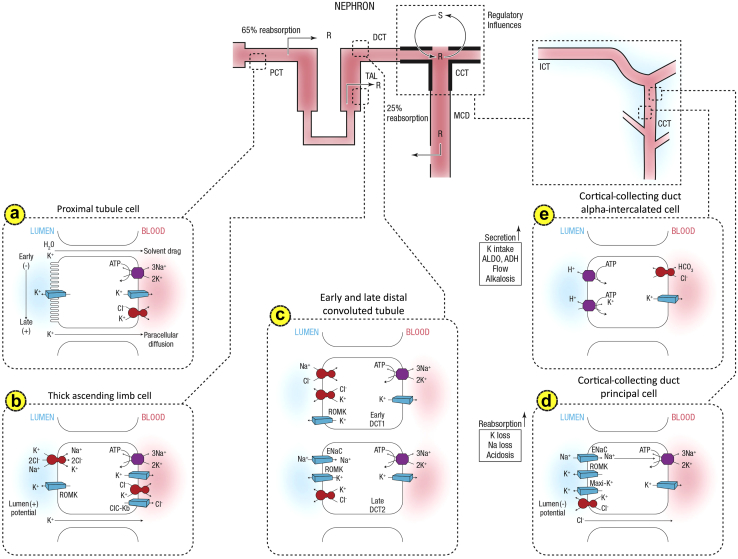
Figure 1
Figure 1
Summary of potassium transport along the nephron. Following filtration, potassium is extensively reabsorbed along the proximal tubule and the loop of Henle. Potassium is secreted along the initial and cortical collecting tubules. Net secretion can be replaced by net reabsorption in states of potassium depletion. (a) A cell model for K+ transport in the proximal tubule. K+ reabsorption in the proximal tubule primarily occurs through the paracellular pathway. Active Na+ reabsorption drives net fluid reabsorption across the proximal tubule, which in turn, drives K+ reabsorption through a solvent drag mechanism. As fluid flows down the proximal tubule, the luminal voltage shifts from slightly negative to slightly positive. The shift in transepithelial voltage provides an additional driving force favoring K+ diffusion through the low-resistance paracellular pathway. Experimental studies suggest that there may be a small component of transcellular K+ transport; however, the significance of this pathway is not known. K+ uptake through the Na+-K+-ATPase pump can exit the basolateral membrane through a conductive pathway or coupled to Cl. An apically located K+ channel functions to stabilize the cell negative potential, particularly in the setting of Na+-coupled cotransport of glucose and amino acids, which has a depolarizing effect on cell voltage. (b) A cell model for K+ transport in the thick ascending limb of Henle. K+ reabsorption occurs by both paracellular and transcellular mechanisms. The basolateral Na+-K+-ATPase pump maintains intracellular Na+ at a low level, thus providing a favorable gradient to drive the apically located Na+-K+-2Cl cotransporter (an example of secondary active transport). The apically located ROMK channel provides a pathway for K+ to recycle from cell to lumen and ensures an adequate supply of K+ to sustain Na+-K+-2Cl cotransport. This movement through ROMK creates a lumen-positive voltage, providing a driving force for passive K+ reabsorption through the paracellular pathway. Some of the K+ entering the cell through the cotransporter exits the cell across the basolateral membrane, accounting for transcellular K+ reabsorption. K+ can exit the cell through a conductive pathway or in cotransport with Cl. ClC-Kb is the primary pathway for Cl efflux across the basolateral membrane. (c) A cell model for K+ transport in the DCT. In the early DCT, luminal Na+ uptake is mediated by the apically located thiazide-sensitive Na+-Cl cotransporter. The transporter is energized by the basolateral Na+-K+-ATPase, which maintains low intracellular Na+ concentration, thus providing a favorable gradient for Na+ entry into the cell through secondary active transport. The cotransporter is abundantly expressed in the DCT1 but progressively declines along the DCT2. ROMK is expressed throughout the DCT and into the cortical collecting duct. Expression of the ENaC, which mediates amiloride-sensitive Na+ absorption, begins in the DCT2 and is robustly expressed throughout the downstream connecting tubule and cortical collecting duct. The DCT2 is the beginning of the ASDN as identified by the presence of both the mineralocorticoid receptor and the enzyme 11b-hydroxysteroid dehydrogenase II. This enzyme maintains the mineralocorticoid receptor free to only bind aldosterone by metabolizing cortisol to cortisone, which has no affinity for the receptor. Electrogenic-mediated K+ transport begins in the DCT2 with the combined presence of ROMK, ENaC, and aldosterone sensitivity. Electroneutral K+-Cl cotransport is present in the DCT and collecting duct. Conditions that promote a low luminal Cl concentration increase K+ secretion through this mechanism, which occurs with delivery of poorly reabsorbable anions, such as sulfate, phosphate, or bicarbonate. (d) The cell that is responsible for K+ secretion in the initial collecting duct and the cortical collecting duct is the principal cell. This cell possesses a basolateral Na+-K+-ATPase that is responsible for the active transport of K+ from the blood into the cell. The resultant high cell K+ concentration provides a favorable diffusion gradient for movement of K+ from the cell into the lumen. In addition to establishing a high intracellular K+ concentration, the activity of this pump lowers intracellular Na+ concentration, thereby maintaining a favorable diffusion gradient for movement of Na+ from the lumen into the cell. Both the movements of Na+ and K+ across the apical membrane occur through well-defined Na+ and K+ channels. (e) Reabsorption of HCO3 in the distal nephron is mediated by apical H+ secretion by the alpha-intercalated cell. Two transporters secrete H+, a vacuolar H+-ATPase, and an H+-K+-ATPase. The H+-K+-ATPase uses the energy derived from ATP hydrolysis to secrete H+ into the lumen and reabsorb K+ in an electroneutral fashion. The activity of the H+-K+-ATPase increases in K+ depletion and thus provides a mechanism by which K+ depletion enhances both collecting-duct H+ secretion and K+ absorption. ADH, antidiuretic hormone; ALDO, aldosterone; ASDN, aldosterone-sensitive distal nephron; ATPase, adenosine triphosphatase; CCT, cortical collecting tubule; Cl, chloride; ClC-Kb, chloride channel Kb; DCT, distal convoluted tubule; ENaC, epithelial sodium channel; H, hydrogen; HCO3, bicarbonate; ICT, initial connecting tubule; K, potassium; MCD, medullary collecting duct; Na, sodium; PCT, proximal tubule; R, reabsorption; ROMK, renal outer medullary potassium; S, secretion; TAL, thick ascending limb.
Figure 2
Figure 2
A schematic depicting the complementary roles of the classic feedback and feed-forward control mechanisms for maintaining potassium homeostasis. An increase in plasma potassium evokes an array of responses that promote a kaliuresis. In contrast, the feed-forward control mechanism is engaged when dietary potassium is sensed by K+ sensors in the gastrointestinal tract in the absence of perceptible changes in plasma potassium.
Figure 3
Figure 3
A summary of the integrated roles of the kidney, extrarenal mechanisms, and gastrointestinal effectors in modulating potassium homeostasis. It demonstrates that the undamped increase in plasma K+ in response to potassium administration is progressively attenuated by the adaptive responses by the kidney, by a hierarchy of nonrenal mechanisms, including participation by insulin and glucose, and by gastrointestinal mechanisms evoked by gastrointestinal potassium sensors.

References

    1. Epstein M. Hyperkalemia as a constraint to therapy with combination renin-angiotensin system blockade: the elephant in the room. J Clin Hypertens (Greenwich) 2009;11:55–60. - PMC - PubMed
    1. Pitt B., Anker S.D., Bushinsky D.A. Evaluation of the efficacy and safety of RLY5016, a polymeric potassium binder, in a double-blind, placebo-controlled study in patients with chronic heart failure (the PEARL-HF) trial. Eur Heart J. 2011;32:820–828. - PMC - PubMed
    1. Epstein M., Reaven N.L., Funk S.E. Evaluation of the treatment gap between clinical guidelines and the utilization of renin-angiotensin-aldosterone system inhibitors. Am J Manag Care. 2015;21(suppl):S212–S220. - PubMed
    1. Kosiborod M., Rasmussen H.S., Lavin P. Effect of sodium zirconium cyclosilicate on potassium lowering for 28 days among outpatients with hyperkalemia: the HARMONIZE randomized clinical trial. JAMA. 2014;312:2223–2233. - PubMed
    1. Packham D.K., Rasmussen H.S., Lavin P.T. Sodium zirconium cyclosilicate in hyperkalemia. N Engl J Med. 2015;372:222–231. - PubMed

LinkOut - more resources
