


Electrophysiological and clinical consequences of hyperkalemia
- PMID: 30675415
- PMCID: PMC6340902
- DOI: 10.1016/j.kisu.2016.01.003
Electrophysiological and clinical consequences of hyperkalemia
Abstract
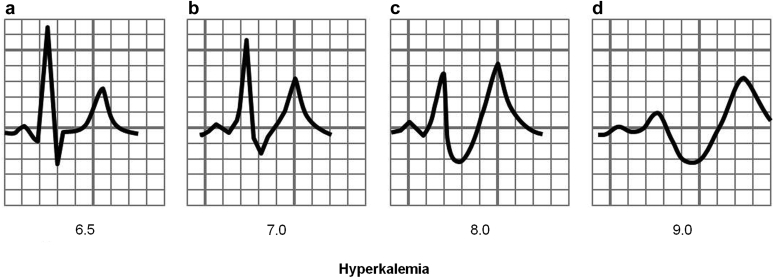
Despite the potentially life-threatening consequences of hyperkalemia, symptoms are often absent or mild. However, when hyperkalemia has been recognized, evaluation of vital signs is essential for determining hemodynamic stability and identifying the presence of cardiac arrhythmias related to the hyperkalemia. Quite commonly, and depending on the severity and rapidity of onset, hyperkalemia may be associated with substantial electrocardiographic (EKG) changes that can lead to death if proper interventions are not instituted. Through its effects on the resting membrane potential and threshold potential of excitable cells, hyperkalemia is a potentially life-threatening disorder. Symptoms and physical examination findings are often absent. Once identified, the entire clinical picture must be taken into account, including an assessment of hemodynamic stability, the presence of other electrolyte abnormalities, and an EKG evaluation. While there is a typical progression of EKG findings based on hyperkalemia severity, EKG manifestations are myriad and their evolution may be unpredictable.
Keywords: EKG; electrophysiology; hemodynamic stability; hyperkalemia; potassium.
Figures
References
-
- Diercks D.B., Shumaik G.M., Harrigan R.A. Electrocardiographic manifestations: electrolyte abnormalities. J Emerg Med. 2004;27:153–160. - PubMed
-
- Chew H.C., Lim S.H. Electrocardiographical case. A tale of tall T's. Hyperkalaemia. Singapore Med J. 2005;46:429–432. - PubMed
-
- Pothiawala S.E. Hyperkalemia induced pseudo-myocardial infarction in septic shock. J Postgrad Med. 2014;60:338–340. - PubMed
-
- Recasens L., Merono O., Ribas N. Hyperkalemia mimicking a pattern of Brugada syndrome. Rev Esp Cardiol. 2013;66:309. - PubMed
Publication types
LinkOut - more resources
Full Text Sources
