


Rationale for enteroviral vaccination and antiviral therapies in human type 1 diabetes
- PMID: 30675626
- PMCID: PMC6450860
- DOI: 10.1007/s00125-019-4811-7
Rationale for enteroviral vaccination and antiviral therapies in human type 1 diabetes
Abstract
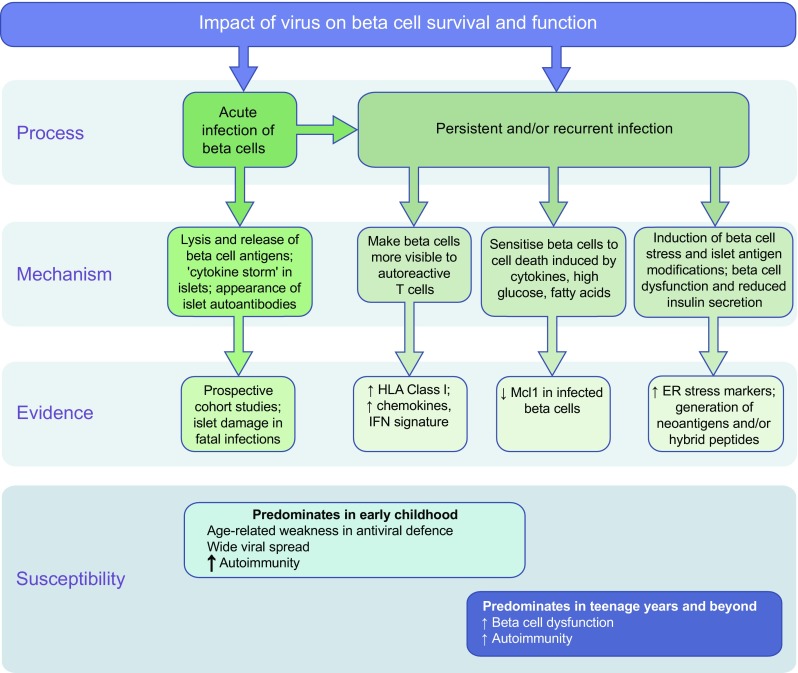
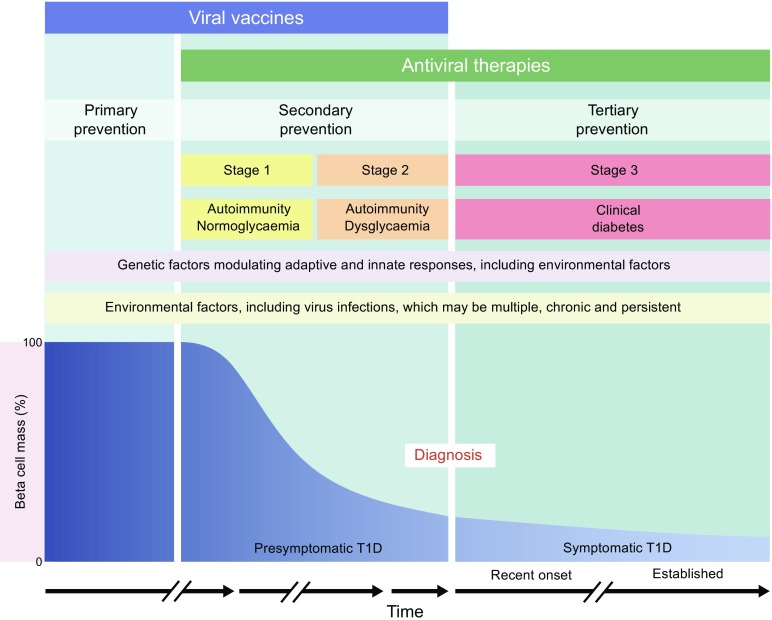
In type 1 diabetes, pancreatic beta cells are destroyed by chronic autoimmune responses. The disease develops in genetically susceptible individuals, but a role for environmental factors has been postulated. Viral infections have long been considered as candidates for environmental triggers but, given the lack of evidence for an acute, widespread, cytopathic effect in the pancreas in type 1 diabetes or for a closely related temporal association of diabetes onset with such infections, a role for viruses in type 1 diabetes remains unproven. Moreover, viruses have rarely been isolated from the pancreas of individuals with type 1 diabetes, mainly (but not solely) due to the inaccessibility of the organ. Here, we review past and recent literature to evaluate the proposals that chronic, recurrent and, possibly, persistent enteroviral infections occur in pancreatic beta cells in type 1 diabetes. We also explore whether these infections may be sustained by different virus strains over time and whether multiple viral hits can occur during the natural history of type 1 diabetes. We emphasise that only a minority of beta cells appear to be infected at any given time and that enteroviruses may become replication defective, which could explain why they have been isolated from the pancreas only rarely. We argue that enteroviral infection of beta cells largely depends on the host innate and adaptive immune responses, including innate responses mounted by beta cells. Thus, we propose that viruses could play a role in type 1 diabetes on multiple levels, including in the triggering and chronic stimulation of autoimmunity and in the generation of inflammation and the promotion of beta cell dysfunction and stress, each of which might then contribute to autoimmunity, as part of a vicious circle. We conclude that studies into the effects of vaccinations and/or antiviral drugs (some of which are currently on-going) is the only means by which the role of viruses in type 1 diabetes can be finally proven or disproven.
Keywords: Antiviral therapy; Autoimmunity; Beta cells; Enterovirus; Pancreas; Prevention; Type 1 diabetes; Vaccine; Virus.
Figures
Comment in
-
Large enteroviral vaccination studies to prevent type 1 diabetes should be well founded and rely on scientific evidence.Diabetologia. 2019 Jun;62(6):1097-1099. doi: 10.1007/s00125-019-4841-1. Epub 2019 Feb 27. Diabetologia. 2019. PMID: 30810767 No abstract available.
-
Large enteroviral vaccination studies to prevent type 1 diabetes should be well founded and rely on scientific evidence. Reply to Skog O, Klingel K, Roivainen M et al [letter].Diabetologia. 2019 Jun;62(6):1100-1103. doi: 10.1007/s00125-019-4873-6. Epub 2019 Apr 23. Diabetologia. 2019. PMID: 31016358 No abstract available.
References
-
- Gundersen E. Is diabetes of infectious origin? J Infect Dis. 1927;41:1975–1979.
Publication types
MeSH terms
Substances
Grants and funding
LinkOut - more resources
Full Text Sources
Other Literature Sources
Medical
Miscellaneous
