


The HIV care continuum among resident and non-resident populations found in venues in East Africa cross-border areas
- PMID: 30675984
- PMCID: PMC6344908
- DOI: 10.1002/jia2.25226
The HIV care continuum among resident and non-resident populations found in venues in East Africa cross-border areas
Abstract
Introduction: HIV care and treatment in cross-border areas in East Africa face challenges perhaps not seen to the same extent in other geographic areas, particularly for mobile and migrant populations. Here, we estimate the proportion of people with HIV found in these cross-border areas in each stage of the HIV care and treatment cascade, including the proportion who knows their status, the proportion on treatment and the proportion virally suppressed.
Methods: Participants (n = 11,410) working or socializing in public places in selected East Africa cross border areas were recruited between June 2016 and February 2017 using the Priorities for Local AIDS Control Efforts method and administered a behavioural survey and rapid HIV test. This approach was designed to recruit a stratified random sample of people found in public spaces or venues in each cross border area. For participants testing positive for HIV, viral load was measured from dried blood spots. The proportion in each step of the cascade was estimated using inverse probability weights to account for the sampling design and informative HIV test refusals. Estimates are reported separately for residents of the cross border areas and non-residents found in those areas.
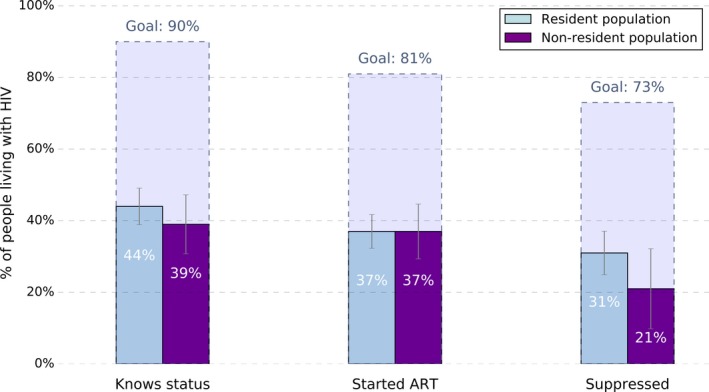
Results: Overall, 43% of participants with HIV found in cross-border areas knew their status, 87% of those participants were on antiretroviral therapy (ART), and 80% of participants on ART were virally suppressed. About 20% of people with HIV found in cross border areas were sampled outside their subdistrict or subcounty of residence. While both resident and non-resident individuals who knew their status were likely to be on ART (85% and 96% respectively), people on ART recruited outside their area of residence were less likely to be suppressed (64% suppressed; 95% CI: 43, 81) compared to residents (84% suppressed; 95% CI: 75, 93).
Conclusions: People living in or travelling through cross-border areas may face barriers in learning their HIV status. Moreover, while non-residents were more likely to be on treatment than residents, they were less likely to be suppressed, suggesting gaps in continuity of care for people in East Africa travelling outside their area of residence despite timely initiation of treatment.
Keywords: East Africa; HIV Care Continuum; Viral Load; border crossing; linkage to care; sex workers; transients and migrants; viral suppression.
© 2019 The Authors. Journal of the International AIDS Society published by John Wiley & Sons Ltd on behalf of the International AIDS Society.
Figures


References
-
- Heshmati A. Advances in African Economic, Social and Political Development Economic Integration, Currency Union, and Sustainable and Inclusive Growth in East Africa.
Publication types
MeSH terms
Substances
Grants and funding
LinkOut - more resources
Full Text Sources
Medical
Molecular Biology Databases
